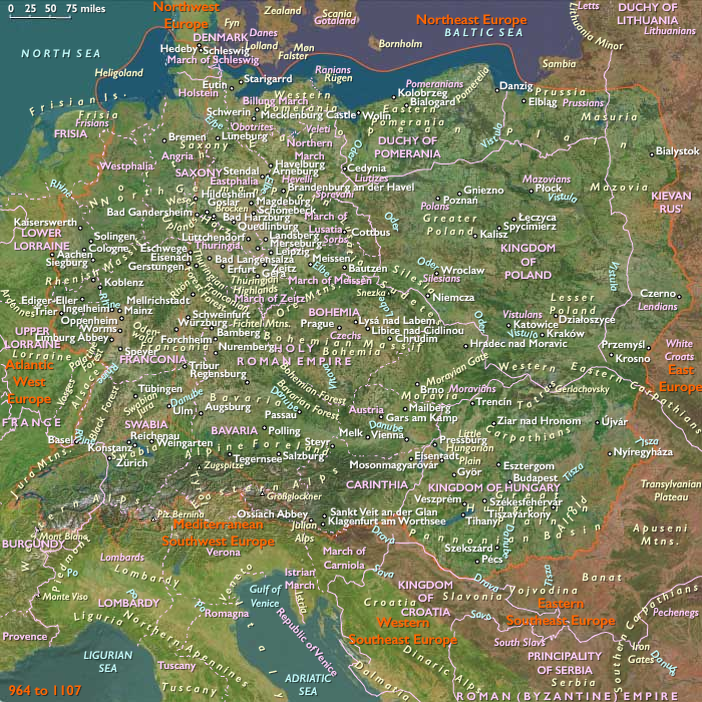
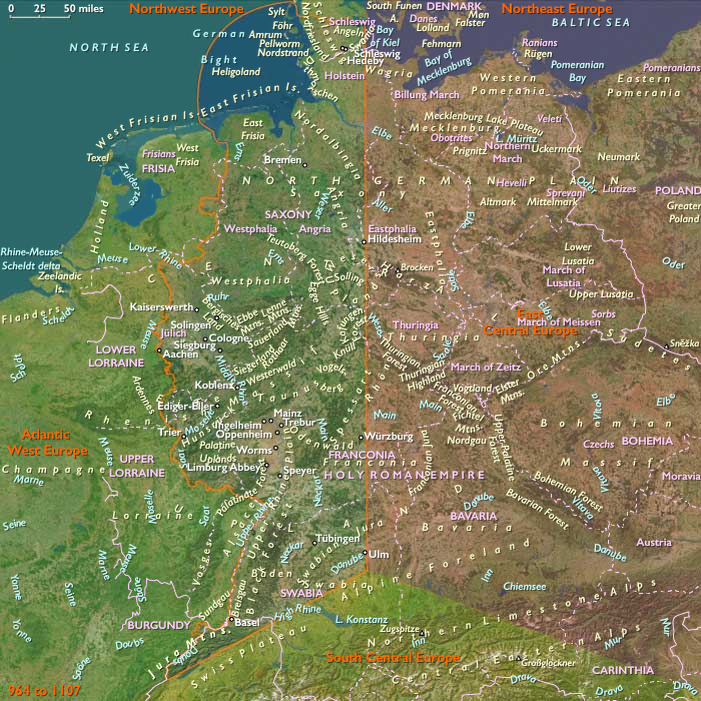
The city of Koblenz is given by …
Years: 1018 - 1018
The city of Koblenz is given by the emperor Henry II to the archbishop and prince elector of Trier after receiving a charter in 1018.
It will remain in the possession of his successors until the end of the eighteenth century, having been their main residence since the seventeenth century.
Locations
People
Groups
Subjects
Regions
Subregions
Related Events
Filter results
Showing 10 events out of 51721 total
A distinctive form of Japanese calligraphy, the phonetic “kana” script, has emerge from abbreviation of the cumbersome usage of Chinese characters as phonetic symbols.
The first kana was a system called man'yōgana, a set of kanji used for their phonetic values, much as Chinese uses characters for their phonetic values in foreign loanwords today.
Man'yōshū, a poetry anthology assembled in 759, is written in this early script.
Hiragana developed as a distinct script from cursive man'yōgana, whereas katakana developed from abbreviated parts of regular script man'yōgana as a glossing system to add readings or explanations to Buddhist sutras.
Hiragana was developed for speed, whereas katakana developed to be small.
Kana is traditionally said to have been invented by the Buddhist priest Kūkai in the ninth century.
Kūkai certainly brought the Siddham script home on his return from China in 806; his interest in the sacred aspects of speech and writing led him to the conclusion that Japanese would be better represented by a phonetic alphabet than by the kanji which had been used up to that point.
The modern arrangement of kana reflects that of Siddham, but the traditional iroha arrangement follows a poem which uses each kana once.
Heian noblewomen develop kana into a respectable mode for poems, diaries, and romances.
Once the ability to compose short poems, written in a cultivated hand, becomes a requirement in Japanese social exchanges, major kana script masters, such as Fujiwara no Yukinari, emerge in the eleventh century.
Yukinari was the son of a courtier by the name of Fujiwara no Yoshitaka.
After the early death of his father, he had been raised by his grandfather, Prince Kanenori.
Yukinari has a fairly successful career as a court official, where he serves as a Major Counselor.
Yukinari further improves the Japanese style calligraphy (wayoshodo), and shows great respect to its founder, Ono no Michikaze (894-966).
He even mentions in his diary, Gonki, that he had a dream wherein he met Michikaze and learnt calligraphy from him.
Yukinari is known as the master of kana.
His style is mild and easily emulated; his lines are dainty and exquisite, resulting in highly elegant characters.
Fujiwara Yukinari is regarded as the founder of the Sesonji lineage of calligraphy, which will later become the leading tradition of wayo calligraphy.
His extant works are mostly written in Mana (Chinese characters used as units of meaning) in Gyosho or Sosho.
One of his most well-known works is the handscroll of Bai Juyi's eight poems from volume 65 of his Poetic Anthology.
He writes this masterpiece in 1018 when he is forty-seven years old.
The scroll is made by joining together nine pieces of specially prepared paper known as ryoshi, then dyed in light brown, claret, and other shades.
This handscroll will be treasured by Emperor Fushimi (reigned from 1288 to 1298), and the colophon over the seams on the back of the paper attests to this.
Currently, the scroll is stored in the Tokyo National Museum.

Khitans under General Xiao Sunning had invaded Goryeo in 993, but retreated after truce negotiations with minister Seo Hui of Goryeo, establishing friendly relations between the two nations.
In 1004, Khitans invaded Song China.
Chinese forces were terribly defeated, and the Song dynasty had been forced to pay tribute to the Liao emperor.
However, the tension between Goryeo and Liao had created another war.
In 1009, General Gang Jo of Goryeo had led a coup against King Mokjong, killing the king and establishing military rule.
In 1010, the alliance had been broken and Liao had attacked Korea for General Gang's treason.
Also, Khitans claim six garrison settlements east of the Yalu River, which Goryeo had claimed as its territory in truce negotiations during 993.
The Goryeoans fought fiercely but were defeated.
However, the Goryeo king had managed to retain his claim on the six garrison settlements.
The Khitans had retreated from the peninsula, with no great prize for the war, but they have not given up their hope of gaining the six garrison settlements and making Goryeo pay tribute.
Beginning in the summer of 1018, the Khitans construct a bridge across the Yalu River, and the Khitan army invades Goryeo for the third time with one hundred thousand troops.
General Gang Gam-chan orders the Heunghaejin stream to be blocked until the Khitans begin to cross it; when the Khitans are mid-way across, he orders that the dam be destroyed so that the water will drown much of the Khitan army.
The damage is great, and General Gang leads a massive attack that annihilates many of the Khitan troops.
Sviatopolk, routed in battle by his brother Yaroslav, had fled to the safety of the Polish court of his father-in-law, Prince Boleslaw, where Sviatopolk has exhorts the Poles to reconquer territories lost to the Novgorodians and to reinstall him as ruler in Kiev.
Following his victory over Yaroslav’s forces at the Bug River, Bolesalw occupies Kiev and reinstalls Svyitopolk as ruler; Yaroslav withdraws to Novgorod.
During the occupation of Kiev in 1018, soldiers attack and rob the Jews, marking one of the earliest reports of a permanent Jewish presence in Kiev.
Having defeated Yaroslav in battle (July 21, 1018) and places his own son-in-law (and Yaroslav's brother), Svyitopolk, on the Kievan throne, Boleslaw's control now extends from the western tributaries of the middle Elbe River to the eastern reaches of the Bug River.
Schwerin, located in northeastern Germany on Lake Schwerin (Schweriner See) about twenty miles (thirty[-two kilometers) south of the Baltic Sea and seventy miles (one hundred and fifteen kilometers) east of Hamburg, is first mentioned in written sources in 1018 as a Wendish settlement.
The Bulgarian army had suffered heavy casualties as a result of the battle of Belasitsa; these losses cannot be restored.
The ability of the central government to control the peripheral and interior provinces of the Empire is reduced and the actions of the local and provincial governors become more decisive for the outcome of the war with the Empire.
Many of them have voluntarily surrendered to Basil II.
Samuel's successors had been his son Gavril (murdered in 1015) and a nephew Ivan (killed in battle in 1018), after the revived Bulgarian kingdom is incorporated into the empire of Constantinople.
Basil allows the country practical autonomy, however.
The battle also has an impact on the Serbs and the Croats, who are forced to acknowledge the supremacy of Constantinople after 1018.
The borders of the Roman Empire are restored to the Danube for the first time since the seventh century, allowing Constantinople to control the entire Balkan peninsula from the Danube to the Peloponnese and from the Adriatic Sea to the Black Sea.
Most Bulgarian commanders have surrendered by 1018, and only Ivats (Ibatzes), who had retreated with his followers to the royal estate of Pronista, a naturally strong and defensible highland position, continues to resist.
Ivats had in 1015 he defeated an imperial army in the battle of Bitola and stopped the disastrous campaign of Basil II in the heart of the Bulgarian Empire.
After the death of Ivan Vladislav and the surrender of the Empress, the Patriarch and many nobles to Constantinople, he chooses to continue the struggle along the sons of the dead emperor and several other nobles.
His stronghold is the fortress Vrohot in Mount Tomor, modern southeastern Albania.
The fortress is soon besieged by Basil II but the fifty-five-day siege is unsuccessful for attackers.
He is treacherously blinded in 1018 by the imperial strategos Eustathios Daphnomeles, who then addresses the defenders and manages to persuade them of the futility of further resistance, and to lay down their arms and seek the emperor's pardon.
The Normans join with the Lombard forces under Melus at Capua and march into Apulia immediately, trying to catch the imperial forces off-guard.
Successful in an encounter in May on the banks of the Fortore against forces sent by the katapano Leo Tornikios Kontoleon, they have seized all the territory between the Fortore and Trani by September and are ravaging Apulia; in October, however, they experience a stunning reverse.
The new katepano, Basil Boiannes, appointed in December 2017, has garnered a massive force of reserves and a contingent of the famed Varangian Guard from Emperor Basil II.
He meets the Norman and Lombard hosts on the Ofanto at the site of the famous defeat dealt the Romans by Hannibal in 216 BCE: Cannae.
This second battle of Cannae is a disaster both for the Normans and for the Lombards.
Of the two hundred and fifty Norman knights under Gilbert's command, Gilbert himself, along with Osmond, die in the battle: only ten knights survive.
The Lombard leaders flee: Melus to the "Samnite lands" (Amatus) of the Papal States and Dattus to Montecassino and the tower again.
Melus will continue wandering through south and central Italy and finally northwards to Germany, ending up at the imperial court of Henry II in Bamberg.
Though greatly honored (he receives the empty title Duke of Apulia from the emperor), he will die a broken man only two years later, just after Pope Benedict arrives in Bamberg at Eastertide to discuss a response by the Western Empire to Constantinople’s victories.
He will be given a lavish funeral and an ornate tomb in the new Bamberg Cathedral by his old ally, the emperor.
His son Argyrus will carry on the struggle for Lombard independence in Apulia after his return from imprisonment in Constantinople.
The population of Córdoba had initially welcomed Ali for his impartiality; however, both his severity and the appearance of a pretender from the previous ruling dynasty of the Umayyads, Abd ar-Rahman IV, has caused his popularity to fall, ending in his assassination on March 22, 1018.
Abd ar-Rahman is elected caliph, but he is in turn ousted by Ali's brother, al-Qasim al-Ma'mun, governor of Seville.
Abd-ar-Rahman IV is murdered at Cádiz while fleeing from a battle in which he had been deserted by the very supporters which had brought him into power.
Al-Mansur ibn Buluggin had become the head of the Zirid dynasty in Ifriqiya after the death of his father Buluggin ibn Ziri, and had installed his brother Hammad as governor of the central Maghreb (grossly corresponding to the modern northern Algeria).
Taking on the Zenata tribes, Hammad had eventually driven them into Morocco.
In 1007, Hammad had founded the residence of al-Qala ("the Fortress") in the Hodna mountains west of Setif and embarked on an extensive building program, which includes a palace and mosque that have become famous among contemporaries.
Following this, Hammad has gained ever more influence in the western Zirid realm.
In 1014, he had declared his independence from the Zirids and recognized the Abbasids in Baghdad as being the rightful Caliphs (not the Fatimids in Egypt, on whose behalf the Zirids rule).
Although there had initially been conflict with the Zirids, in 1016 they had been forced to conclude a ceasefire, and in 1018 they recognize the independence of the Hammadids.