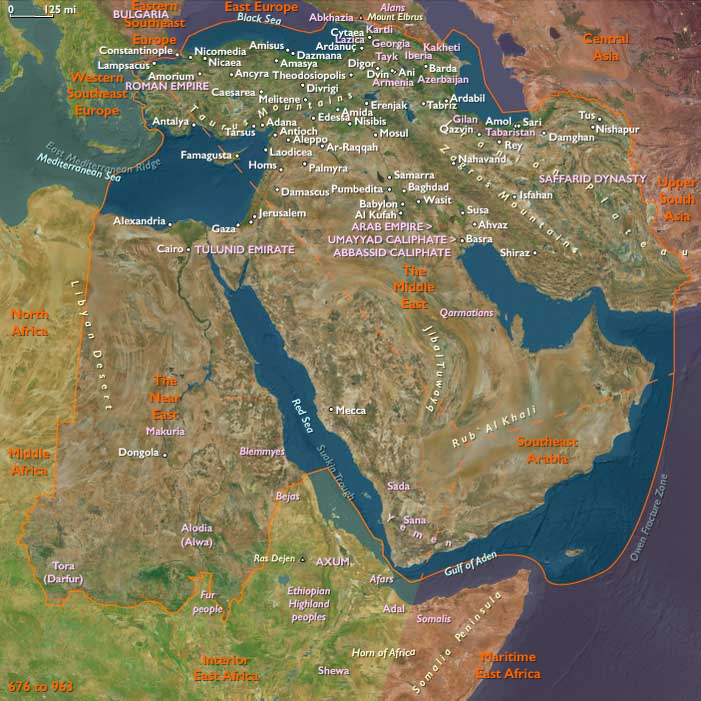
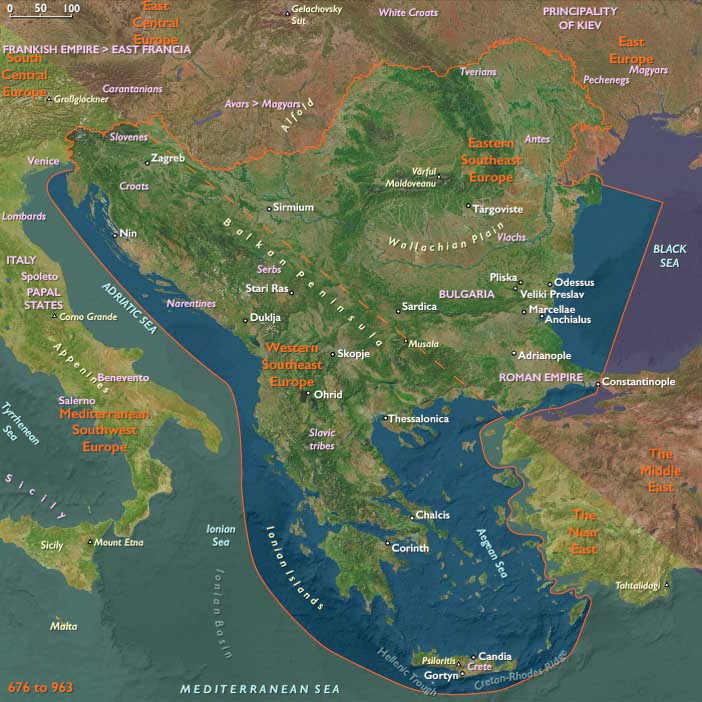
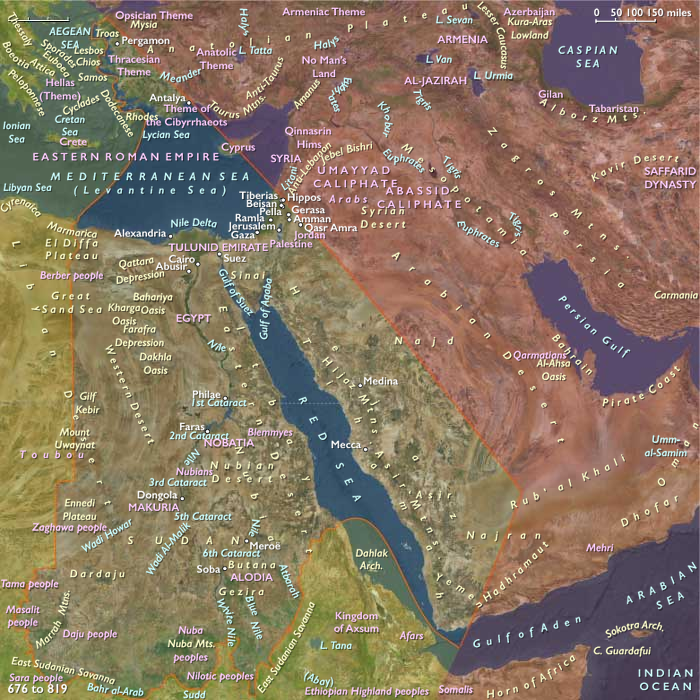
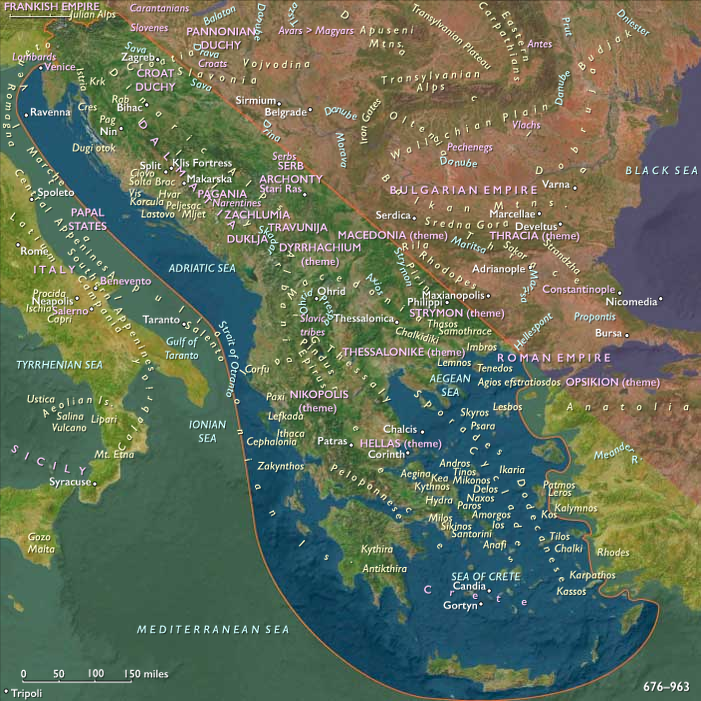
…the city of Jerash (in present-day Jordan) …
Years: 726 - 726
…the city of Jerash (in present-day Jordan) suffers a major earthquake.
Locations
Groups
Subjects
Regions
Subregions
Related Events
Filter results
Showing 10 events out of 55565 total
Emperor Leo III has undertaken a set of civil reforms, including the abolition of the system of prepaying taxes, which had weighed heavily upon the wealthier proprietors, the elevation of the serfs into a class of free tenants, and the remodeling of family, maritime law and criminal law, notably substituting mutilation for the death penalty in many cases.
The new measures, which are embodied in a new code called the Ecloga (Selection), published in 726, meet with some opposition on the part of the nobles and higher clergy.
The Emperor also undertakes some reorganization of the theme structure by creating new themata in the Aegean region.
After an apparently successful attempt to enforce the baptism of all Jews and Montanists in the Roman Empire (722), Leo begins in 726 to issue a series of edicts against the worship of images.
The origins and nature of the policy of Iconoclasm, the most singular religious development in Leo’s reign, are obscure and controversial.
Leo is deeply religious and seems to have become genuinely convinced of the sacrilegious character of religious pictures and relics as objects of veneration in worship services.
It is uncertain whether any boyhood experiences in northern Syria, including contact with Muslims, has influenced his Iconoclastic views, as his critics often charge.
The Iconoclastic opinions of certain bishops in western Asia Minor does, however, have some effect upon him.
Thus, he begins to speak out publicly in 726 against the use of sacred pictures, and orders the destruction of the image of Christ at the Chalke palace in Constantinople.
This prohibition of a custom that has been in use for centuries seems to have been inspired by a genuine desire to improve public morality, and receives the support of the official aristocracy and a section of the clergy.
A majority of the theologians and all the monks oppose these measures with uncompromising hostility, and in the western parts of the Empire the people refuse to obey the edict.

Maslama ibn Abd al-Malik, absent from the sources for five years, had reemerged in 725, shortly after Yazid's death and the accession of Hisham, who sends Maslama to replace al-Djarrah ibn Abdallah al-Hakami in the Caucasus front against the Khazars.
Initially, however, Maslama is mostly active in the efforts against the Empire, and the war against the Khazars is delegated to al-Harith ibn Amr al-Ta'i.
In winter 725, Maslama leads an expedition against Asia Minor from Melitene, which culminates in the sack of Caesarea on January 13, 726.
Along with the capture of Gangra by Abdallah al-Battal in 727, this is one of the major successes of Arab arms against the Empire in the 720s.
A few months later, he also leads the otherwise unremarkable northern summer expedition into imperial territory.
The volcanic island of Thera erupts, while …
The Moors have raided Frankish territory since their arrival in Spain from Africa in 711, threatening Gaul and on one occasion reaching Burgundy and sacking Autun in 725.
The Moors again raid Frankish-controlled Aquitaine in 725—26.
Pope Gregory II, upon receiving the order of Roman Emperor Leo III that all holy images be destroyed, denounces the decree.
Liutprand had not attacked the Exarchate of Ravenna or the Papacy in his early reign as King of the Lombards, but in 726, the Emperor Leo III makes his first of many edicts outlawing images or icons (see the iconoclastic controversy).
The pope, Gregory II, orders the people to resist and the Roman duke of Naples, Exhiliratus, is killed by a mob while trying to carry out the imperial command to destroy all the icons.
King Ine of Wessex resigns his crown and leaves for Rome, leaving behind no obvious heir, and according to Bede simply left his kingdom "to younger men".
In the wake of his departure, the West Saxon throne is disputed between Æthelheard and a rival claimant, Oswald.
Oswald may have had the better claim, as the Anglo-Saxon Chronicle calls him a descendant of the early king Ceawlin, but it is Æthelheard who prevails.
It is possible that his success was due to the support of Æthelbald of Mercia, since he seems to have been subject to Æthelbald afterward.
Umayyad troops under Abdallah al-Battal and Mu'awiya ibn Hisham raze Gangra and …
…besiege Nicaea, the capital of the Opsikian Theme.
After forty days of siege, the Arab army abandons the attempt and returns to the Caliphate.
The successful repulsion of the attack is a major boost for Leo III’s recently initiated campaign to abolish the veneration of icons in the Empire; Leo claims it as evidence of divine favor for his policy.
A rebellion in the Cyclades against Emperor Leo III the Isaurian may stem from opposition to his doctrines.
Agallianos Kontoskeles is serving as tourmarches of the Theme of Hellas in 726/7 when the theme erupts in revolt against the emperor.
Agallianos, along with Stephen, possibly the commander of the naval district of the Cyclades, becomes the leader of the revolt, and a certain Kosmas is acclaimed as emperor by the rebels.
However, the rebel fleet is defeated on April 18, 727 by the loyalist navy through the use of Greek fire.
Agallianos drowns when he falls from the board of his ship into the sea in full armor, while Stephen and Kosmas are captured and beheaded. (On account of his surname "Kontoskeles" ("short-leg"), the Patria of Constantinople erroneously involves him in the construction of the Kontoskalion harbour in Constantinople.