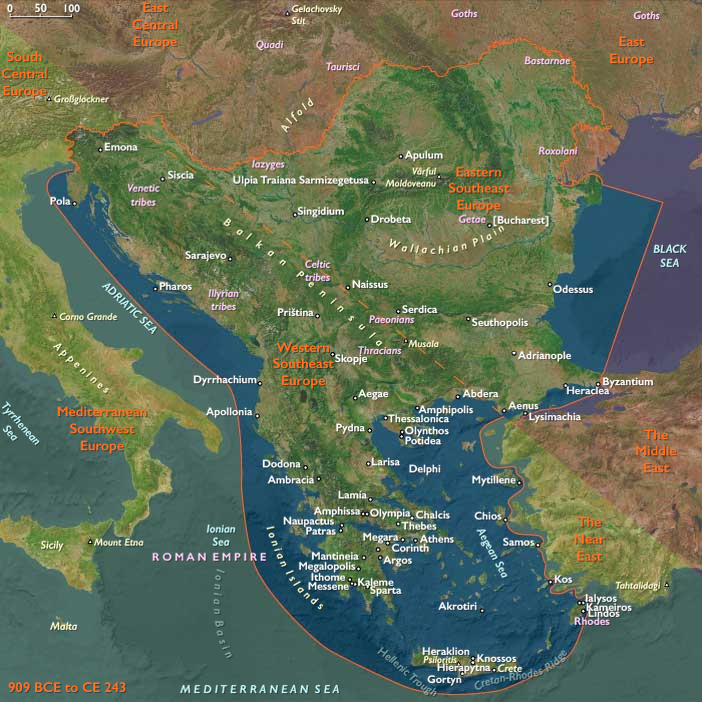
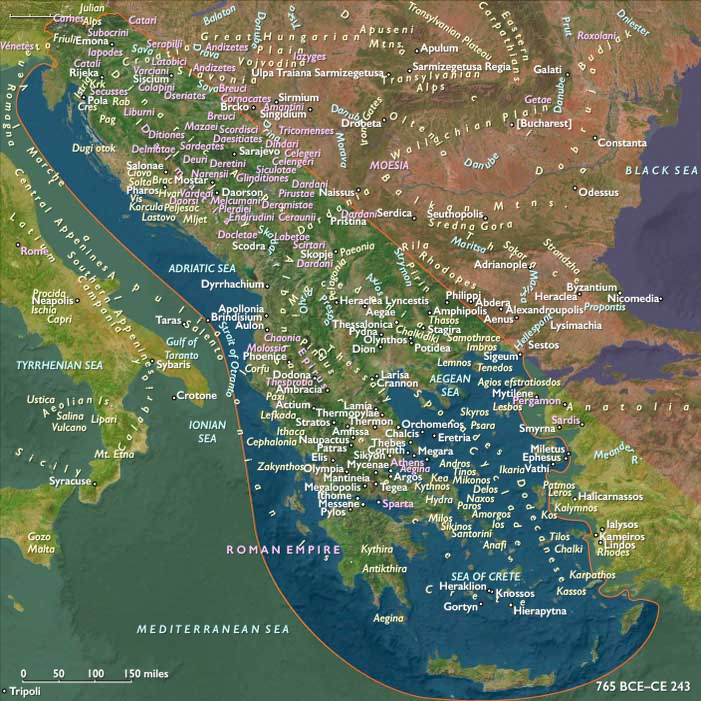
The city of Elis, having gained control …
Years: 479BCE - 479BCE
The city of Elis, having gained control of the entire Elis region by 580, joins its Peloponnesian neighbor Sparta in the anti-Persian alliance of 479 BCE.
Locations
People
Groups
- Athens, City-State of
- Greece, classical
- Persian people
- Sparta, Kingdom of
- Achaemenid, or First Persian, Empire
Topics
- Younger Subboreal Period
- Iron Age Europe
- Iron Age Cold Epoch
- Classical antiquity
- Greco-Persian Wars, Early
- Persian Invasion of Greece, Second
Commodoties
Subjects
Regions
Subregions
Related Events
Filter results
Showing 10 events out of 65565 total
Xanthippus, in 479 BCE, commands the Athenian force at Mycale on the Asiatic coast, where the residue of the Persian navy is to engage the Greek fleet, commanded by Spartan co-king Leotychidas.
The Persian navy instead beaches its ships and, joining a land army, fights a losing battle against a Spartan force led by Leotychidas.
This victory prepares the way for the liberation of the Greeks of western Asia Minor from Persian rule.
The Phocians, whose early history remains obscure, had at first joined in the national defense during the Persian invasion of 480 BCE, but their irresolute conduct had contributed to the Greek defeat by Persia at Thermopylae.
The Phocians are on the Persian side at Plataea, where the Persian army of occupation under Mardonius engages a Pan-Greek force of Spartans, Tegeans, Chalcidians and Athenians on August 27, 479 BCE on the slopes of Mount Cithaeron below the city; Aristides commands the Athenian forces.
The Thebans had been brought for the first time into hostile contact with the Athenians, who had helped the small village of Plataea to maintain its independence against them, and in 506 BCE had repelled an inroad into Attica.
The aversion to Athens best serves to explain the apparently unpatriotic attitude which Thebes has displayed during the Persian invasion of Greece.
Though a contingent of four hundred had been sent to Thermopylae and remained there with Leonidas until just before the last stand when they surrendered to the Persians, the governing aristocracy had soon after joined Xerxes with great readiness and fights zealously on his behalf at the Battle of Plataea.
The superiority of Greek armor and tactics is the deciding factor: Mardonius is killed, and his death obliges the less organized and less disciplined Persian forces to withdraw, decisively crushing Persian ambitions on the Greek mainland.
The Plataeans hereafter will offer sacrifice annually to Zeus the Liberator in honor of the Greek dead, and Pausanias declares the inviolability of Plataea.
A people of uncertain origin called the Bottiaeans have since about 650 BCE inhabited Olynthus in Bottike, a western region of the Chalcidice Peninsula of northwestern Greece, lying about one and a half miles (two and a half kilometers) inland from the Gulf of Torone of the Adriatic Sea.
The Persian general Artabazos, on his return from escorting Xerxes to the Hellespont, suspecting that a revolt from the Great King is meditated, hands the town over to Kritovoulos from Toroni and to a fresh population consisting of Greeks from the neighboring region of Chalcidice (Herod. viii. 127).
Though Herodotus reports that Artabazus slaughtered them, Bottiaeans continue to live in the area.
The Spartans under Pausanias, the son of King Cleombrotus I, nephew of King Leonidas, and regent for the slain king's underage son, advance from the Peloponnese via the Isthmus and Eleusis; there had once been a question of making a stand at the Isthmus for the defense of the Peloponnese, but Salamis has made that unnecessary.
Sparta honors Themistocles with a great ovation; but Athens, led during the crisis by the Areopagus, or council of nobles, gives the chief commands in 479 to the recalled exiles, Aristides and Xanthippus, who had both returned the previous year.
Cimon's conspicuous valor in the victorious sea fight with the Persians at Salamis leads soon to his election as strategos—one of Athens' ten annual war ministers and generals.
The Greeks in addition recognize, with a prize for valor, the conspicuous bravery of the tiny Aeginetan contingent (only about forty ships) at the battle of Salamis.
In the repulse of Xerxes I it is possible that the Aeginetans played a larger part than is conceded to them by Herodotus.
The Athenian tradition, which he follows in the main, would naturally seek to obscure their services.
As it is to Aegina rather than Athens that the prize of valor at Salamis is awarded, the destruction of the Persian fleet appears to have been as much the work of the Aeginetan contingent as of the Athenian (Herod. viii. 91).
There are other indications, too, of the importance of the Aeginetan fleet in the Greek scheme of defense.
In view of these considerations, it becomes difficult to credit the number of the vessels that is assigned to them by Herodotus (thirty as against one hundred and eighty Athenian vessels).
Given the Persians’ return to Greece after the small-scale humiliation of Marathon in 490, there can be no immediate certainty that they will abandon their plans to conquer Greece after the far greater humiliations of 480 and 479.
A leader is required in the event of another Persian return.
The eastern Greeks of the islands and mainland feel themselves particularly vulnerable and appeal to the natural leader, Sparta.
The Spartans' proposed solution, a plan to evacuate Ionia and resettle its Greek inhabitants elsewhere, is unacceptable; this would be a remarkable usurpation of Athens' colonial or pseudocolonial role as well as a traumatic upheaval for the victims.
Samos, Chios, Lesbos, and other islanders are received into the Hellenic League.
With the Persian menace removed, however, petty squabbling begins among the members of the Greek alliance.
Sparta, feeling that its job is completed, leaves the association, and Athens assumes domination of the league.
As Sparta is as much a prisoner of the helot problem as ever, she cannot rely on the loyalty of Arcadia or the Peloponnese generally: Mantineia and Elis had sent their contingents to the Battle of Plataea suspiciously late.
Spartan worries about Arcadia are relevant to this “Great Refusal” of leadership in 479, which makes possible the coming Athenian empire.
Gelo and Theron do not attack Rhegion or the Carthaginian territory in Sicily after the battle, nor does Carthage, which initially mans the city walls and prepares for a Greek invasion of Africa, renew the struggle.
Gelo offers mild terms to the Carthaginian embassy that arrives asking for a ceasefire.
Carthage pays two thousand silver talents as indemnity and erects two monuments in the memory of Himera, but loses no territory.
Selinus and Rhegion also come to terms with Syracuse, and Anaxilas marries his daughter to Hiero, brother of Gelo, who will succeed him as tyrant of Syracuse in 478.
Open war between Rome and the Etruscan city of Veii, after a pacific coexistence between the close cities, had in 475 BCE broken out after the Romans mounted a cross-border raid that Veii successfully resisted.
The conflict had escalates into a battle in 480 BCE, in which the Roman army, close to defeat, had been saved by consul Kaeso Fabius Vibulanus.
After the battle, the Veientes had continued raiding Roman territory, retreating in front of Roman legions to deny them open battle.
Engaged in a conflict with Aequi and Volsci, the Romans are fighting on two fronts.
Thus, in 479 BCE, the gens Fabia offers to deal with Veii on its own, while the Republican legions have to fight against the other enemies.
Livy says that all of the three hundred and six adult (i.e., more than fifteen years old) Fabii went to the war, together with their clients.
The Fabii build a stronghold on the river Cremera, close to Veii, from which they manage to limit Veiian raids.
The Veientes engage an open battle near the Roman stronghold, but are defeated by Fabii and a Roman army led by consul Lucius Aemilius Mamercinus, and obliged to ask for a truce.
After the truce is broken, the Veientes renew their raid, but are repeatedly defeated by the Fabii, who, encouraged by the successes, become bold and attack and pillage Veii territory.
In the end, however, the Fabii fall in the trap laid by the Veientes.
Considering the enemies far from the stronghold, the Romans exit from the stronghold to capture a herd, scattering in pursuit of the animals.
In that moment, the outnumbering Veientes exit and surround the Fabii.
Adopting the wedge formation, the Romans break through and reach a hill, where they successfully repulse the Etruscan attacks, until a Veienite formation arrives to their back.
All of the Fabii are slaughtered save Quintus Fabius Vibulanus, who was too young to be sent to war.
The preserved account of the battle, written by Livy, is an elaboration of the real events, and celebrates the sacrifice of the gens Fabia.
Probably, its aim is to give a reason of the absence of Fabii from consular lists in the years following the battle.
Furthermore, this account is clearly influenced by the Spartan last stand at the Battle of Thermopylae.

Pausanias, a young man flushed from his success at Plataea and now admiral of the Greek fleet, wins victories in Cyprus (a temporary conquest) and the Bosporus, and captures Byzantium in 478.
Aristides commands the Athenian contingent of thirty ships in the fleet that Pausanias leads.
While Pausanias is at Byzantium, his arrogance and his adoption of Persian clothing and manners offend the other Greeks, “not least,” Thucydides says, “the Ionians and the newly liberated populations,” and raises suspicions of disloyalty.
Recalled to Sparta, he is tried and acquitted of the charge of treason but is not restored to his command and is instead replaced by Dorcis; yet Dorcis and others like him lack Pausanias' charisma, and Sparta sends out two more commanders.
When the Athenians separate from the Spartans to form the Delian League, Pausanias returns to Byzantium “in a private capacity,” setting himself up as a tyrant to intrigue with Persia, and holds the city until his expulsion by the Athenians (probably in 477).
Years: 479BCE - 479BCE
Locations
People
Groups
- Athens, City-State of
- Greece, classical
- Persian people
- Sparta, Kingdom of
- Achaemenid, or First Persian, Empire
Topics
- Younger Subboreal Period
- Iron Age Europe
- Iron Age Cold Epoch
- Classical antiquity
- Greco-Persian Wars, Early
- Persian Invasion of Greece, Second