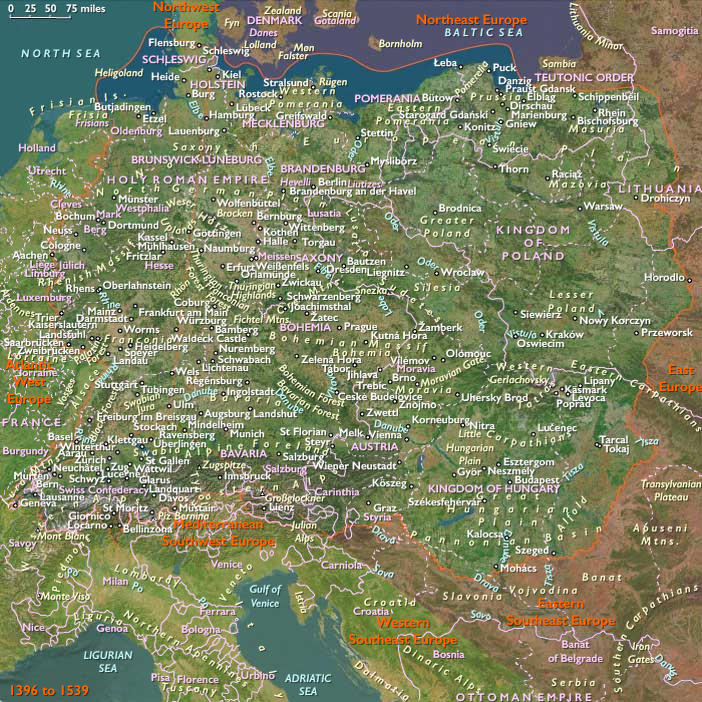
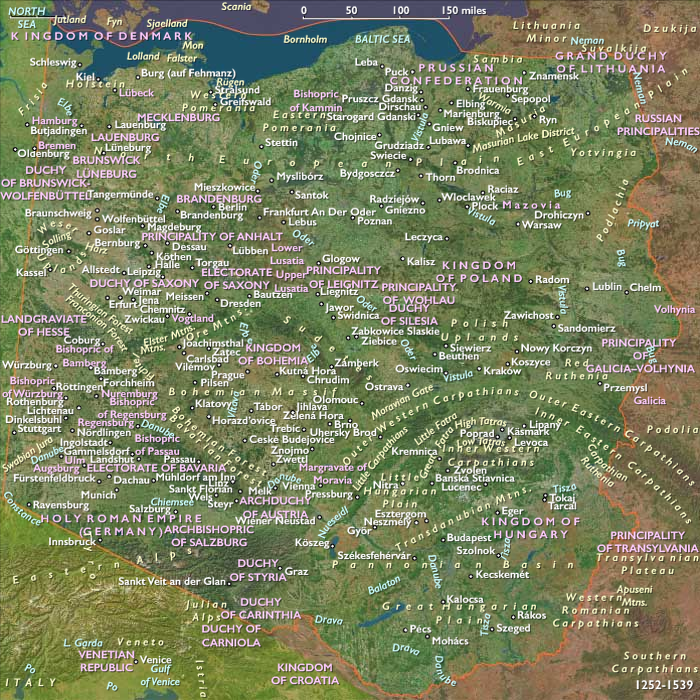
The city of České Budějovice, or Budweis, …
Years: 1505 - 1505
The city of České Budějovice, or Budweis, founded by King Ottokar II of Bohemia, had been granted its municipal charter in 1265.
The location and development of the royal city had been carried by the king's knight Hirzo as a platform for the king's power in South Bohemia and to counterbalance the powerful noble House of Rosenberg, a significant and influential Bohemian noble family In 1341, King John of Bohemia had granted permission to Jewish families to reside within the Budejovice walls and a first synagogue had been erected in 1380.
However, several pogroms have occurred in the late fifteenth and early sixteenth century.
In one such instance, ten Jews are tortured and killed in the city on December 12, 1505, after being accused by a local shepherd of killing a local girl.
Years later, on his deathbed, the shepherd will confess that he had fabricated the tale.
From the end of the Hussite Wars, the city is a bulwark of the Catholic Church during the long-lasting religious conflicts in the Kingdom of Bohemia.
Locations
Groups
Topics
Subjects
Regions
Subregions
Related Events
Filter results
Showing 10 events out of 39547 total
Some of the adherents of the Sect of Skhariya the Jew had remained under the protection of Yelena Stefanovna and her son Tsarevich Dmitry, the grandson of Ivan III).
However, in 1502 Dmitry had been stripped of his title (it had been transferred to Vasili the son of Ivan III and Sophia Paleologue).
Ivan III dies on October 27, 1505; his eldest son succeeds him as Vasili III.
Yelena and Dmitry are arrested and imprisoned in 1505, leaving the adherents vulnerable to attacks from the authorities.
Other adherents are banished, imprisoned, or excommunicated.
Feodor Kuritsyn's adherents' club has ceased to exist.
The Lithuanians had allied themselves with Hacı I Giray, founder of the Crimean Khanate.
However, in the 1480s his son Meñli I Giray, who had come to power with the help of the Ottoman Empire, has allied himself with the Grand Duchy of Moscow, which has long been an enemy of the Grand Duchy of Lithuania.
Lithuanians had then allied with the Golden Horde and its remnant Great Horde which were enemies of the Crimean Khanate.
During the Muscovite–Lithuanian War of 1503, the Crimean Tatar armies had pillaged the grand duchy's southern towns of Slutsk, Kletsk, and Nyasvizh and even threatened the capital city of Vilnius.
Alexander Jagiellon, Grand Duke of Lithuania, had then ordered the construction of a defensive wall around his capital; it will be completed in 1522.
In August 1505, Meñli I Giray sends his eldest son to plunder the territories of Minsk, …
…Polotsk, …
…Vitebsk and …
…Navahrudak.
It is not only a raid for slaves and loot, but also for political pressure to execute the imprisoned Sheikh Ahmed, the last Khan of the now-defunct Great Horde.
The Glinsky family claims descent from Orthodox Hungarian nobles and khan Mamai.
Michael Glinsky had been sent as a young man to the court of Emperor Maximilian I and served in emperor's army.
Winning distinction during Maximilian's campaigns against Friesland in 1498, Glinsky had been awarded the Order of the Golden Fleece.
In the service of Albrecht of Saxony during the Italian Wars, he had converted to Roman Catholicism.
Glinski has traveled extensively in Austria, Italy, and Spain.
He also studied medicine at the University of Bologna; this fact will be used against him in later life as such education had introduced him to poisons.
During his twelve-year tour of western courts, Glinsky can boast of personal connections and relationships with many members of the nobility, including Emperor Maximilian.
Glinsky had returned in late 1498, to Lithuania, where he quickly became a favorite and personal friend of Alexander Jagiellon, Grand Duke of Lithuania.
Almost immediately upon return, Glinsky becomes Grand Duke's vice-regent in Utena.
Appointed Court Marshal of Lithuania, he had become a member of the Lithuanian Council of Lords in 1500.
The following year he was granted privileges to conduct lucrative trade in wax and oversee the coin mint in Vilnius.
Due to his connections with western Europe and knowledge of foreign languages, Glinsky often acts as a foreign minister.
Such a quick rise of a young man has stirred up resentment among the local nobility.
The greatest rivalry develops between Glinsky and Jan Zabrzeziński, Voivode of Trakai.
In 1504, Grand Duke Alexander, urged by Glinsky, had confiscated land possessions of Zabrzeziński's son-in-law.
The following year, Zabrzeziński is fined, stripped of his titles, and banished from the Council of Lords along with his supporters.
However, Zabrzeziński soon reconciles with Alexander and is reinstated as the Grand Marshal of Lithuania.
Martin Luther, born on November 10, 1483, at Eisleben to Saxon miner Hans Luder (or Ludher, later Luther)and his wife Margarethe (née Lindemann), had been baptized as a Catholic the next morning on the feast day of St. Martin of Tours.
His family had moved to Mansfeld in 1484, where his father was a leaseholder of copper mines and smelters and served as one of four citizen representatives on the local council.
He has several brothers and sisters, and is known to have been close to one of them, Jacob.
Hans Luther is ambitious for himself and his family, and he is determined to see Martin, his eldest son, become a lawyer.
He had sent Martin to Latin schools in Mansfeld, then Magdeburg in 1497, where he attended a school operated by a lay group called the Brethren of the Common Life, and Eisenach in 1498.
The three schools focused on the so-called "trivium": grammar, rhetoric, and logic.
Luther will later compare his education there to purgatory and hell.
In 1501, at the age of nineteen he entered the University of Erfurt, which he will later describe as a beerhouse and whorehouse; he had received his master's degree in 1505.
Founded in 1392, the University, together with that of Cologne, is one of the first city-owned universities in Germany; they are usually owned by the Landesherren.
The university had quickly became a hotspot of German cultural life in Renaissance humanism with scholars like Ulrich von Hutten, Helius Eobanus Hessus and Justus Jonas.
In accordance with his father's wishes, Luther enrolls in law school at the same university this year but drops out almost immediately, believing that law represents uncertainty.
Seeking assurances about life, Luther is drawn to theology and philosophy, expressing particular interest in Aristotle, William of Ockham, and Gabriel Biel.
He is deeply influenced by two tutors, Bartholomaeus Arnoldi von Usingen and Jodocus Trutfetter, who teach him to be suspicious of even the greatest thinkers and to test everything himself by experience.
Philosophy proves to be unsatisfying, offering assurance about the use of reason but none about loving God, which to Luther is more important.
Reason cannot lead men to God, he feels, and he thereafter develops a love-hate relationship with Aristotle over the latter's emphasis on reason.
For Luther, reason can be used to question men and institutions, but not God.
Human beings can learn about God only through divine revelation, he believes, and Scripture therefore becomes increasingly important to him.
He will later attributed his decision to an event: on July 2, 1505, he is returning to university on horseback after a trip home.
During a thunderstorm, a lightning bolt strikes near him.
Later telling his father he was terrified of death and divine judgment, he cries out, "Help!
Saint Anna, I will become a monk!"
He comes to view his cry for help as a vow he can never break.
He leaves law school, sells his books, and enters a closed Augustinian friary in Erfurt on July 17, 1505.
One friend blames the decision on Luther's sadness over the deaths of two friends.
Luther himself seems saddened by the move.
Those who attend a farewell supper walk him to the door of the Black Cloister.
"This day you see me, and then, not ever again," he said His father is furious over what he sees as a waste of Luther's education.
Luther dedicates himself to the Augustinian order, devoting himself to fasting, long hours in prayer, pilgrimage, and frequent confession.
He will later describe this period of his life as one of deep spiritual despair.
Johann von Staupitz, his superior, points Luther's mind away from continual reflection upon his sins toward the merits of Christ.
He teaches that true repentance does not involve self-inflicted penances and punishments but rather a change of heart.

Pêro da Covilhã, a Portuguese explorer and spy traveling overland disguised as an Arab merchant, had been the first European known to have visited Sofala in 1489.
His secret report to Lisbon had identified Sofala's role as a gold emporium (although by this time, the gold trade was quite diminished from its heyday).
In 1501, Sofala had been scouted from the sea and its location determined by captain Sancho de Tovar.
In 1502, Pedro Afonso de Aguiar (others say Vasco da Gama himself) led the first Portuguese ships into Sofala harbor.
Aguiar (or Gama) had sought out an audience with the ruling sheikh Isuf of Sofala (Yçuf in João de Barros’ Çufe in Damião de Goes).
At the time, Isuf was engaged in a quarrel with Kilwa.
The minister Emir Ibrahim had deposed and murdered the legitimate Sultan al-Fudail of Kilwa, and seized power for himself.
Isuf of Sofala had refused to recognize the usurper and was looking for a way to shake off Kilwa's lordship and chart an independent course for Sofala.
The Portuguese, with their powerful ships, seemed to provide the key.
At any rate, the elderly sheikh Isuf realized it would be better to make allies rather than enemies out of them, and had agreed to a commercial and alliance treaty with the Kingdom of Portugal.
This is followed upon in 1505 when Pêro de Anaia (part of the Seventh Portuguese Armada) is granted permission by Sheikh Isuf to erect a factory and fortress near the city.
Fort São Caetano of Sofala is the second Portuguese fort in East Africa (the first, at Kilwa, had been built only a few months earlier).
Anaia uses stone imported for the purpose from Europe.
(It will subsequently be reused for construction of Beira's cathedral.)
The Portuguese fort does not last very long, as much of the garrison is quickly decimated by fevers (probably malaria).
Piero di Cosimo acquires a reputation for eccentricity—a reputation enhanced and exaggerated by later commentators such as Giorgio Vasari, who includes a biography of Piero di Cosimo in his Lives of the Artists.
Reportedly, he was frightened of thunderstorms, and so pyrophobic that he rarely cooked his food; he lived largely on hard-boiled eggs, which he prepared fifty at a time while boiling glue for his artworks.
He also resisted any cleaning of his studio, or trimming of the fruit trees of his orchard; he lived, wrote Vasari, "more like a beast than a man".
If, as Vasari asserts, he spent the last years of his life in gloomy retirement, the change was probably due to preacher Girolamo Savonarola, under whose influence he turned his attention once more to religious art.
The death of his master Roselli may also have had an impact on Piero's morose elder years.
The Immaculate Conception with Saints, at the Uffizi, and the Holy Family, at Dresden, illustrate the religious fervor to which he was stimulated by Savonarola.
While there he met Ariosto and commenced writing his first work, Gli Asolani, a dialogue on the subject of courtly love.
The poems in this book are reminiscent of Boccaccio and Petrarch, and will be widely set to music in the sixteenth century.
Bembo himself prefers his poetry to be performed by a female singer accompanied by a lute, a wish which is to be granted to him when he meets Isabella d'Este in 1505 and sends her a copy of his book.
In 1502 and 1503 he was again in Ferrara, and had a love affair with the notorious Lucrezia Borgia, who was newly the wife of Alfonso d'Este.