
Atlantic Southwest Europe (244–387 CE): Provincial Resilience, …
Years: 244 - 387
Atlantic Southwest Europe (244–387 CE): Provincial Resilience, Economic Transformation, and Christianization Amid Imperial Turmoil
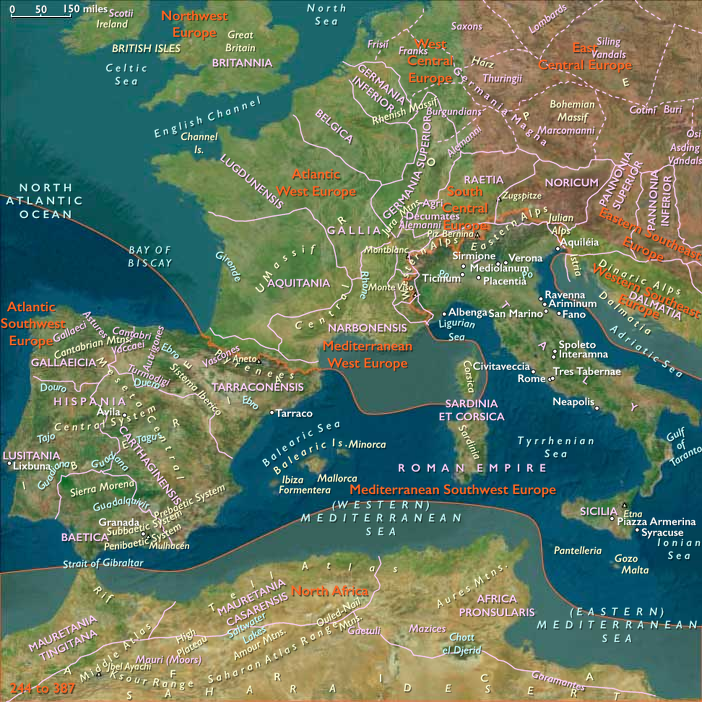
From 244 to 387 CE, Atlantic Southwest Europe—including northern and central Portugal, Galicia, Asturias, Cantabria, and northern Spain south of the Franco-Spanish border (43.05548° N, 1.22924° W)—navigated a complex era marked by persistent imperial instability, economic shifts, and deep cultural and religious transformations. As the Roman Empire grappled with the Crisis of the Third Century and subsequent administrative restructuring under Diocletian and Constantine, this region preserved notable provincial stability and economic resilience. Christianity, meanwhile, emerged as a dominant cultural force, reshaping local traditions and institutions.
Political and Administrative Developments
Provincial Administration and Local Governance
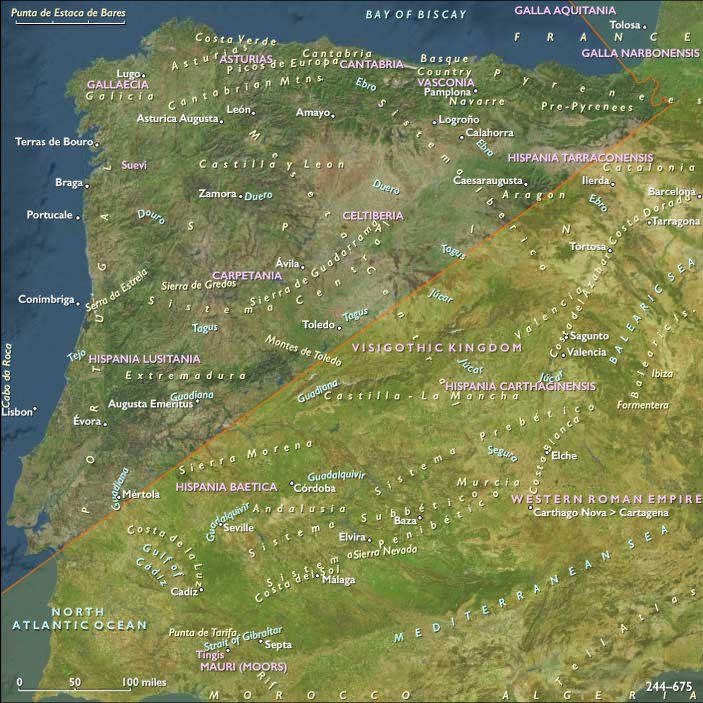
Hispania was divided into several provinces, notably Gallaecia (covering modern Galicia and northern Portugal) and Lusitania (encompassing much of modern Portugal and Extremadura). Lusitania was governed from Emerita Augusta (modern Mérida), a thriving administrative and economic hub that served as the provincial capital. Under Diocletian’s reforms, these provinces became part of the larger Diocese of Hispania, governed from Tarraco (modern Tarragona), significantly strengthening imperial bureaucracy and administrative oversight.
Imperial Military Presence and Local Security
Roman military units, primarily auxiliary troops rather than full legions, were stationed in northern regions such as Asturias and Cantabria. Their primary roles were to maintain control, prevent rebellions, and guard against incursions by less-assimilated local tribes. Despite broader imperial turmoil, this localized military presence ensured a considerable degree of internal stability.
Germanic Raids and Frontier Security
Throughout the late 3rd and the 4th centuries, coastal settlements occasionally suffered raids by Germanic groups, notably the Franks. Although these incursions disrupted trade and settlements, they did not yet lead to permanent Germanic settlements, which only began in earnest after the early 5th century.
Economic and Social Transformations
Regional Production and Economic Stability
Northern Iberia and Lusitania remained economically vital to the empire, producing:
-
Gold and silver mined extensively in Asturias and Galicia.
-
Olive oil and grain from the fertile territories of Lusitania.
-
Fish products and salt from coastal settlements like Olissipo (Lisbon) and Bracara Augusta (Braga).
Despite imperial disruptions, regional trade remained resilient, maintaining commercial connections with Gaul, North Africa, and the broader Mediterranean, though sporadic pirate activities and border instability occasionally hindered commerce.
Transition from Slavery to Localized Labor Systems
A significant economic shift occurred as traditional widespread slavery declined. Increasingly, regional economies relied upon tenant farming, semi-free laborers (coloni), free artisans, and localized community-based labor arrangements. This shift reflected broader imperial trends toward economic self-sufficiency and foreshadowed medieval economic structures.
Decline of Urban Life and Rise of Villa Economies
While larger cities such as Emerita Augusta, Bracara Augusta, and Asturica Augusta (Astorga) remained vibrant regional centers, many smaller towns and municipalities declined. Local elites (curiales) took on greater administrative responsibilities as imperial oversight weakened. By the late 4th century, fortified rural estates (villae) increasingly replaced urban centers as economic focal points, laying early foundations for feudal economic and social structures characteristic of medieval Iberia.
Cultural and Religious Developments
Expansion and Institutionalization of Christianity
Christianity expanded rapidly across Atlantic Southwest Europe in the 3rd and 4th centuries, with the earliest known communities emerging by the late 2nd century. Emperor Constantine’s Edict of Milan (313 CE) granted religious tolerance to Christians, facilitating the establishment of influential bishoprics in key regional cities, notably Bracara Augusta and Emerita Augusta.
The Council of Elvira (c. 306 CE), convened near modern Granada, emerged as one of the earliest Christian synods in Hispania, playing a central role in shaping the regional structure of the early church. By the end of the 4th century, Christianity became the dominant religion following Emperor Theodosius I’s declaration of Nicene Christianity as the official state religion (380 CE). Bishops and clergy began to hold significant civic authority, profoundly influencing local governance and regional cultural identities.
Decline of Paganism and Enduring Syncretism
Traditional Roman polytheism and indigenous religious practices gradually declined, especially within urban and elite circles, as Christianity solidified its influence. Temples were progressively converted into churches, with Christian basilicas emerging prominently in urban centers. Nevertheless, rural areas—particularly in Galicia and northern Portugal—continued to practice indigenous and Roman pagan traditions, creating distinctive regional syncretism that blended older rituals with Christian beliefs and practices.
Civic Identity and Regional Cohesion
Civic identity in Atlantic Southwest Europe evolved significantly during this era, blending traditional Iberian, Roman, and emerging Christian elements. The universal citizenship first granted by Caracalla’s Constitutio Antoniniana (212 CE) remained foundational, while increasingly Christian affiliations reshaped regional and local identities amid ongoing imperial reorganization.
Notable Tribal Groups and Settlements
-
Lusitanians: Maintained economic prosperity and vibrant cultural traditions while deeply integrating Christianity into local governance and social life.
-
Vettones and Vaccaei: Sustained regional stability, autonomy, and economic resilience, effectively adapting to shifting religious and economic contexts.
-
Gallaeci, Astures, Cantabri: Continued stable governance, prosperous economic activity, and culturally resilient identities, preserving traditional indigenous practices alongside significant Christian integration.
-
Vascones: Successfully maintained diplomatic neutrality, territorial autonomy, internal stability, and distinct cultural identity, enhancing overall regional resilience.
Long-Term Significance and Legacy
From 244 to 387 CE, Atlantic Southwest Europe demonstrated exceptional regional stability, economic resilience, and cultural adaptability. By effectively navigating imperial crises, embracing significant economic transitions, and deeply institutionalizing Christianity, the region established enduring foundations for its future historical, cultural, and social evolution, profoundly influencing the subsequent medieval character of the Iberian Peninsula.
People
Groups
- Vascones
- Lusitanians, or Lusitani
- Astures (Celtic tribe)
- Cantabri (Celtic tribe)
- Gallaeci
- Hispania Tarraconensis (Roman province)
- Lusitania (Roman province)
- Hispania Baetica (Roman province)
- Christians, Early
- Suebi (Suevi), Realms of the
- Roman Empire (Rome): Non-dynastic
- Roman Empire: Tetrarchy
- Gallaecia (Roman province)
- Roman Empire: Constantinian dynasty (Nicomedia)
- Christianity, Nicene
- Roman Empire: Constantinian dynasty (Constantinople)
- Roman Empire: Valentinian dynasty (Rome)
- Roman Empire: Theodosian dynasty (Constantinople)
Topics
Commodoties
Subjects
Regions
Subregions
Years: 244 - 387
People
Groups
- Vascones
- Lusitanians, or Lusitani
- Astures (Celtic tribe)
- Cantabri (Celtic tribe)
- Gallaeci
- Hispania Tarraconensis (Roman province)
- Lusitania (Roman province)
- Hispania Baetica (Roman province)
- Christians, Early
- Suebi (Suevi), Realms of the
- Roman Empire (Rome): Non-dynastic
- Roman Empire: Tetrarchy
- Gallaecia (Roman province)
- Roman Empire: Constantinian dynasty (Nicomedia)
- Christianity, Nicene
- Roman Empire: Constantinian dynasty (Constantinople)
- Roman Empire: Valentinian dynasty (Rome)
- Roman Empire: Theodosian dynasty (Constantinople)
Topics
Commodoties
Subjects
Regions
Subregions