The Cimmerians (Gimmari in Assyrian records; Gomer …
Years: 705BCE - 694BCE
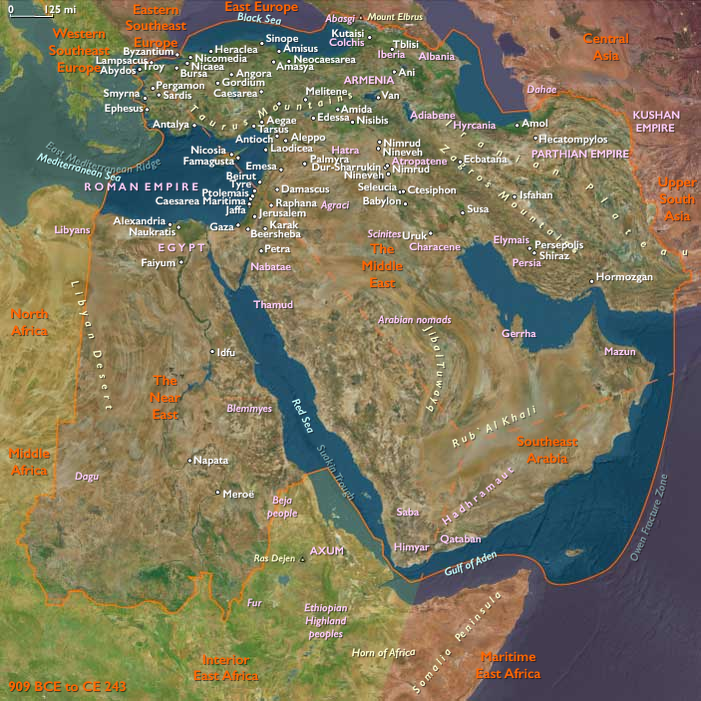
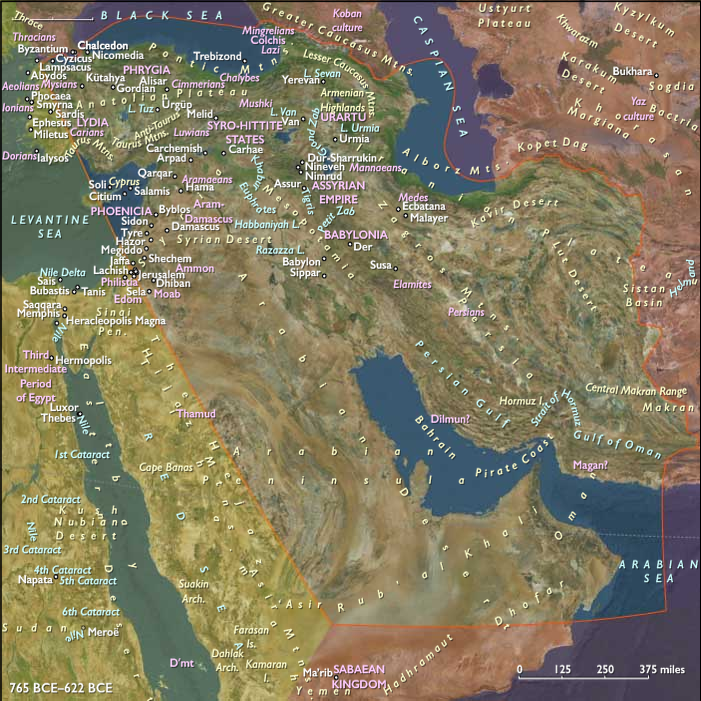
The Cimmerians (Gimmari in Assyrian records; Gomer in the Bible) shatter the thriving Phrygian kingdom in 696 and 695, destroying its capital city of Gordion and (according to Herodotus) causing its king, Midas, to commit suicide rather than face capture.
From here, the Cimmerians harry Lydia until being finally driven into Cappadocia by the Scythians.
Locations
People
Groups
- Phrygia, Kingdom of
- Cimmerians
- Urartu, Kingdom of
- Scythians, or Sakas
- Assyria, (New) Kingdom of (Neo-Assyrian Empire)
Topics
- Younger Subboreal Period
- Iron Age, Near and Middle East
- Iron Age Cold Epoch
- Classical antiquity
- Assyrian Wars of c. 745-609 BCE
- Cimmerian Invasion of Phrygia
Commodoties
Subjects
Regions
Subregions
Related Events
Filter results
Showing 10 events out of 66304 total
An important bronze-using culture, called Dong Son, after one of its principal sites, appears about 700 on the Tonkin plain, in present northern Vietnam.
Dong-son artisans make frequent use of heavy, slightly square spirals in relief; other motifs include key patterns and rows of dots.
The Dong Son culture is linked to the Tibeto-Burman culture, the Dai culture in Yunnan and Laos, the Mon–Khmer cultures and the culture associated with the Plain of Jars in Laos.
Similar artifacts have been found in Cambodia along the Mekong River dating back to the fourth millennium BCE.
Dong Son influence is seen today throughout Southeast Asia, from the moko drum of Alor, Indonesia (suspected of originating with Dong Son bronze drums) to the design of keris knife.
To the south of the Dong Son culture is the proto-Cham Sa Huynh culture.
Duke Zhuang's two sons fight a protracted civil war over the leadership of Zheng after the death their father's death in 701.
The Middle East: 705–694 BCE
Sennacherib’s Ascension and Consolidation
Following the sudden death of Sargon II in battle against the migrating Cimmerians in 705 BCE, his son Sennacherib ascends the Assyrian throne. Bringing extensive military and administrative expertise, Sennacherib inherits an expansive yet turbulent empire. He promptly relocates the imperial capital from Sargon’s unfinished fortress at Dur Sharrukin (Khorsabad) to the historically significant city of Nineveh, initiating a vast urban renewal project. Under his command, Nineveh is magnificently enlarged and reconstructed, becoming the symbolic and political center of Assyrian power.
Cimmerian Incursions and Phrygia’s Collapse
The Cimmerians, a nomadic people originally expelled from the Caucasus by the advancing Scythians, continue their relentless search for new territories in eastern Anatolia. Having been decisively repelled by Sargon II shortly before his death, they turn their attention westward. Between 696 and 695 BCE, they deliver a catastrophic blow to the wealthy and influential Phrygian kingdom, sacking and destroying its capital city, Gordium. According to the historian Herodotus, the Phrygian king Midas commits suicide rather than face capture or humiliation by these fierce invaders. From Phrygia, the Cimmerians carry their destructive raids into Lydia, sowing chaos before ultimately being pushed into Cappadocia by the encroaching Scythians.
Assyrian Military Power and Regional Unrest
Under Sennacherib’s reign, the Assyrian military—particularly its archers, renowned for their disciplined organization, powerful bows, and iron-tipped arrows—asserts dominance throughout the empire’s vast territories. However, shortly after taking power, Sennacherib confronts widespread rebellions. In the west, uprisings erupt throughout Syria and Palestine, demanding swift military response to restore Assyrian authority.
Renewed Babylonian Turmoil
In Babylonia, the Chaldean prince Marduk-apla-iddina II (also known as Merodach-Baladan), who had first seized Babylon’s throne in 721 BCE and was ousted by Sargon II around 710 BCE, returns from exile in Elam upon hearing of Sargon’s death. Successfully rallying support among discontented Babylonians, Marduk-apla-iddina reclaims the throne in 703 BCE, reigniting a persistent rebellion against Assyrian rule. His second reign is brief—lasting only nine months—before Sennacherib decisively defeats him near Kish. Escaping once more into exile in Elam, Marduk-apla-iddina dies shortly thereafter, around 701 BCE.
Nonetheless, Babylon remains restive. A significant rebellion breaks out again in 699 BCE, signaling enduring resistance against Assyrian dominance. Sennacherib is thus forced into continual military vigilance, as the empire simultaneously confronts external invasions and internal revolts.
This era (705–694 BCE) thus marks a period of notable transitions and turbulence in the Middle East, characterized by aggressive migratory pressures, destructive invasions, and the determined reassertion of Assyrian imperial authority under the vigilant leadership of Sennacherib.

The Assyrians have recorded the migrations of the Cimmerians, a Transcaucasian people, who, since their expulsion from the Caucasus by the Scythians, have searched for a new homeland in eastern Anatolia.
Most scholars now believe they had assaulted Urartu (Armenia) about 714 BCE, then attempted to enter Assyrian territory but in 705, after being repulsed by Sargon II of Assyria, who falls in the campaign against them, they turn aside into central Anatolia.
Sargon’s unfinished fortress-capital is virtually abandoned following his death.
His son Sennacherib, who has gained copious military and administrative experience, succeeds him in 705 as ruler of a greatly enlarged Assyria.
The Assyrian archers have gained renown for their excellent organization, strong bows, and iron-tipped arrows.
Sennacherib makes Nineveh the Assyrian capital, enlarging and rebuilding the city on a magnificent scale.
Shortly after his ascendancy, he is fully occupied with rebellious subjects in both the east and the west.
The Babylonian revolt, quickly suppressed, is followed by uprisings in Syria and Palestine.
Chaldean prince Marduk-apla-iddina II (the biblical Merodach-Baladan, also called Marduk-Baladan, Baladan and Berodach-Baladan, lit.
“Marduk has given me an Heir”), who had usurped the throne of Babylon in 721 and been ousted by Sargon in 710, returns from exile in Elam and ignites rebellion in Babylonia.
He is able to enter Babylon and be declared king again.
Nine months later, he is defeated near Kish by the Assyrians, but manages to flee to Elam.
He dies in exile a couple of years later.
Assyria’s war against Merodach-Baladan’s Elamite ally continues.
Babylon revolts again in 699.
Marduk-apla-iddina II had returned from Elam after the death of Sargon and ignited rebellion in Babylonia.
Briefly recapturing the throne from a native Babylonian nobleman, he had been able to enter Babylon and again be declared king in 703 BCE.
Defeated nine months later near Kish by the Assyrians, he had managed to flee to Elam, and dies in exile a couple of years later.
Near East (705–694 BCE): Rebellion, Revival, and Imperial Consolidation
Assyrian Domination and Regional Revolts
The death of Assyrian king Sargon II in 705 BCE triggers widespread rebellion across the Near East against Assyrian dominance. Hezekiah, king of Judah, emerges prominently in these revolts, aiming to free Judah from Assyrian suzerainty. Allied with city-states such as Ashkelon and Ekron and backed by Egypt, Hezekiah fortifies Jerusalem, notably constructing the Siloam tunnel to ensure water supply during sieges. However, the Assyrian King Sennacherib invades Judah in 701 BCE, seizing numerous fortified cities, including Lachish and Jaffa. Jerusalem narrowly avoids capture, reportedly due to a devastating plague among Assyrian forces, an event later ascribed in Hebrew scriptures to divine intervention.
Cultural Resurgence and New Settlements
Around 700 BCE, the Troas region, previously abandoned, experiences renewed Greek colonization by settlers from Mytilene on Lesbos, who establish Ilion (Troy VIII). Concurrently, Milesian Greeks, with approval from Gyges of Lydia, establish Abydos at a strategic location on the Asian side of the Hellespont, opposite Sestus, enhancing both trade and geopolitical positioning.
Cypriot Urban Development
Cyprus undergoes significant urban and economic growth, epitomized by Idalium (modern Dali, Nicosia District), a prominent city renowned for its copper trade since the third millennium BCE. Listed prominently in Assyrian records from Sargon II and Esarhaddon, Idalium and other Cypriot cities become integral to Assyrian trade networks, reflecting Cyprus's deep integration into broader regional dynamics.
Prophetic Voices Amid Turmoil
During Hezekiah's second rebellion (705–701 BCE), the Judahite prophet Isaiah renews his warnings, emphasizing themes of sin, impending judgment, and eventual deliverance. Isaiah’s messages, which form the core of the first part of the "Book of Isaiah," highlight the complex interaction between political actions and religious beliefs, shaping Judah's identity amid the imperial threats.
Legacy of the Era
The period from 705 to 694 BCE is marked by resistance to Assyrian hegemony, strategic urban developments, and significant religious and cultural advancements. Hezekiah's persistent quest for autonomy, despite setbacks, symbolizes Judah’s enduring resilience, while the cultural revival seen in Troy and Abydos underscores wider patterns of regional renewal and increased connectivity.
Idalium (Greek: Idalion) is an ancient city in Cyprus, in modern Dali, Nicosia District, founded on the copper trade in the third millennium BCE.
Its name in the eighth century BCE is "Ed-di-al" as it appears on the Prism of Essarhaddon and the Stele of Sargon.
The original inhabitants were the natives of the island, known to scholars as the "Eteocypriotes."
The original city lay on the northern side of the Yialias River in modern "Ayios Sozomenos."
The people of Ed-di-al began manufacturing operations on the south side of the river in what is now modern Dhali During the thirteenth century BCE.
From here, the city has grown to the major urban and copper-trading center found by the Assyrians at the end of the eighth century BCE.
Idalion is the first among seven city kingdoms listed on the Stele of Sargon (701 BCE) and first among the ten Cypriot kingdoms listed on the prism (many-sided tablet) of the Assyrian king Esarhaddon.
The Troas (Troy) region is colonized from Mytilene on the island of Lesbos early in the eighth century.
New settlers appear around 700 on the site of Troy, deserted for four centuries, and build a city of modest size over and around the ruins of the Bronze Age fortress.
This Greek settlement is given the Hellenized name of Ilion (and is known to archaeologists as Troy VIII.
Years: 705BCE - 694BCE
Locations
People
Groups
- Phrygia, Kingdom of
- Cimmerians
- Urartu, Kingdom of
- Scythians, or Sakas
- Assyria, (New) Kingdom of (Neo-Assyrian Empire)
Topics
- Younger Subboreal Period
- Iron Age, Near and Middle East
- Iron Age Cold Epoch
- Classical antiquity
- Assyrian Wars of c. 745-609 BCE
- Cimmerian Invasion of Phrygia