
The Christian revival of Celtic art, which …
Years: 403 - 403
The Christian revival of Celtic art, which borrows heavily from late Roman provincial and contemporary Anglo-Saxon designs, is rapidly transmitted to Ireland.
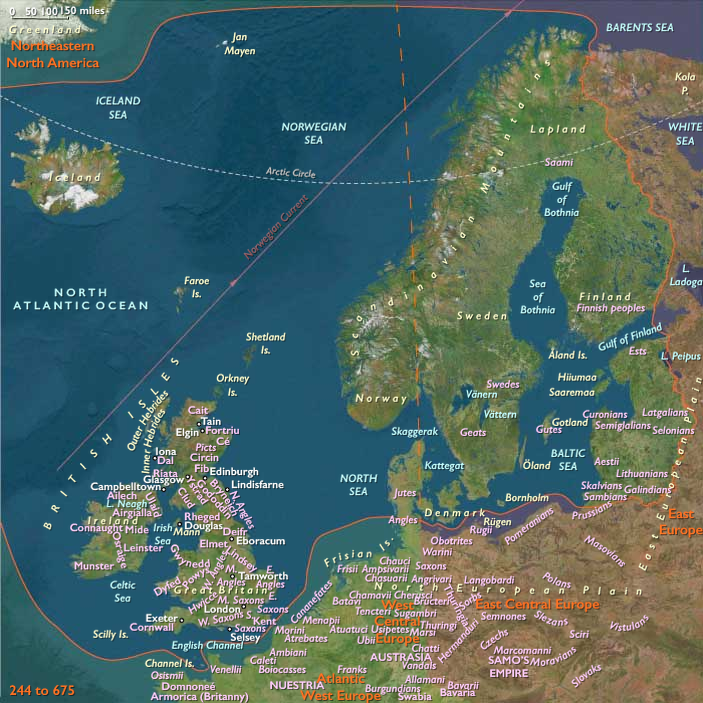
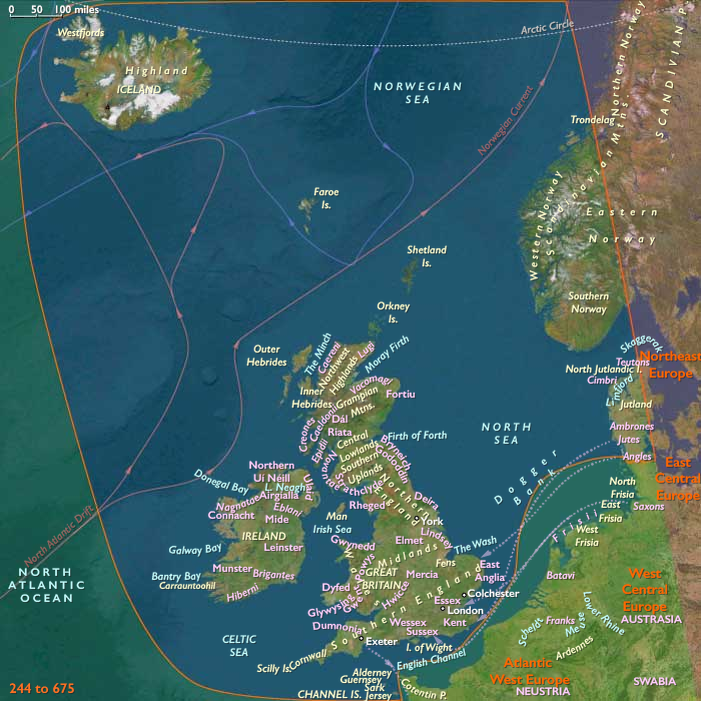
The Scots of Ireland from about 395 had begun attacking Roman Britain from Strathclyde south to Wales, devastating coastal settlements and carrying off thousands of captives into slavery.
According to later tradition, during one of his many raids on Britain, Niall of the Nine Hostages, high king at Meath, captured the future Saint Patrick, aged sixteen, and brought him in bondage to Ireland, where he serves as a swineherd.
Patrick will succeed in escaping to Britain many years later, but he will eventually return to Ireland and play an important early role in the conversion of the Irish to Christianity.
The fifth and youngest son of Eochaid Mugmedon, an Irish High King, and Cairenn Chasdubh (curly black), the enslaved daughter of Sachell Balb (Sachell the stammerer), a British king, Niall is the eponymous ancestor, through his sons Conall Gulban, Endae, Eogan, Coirpre, Lóegaire, Maine of Tethba, Conall Cremthainne and Fiachu Fiachrach, of the Northern and Southern Uí Néill dynasties, some of whom will hold power in Ulster until their defeat in the Nine Years War in 1603. (In January 2006, scientists suggested that Niall may have been the most fecund male in Irish history, and second only to Genghis Khan worldwide.)
There are various versions of how Niall gained his epithet, the oldest being that he had taken a hostage from each of the nine túatha or petty kingdoms of the Airgialla.
The later, better known story is that he had taken a hostage from each of the five provinces of Ireland (Ulster, Connacht, Leinster, Munster and Meath), and one each from the Scots, Saxons, Britons, and Franks (or one each from Dál Riata, Caledonia, Strathclyde and Northumbria).
Irish sources describe Niall's expeditions to Britain and France, and his reign, as given in the Irish Annals, which is roughly contemporaneous with the foundation of Dál Riata in Scotland by Irish migrants and the raids by "Scots" on late Roman and sub-Roman Britain.
Locations
People
Groups
- Ireland, ancient
- Britons (historical)
- Saxons
- Scoti
- Irish people
- Roman Empire: Theodosian dynasty (Constantinople)
- Roman Empire, Western (Milan)
- Anglo-Saxons
Topics
- Middle Subatlantic Period
- Late Antiquity
- Migration Period
- Fall of the Western Roman Empire
- Irish Raids in Britain
Commodoties
Subjects
Regions
Subregions
Related Events
Showing 1 events out of 1 total
Years: 403 - 403
Locations
People
Groups
- Ireland, ancient
- Britons (historical)
- Saxons
- Scoti
- Irish people
- Roman Empire: Theodosian dynasty (Constantinople)
- Roman Empire, Western (Milan)
- Anglo-Saxons
Topics
- Middle Subatlantic Period
- Late Antiquity
- Migration Period
- Fall of the Western Roman Empire
- Irish Raids in Britain
Commodoties
Subjects
Regions
Subregions