
Traditional genealogies trace the ancestry of most …
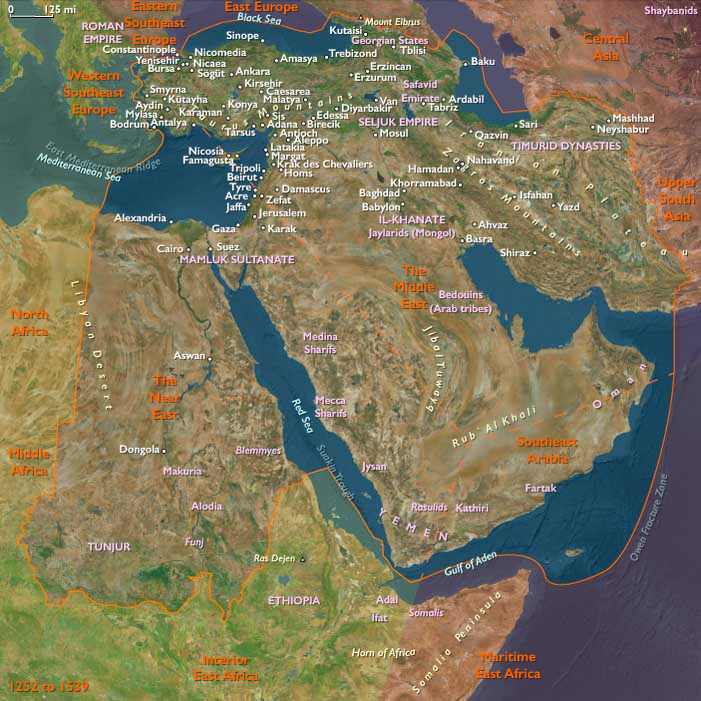
Years: 1252 - 1395
Traditional genealogies trace the ancestry of most of the Nile Valley's mixed population to Arab tribes that migrate into the region during this period.
Even many non-Arabic speaking groups claim descent from Arab forebears.
The Jaali and the Juhaynah are the two most important Arabic-speaking groups to emerge in Nubia are.
Both show physical continuity with the indigenous pre-Islamic population.
The former claim descent from the Quraysh, the Prophet Muhammad's tribe.
Historically, the Ja'alin have been sedentary farmers and herders or townspeople settled along the Nile and in Al Jazirah.
The nomadic Juhayna comprise a family of tribes that includes the Kababish, Baqqara, and Shukriya.
They are descended from Arabs who migrate after the thirteenth century into an area that extends from the savanna and semidesert west of the Nile to the hill country east of the Blue Nile.
Both groups form a series of tribal shaykhdoms that succeed the crumbling Christian Nubian kingdoms and that are in frequent conflict with one another and with neighboring non-Arabs.
Locations
Groups
- Nubians
- Blemmyes
- Aksum (or Axum), Kingdom of
- Ja'alin tribe
- Beja people
- Juhaynah
- Makuria, Kingdom of
- Christians, Monophysite
- Christianity, Chalcedonian
- Coptic Orthodox Church of Alexandria
- Alodia, or Alwa (Subah, or Soba), Kingdom of
- Abbasid Caliphate (Baghdad)
- Egypt and Syria, Mamluk Bahri Sultanate of
- Egypt and Syria, Mamluk Burji Sultanate of
Commodoties
Subjects
Regions
Subregions
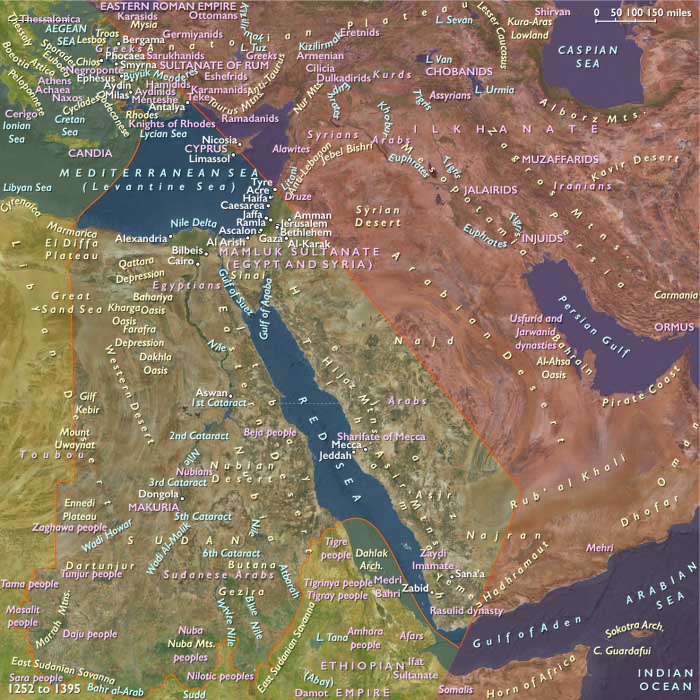
Years: 1252 - 1395
Locations
Groups
- Nubians
- Blemmyes
- Aksum (or Axum), Kingdom of
- Ja'alin tribe
- Beja people
- Juhaynah
- Makuria, Kingdom of
- Christians, Monophysite
- Christianity, Chalcedonian
- Coptic Orthodox Church of Alexandria
- Alodia, or Alwa (Subah, or Soba), Kingdom of
- Abbasid Caliphate (Baghdad)
- Egypt and Syria, Mamluk Bahri Sultanate of
- Egypt and Syria, Mamluk Burji Sultanate of
Commodoties
Subjects
Regions
Subregions