
Filters:
The Christian commanders, after a failed attack …
Years: 1550 - 1550
September
The Christian commanders, after a failed attack by Mahdia's defenders, order four galleys to patrol the area during the night to prevent further attacks.
Several others are also sent to Sicily carrying the wounded and ill soldiers and requests for replacements and ammunition, which are provided from Milan, Florence, Lucca and Genoa.
The siege engineers, pending their receipt of reinforcements and munitions,focus on the weakest points of Mahdia's defenses.
García Álvarez de Toledo, 4th Marquis of Villafranca, suggests bombing the walls from the sea, forming a gun battery on two galleys previously demasted and united to each other with hangers and planks.
Nine pieces of artillery are settled on the platform, which is protected by shields and parapet, prior to anchoring the galleys off the walls.
The guns of García Álvarez de Toledo's galleys, along with the land batteries and of the other naval artillery, open fire on the city on September 8.
The bombardment, which does not end until two days later, opens large gaps in Mahdia's defenses.
Then, at the orders of their officers, the Spanish soldiers storm the fortifications in three different points.
An attack is repulsed, but the other two overwhelm the defenders and surprise the remaining Ottoman troops from their rear
The last defenders resist inside the towers for a while, but they are finally defeated.
Governor Hesar is captured, and about seven thousand of Mahdia’s soldiers and civilians are killed or captured.
Several others are also sent to Sicily carrying the wounded and ill soldiers and requests for replacements and ammunition, which are provided from Milan, Florence, Lucca and Genoa.
The siege engineers, pending their receipt of reinforcements and munitions,focus on the weakest points of Mahdia's defenses.
García Álvarez de Toledo, 4th Marquis of Villafranca, suggests bombing the walls from the sea, forming a gun battery on two galleys previously demasted and united to each other with hangers and planks.
Nine pieces of artillery are settled on the platform, which is protected by shields and parapet, prior to anchoring the galleys off the walls.
The guns of García Álvarez de Toledo's galleys, along with the land batteries and of the other naval artillery, open fire on the city on September 8.
The bombardment, which does not end until two days later, opens large gaps in Mahdia's defenses.
Then, at the orders of their officers, the Spanish soldiers storm the fortifications in three different points.
An attack is repulsed, but the other two overwhelm the defenders and surprise the remaining Ottoman troops from their rear
The last defenders resist inside the towers for a while, but they are finally defeated.
Governor Hesar is captured, and about seven thousand of Mahdia’s soldiers and civilians are killed or captured.
Locations
People
Groups
- Berber people (also called Amazigh people or Imazighen, "free men", singular Amazigh)
- Papal States (Republic of St. Peter)
- Genoa, (Most Serene) Republic of
- Tunis, Sultanate of (Hafsid Kingdom)
- Holy Roman Empire
- Ottoman Empire
- Naples, Kingdom of
- Ottoman Algeria
- Habsburg Monarchy, or Empire
- Knights of Malta, Sovereign and Military Order of the
- Spain, Habsburg Kingdom of
Topics
Commodoties
Subjects
Regions
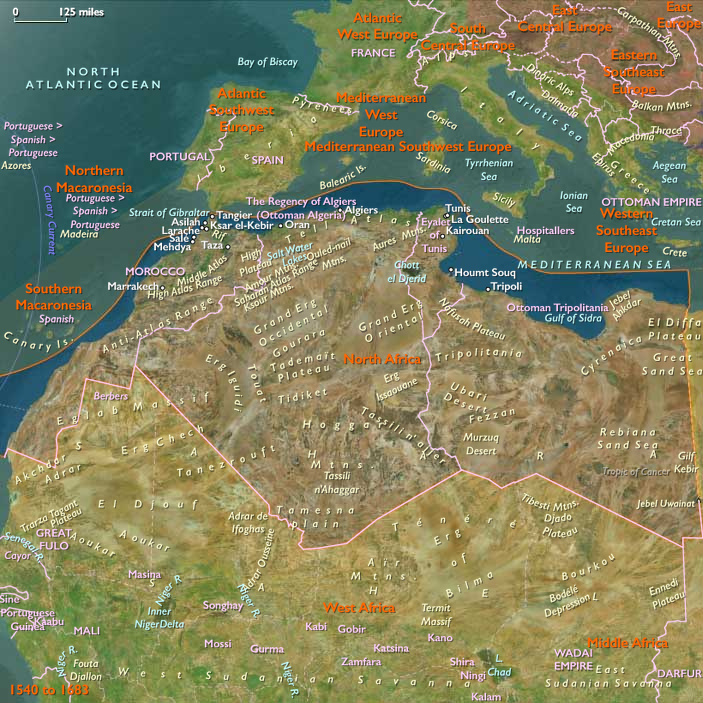
Subregions
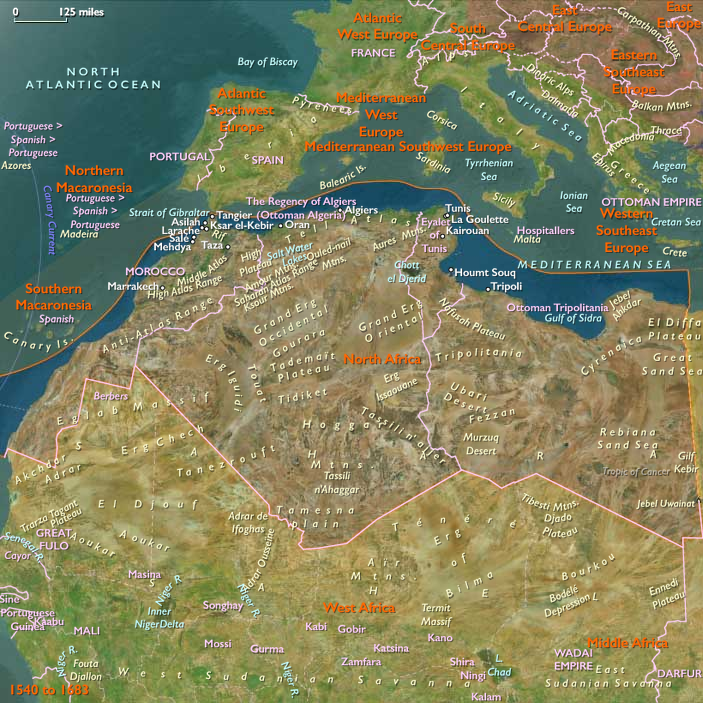
Years: 1550 - 1550
September
Locations
People
Groups
- Berber people (also called Amazigh people or Imazighen, "free men", singular Amazigh)
- Papal States (Republic of St. Peter)
- Genoa, (Most Serene) Republic of
- Tunis, Sultanate of (Hafsid Kingdom)
- Holy Roman Empire
- Ottoman Empire
- Naples, Kingdom of
- Ottoman Algeria
- Habsburg Monarchy, or Empire
- Knights of Malta, Sovereign and Military Order of the
- Spain, Habsburg Kingdom of
Topics
Commodoties
Subjects
Regions
Subregions