The Chinese Han empire changes under the …
Years: 189BCE - 46BCE
The Chinese Han empire changes under the reign of Emperor Wu from a relatively passive foreign policy to an offensive strategy in order to deal with the increasing Xiongnu incursions on the northern frontier.
The Han–Xiongnu War, also known as the Sino-Xiongnu War, is a series of military conflicts fought between the Han empire and the nomadic confederation of Xiongnu tribes between 133 BCE and 89 CE.
Commodoties
Subjects
Regions
Subregions
Related Events
Filter results
Showing 10 events out of 63449 total
Vietnamese historians regard Trieu Da as a defender of their homeland against an expanding Han empire.
In 111 BCE, however, the Chinese armies of Emperor Wu Di defeat the successors of Trieu Da and incorporate Nam Viet into the Han empire.
The Chinese are anxious to extend their control over the fertile Red River Delta, in part to serve as a convenient supply point for Han ships engaged in the growing maritime trade with India and Indonesia.
Maritime East Asia (189–46 BCE): Han Dynasty Expansion and Cultural Renaissance
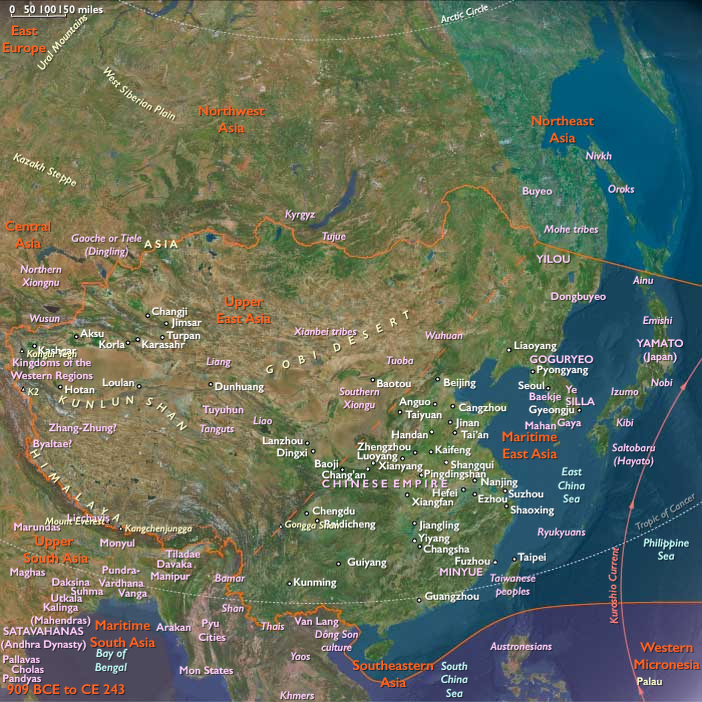
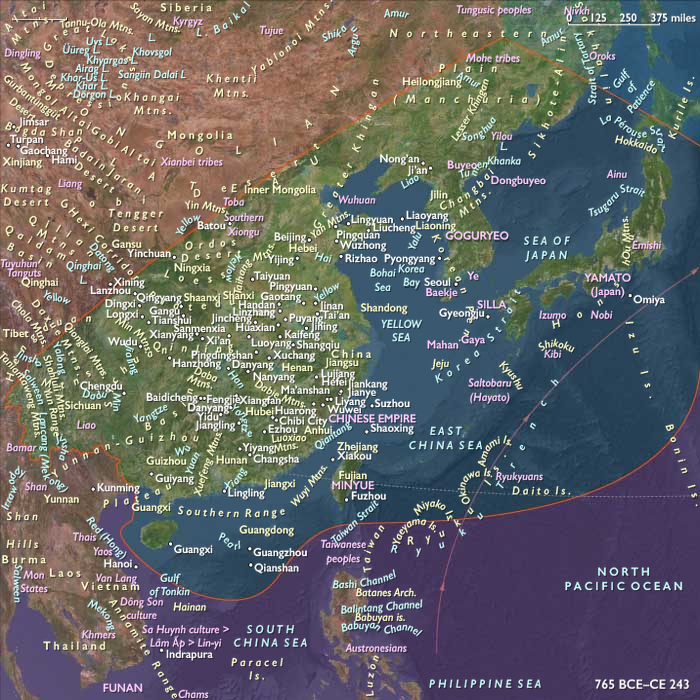
Between 189 BCE and 46 BCE, MAritime East Asia—comprising lower Primorsky Krai, the Korean Peninsula, the Japanese Archipelago below northern Hokkaido, Taiwan, and southern, central, and northeastern China—experiences significant territorial expansion, cultural revival, and technological progress under the Han dynasty.
Establishment and Administration of the Han Dynasty
Following a brief civil war, the Han Dynasty (206 BCE–220 CE) emerges, establishing its capital at Chang'an. The Han rulers maintain much of the Qin administrative structure but temper centralized rule by introducing vassal principalities to facilitate governance. Confucianism, previously suppressed under Qin, becomes the official state ideology, and Confucian scholars become central to civil administration, establishing the earliest civil service examination system.
This era also sees a remarkable cultural renaissance, notably through the work of historian Sima Qian (145–87 BCE), whose Shiji (Historical Records) documents Chinese history comprehensively from legendary periods through Emperor Wu Di (141–87 BCE). Intellectual, literary, and artistic endeavors flourish, profoundly influencing subsequent generations.
Military Expansion and the Silk Road
The Han dynasty is marked by substantial military prowess, expanding westward into the Tarim Basin region (modern Xinjiang), thereby securing and promoting the Silk Road, a crucial trade route linking China with Antioch, Baghdad, and Alexandria. This route becomes synonymous with the export of Chinese silk to the Roman Empire.
Han armies also penetrate into northern Vietnam and northern Korea, where they establish commanderies, notably Lelang (Nangnang) near modern-day P'yongyang. These commanderies facilitate cultural and commercial exchanges, though their governance remains fragile and heavily reliant on diplomatic tributary relationships, symbolized by intermarriages and periodic exchanges of gifts with local rulers.
Developments on the Korean Peninsula
In Korea, the most notable polity is Old Choson, flourishing along the Liao and Taedong rivers, known for its bronze culture and formidable military strength. Under the leadership of Wiman (194–180 BCE), who synthesizes Chinese influence with indigenous traditions, Wiman Choson expands significantly but ultimately falls to Han conquest in 108 BCE.
This era coincides with the peninsula’s shift from bronze to iron culture, profoundly enhancing agricultural productivity through iron tools such as hoes, plowshares, and sickles. Increased grain cultivation supports population growth and lays continuous agrarian foundations for later unified Korean states.
The Han–Xiongnu Conflict
In response to increasing threats from nomadic Xiongnu tribes on the northern frontier, Emperor Wu Di initiates the prolonged Han–Xiongnu War (133 BCE–89 CE). This shift from defensive to offensive strategy characterizes Han foreign policy, further solidifying its control over frontier regions and protecting key trade routes.
Technological and Mathematical Advancements
The Han dynasty witnesses remarkable technological achievements, including the invention of paper and porcelain. In mathematics, the influential text Nine Chapters on the Mathematical Art (Jiu Zhang Suan Shu) introduces negative numbers and innovative methods for solving simultaneous equations, marking significant milestones in mathematical history.
Legacy of the Age: Consolidation and Cultural Synthesis
Thus, the age from 189 to 46 BCE under the Han dynasty marks a pivotal period of territorial expansion, cultural revival, and technological innovation. This era establishes enduring administrative, philosophical, and technological frameworks that profoundly influence East Asian civilization for centuries.

The Han dynasty, after which the members of the ethnic majority in China, the "people of Han," are named, is notable also for its military prowess.
The empire expands westward as far as the rim of the Tarim Basin (in modern Xinjiang-Uygur Autonomous Region), making possible relatively secure caravan traffic across Central Asia to Antioch, Baghdad, and Alexandria.
The paths of caravan traffic are often called the "silk route" because the route is used to export Chinese silk to the Roman Empire.
Chinese armies also invade and annexed parts of northern Vietnam and northern Korea toward the end of the second century BCE.
Han control of peripheral regions is generally insecure, however.
To ensure peace with non-Chinese local powers, the Han court develops a mutually beneficial "tributary system."
Non-Chinese states are allowed to remain autonomous in exchange for symbolic acceptance of Han overlordship.
Tributary ties are confirmed and strengthened through intermarriages at the ruling level and periodic exchanges of gifts and goods.
A number of walled-town states on the Korean peninsula had survived long enough to come to the attention of China by the fourth century BCE.
The most illustrious state is Old Choson, which had established itself along the banks of the Liao and the Taedong rivers in southern Manchuria and northwestern Korea.
Old Choson has prospered into a civilization based on bronze culture and a political federation of many walled towns, which, judging from Chinese accounts, is formidable to the point of arrogance.
Riding horses and using bronze weapons, the Choson people extend their influence to the north, taking most of the Liaodong Basin, but the rising power of the north China state of Yan (also known as Eastern Zhou) checks Choson's growth and eventually pushes it back to territory south of the Ch'ongch'on River, located midway between the Yalu and Taedong rivers.
As Yan gives way in China to the Qin (221-207 BCE) and the Han (206 BCE - CE 220) dynasties, Choson declines, and refugee populations migrate eastward.
Out of this milieu emerges Wiman, a man who assumes the kingship of Choson sometime between 194 and 180 BCE.
Wiman Choson melded Chinese influence and the Old Choson federated structure; apparently reinvigorated under Wiman, this state again expands over hundreds of kilometers of territory.
Its ambitions run up against a Han invasion, however, and Wiman Choson falls in 108 BCE.
Cultivation of rice and other grains increases markedly, allowing the population to expand.
There is an unquestioned continuity in agrarian society from this time until the emergence of a unified Korean state many centuries later, even if the peoples of the peninsula cannot be called Korean.
It is illustrative of the relentlessly different historiography practiced in North Korea and South Korea, as well as both countries' dubious projection backward of Korean nationalism, that North Korean historians will deny that the Lelang district was centered in Korea and place it northwest of the peninsula, possibly near Beijing.
Perhaps this is because Lelang is clearly a Chinese city, as demonstrated by the many burial objects showing the affluent lives of Chinese overlords and merchants.
A new Chinese dynasty, called Han (206 BCE- CE 220), had emerged with its capital at Chang'an after a short civil war.
The new empire has retained much of the Qin administrative structure but has retreated a bit from centralized rule by establishing vassal principalities in some areas for the sake of political convenience.
The Han rulers modify some of the harsher aspects of the previous dynasty; Confucian ideals of government, out of favor during the Qin period, are adopted as the creed of the Han empire, and Confucian scholars gain prominent status as the core of the civil service.
A civil service examination system also is initiated.
Intellectual, literary, and artistic endeavors revive and flourish.
The Han period produces China's most famous historian, Sima Qian (145-87 BCE?), whose Shiji (Historical Records) provides a detailed chronicle from the time of a legendary Xia emperor to that of the Han emperor Wu Di (141-87 BCE).
Technological advances also marked this period.
Two of the great Chinese inventions, paper and porcelain, date from Han times.
Negative numbers appear for the first time in history in the Nine Chapters on the Mathematical Art (Jiu zhang suan-shu), which in its present form dates from the period of the Han Dynasty (202 BCE – CE 220), but may well contain much older material.
The Nine Chapters used red counting rods to denote positive coefficients and black rods for negative. (This system is the exact opposite of contemporary printing of positive and negative numbers in the fields of banking, accounting, and commerce, wherein red numbers denote negative values and black numbers signify positive values).
The Chinese are also able to solve simultaneous equations involving negative numbers.
Chinese armies drive the Xiongnu back across the Great Wall between 130 and 121 BCE, weaken their hold on Gansu Province as well as on what is now Nei Monggol Autonomous Region (Inner Mongolia), and finally push them north of the Gobi into central Mongolia.
Following these victories, the Chinese expand into the areas later known as Manchuria, the Korean Peninsula, and Inner Asia.
The Xiongnu, once more turning their attention to the west and the southwest, raid deep into the Oxus Valley between 73 and 44 BCE.
The descendants of the Yuezhi and their Chinese rulers, however, will form a common front against the Xiongnu and repel them.
The Xiongnu had again raided northern China about 200 BCE, finding that the inadequately defended Great Wall was not a serious obstacle.
By the middle of the second century BCE, they control all of northern and western China north of the Huang He.
This renewed threat leads the Chinese to improve their defenses in the north, while building up and improving the army, particularly the cavalry, and while preparing long-range plans for an invasion of Mongolia.