The Chaudor tribe leads a powerful Turkmen …
Years: 1516 - 1527
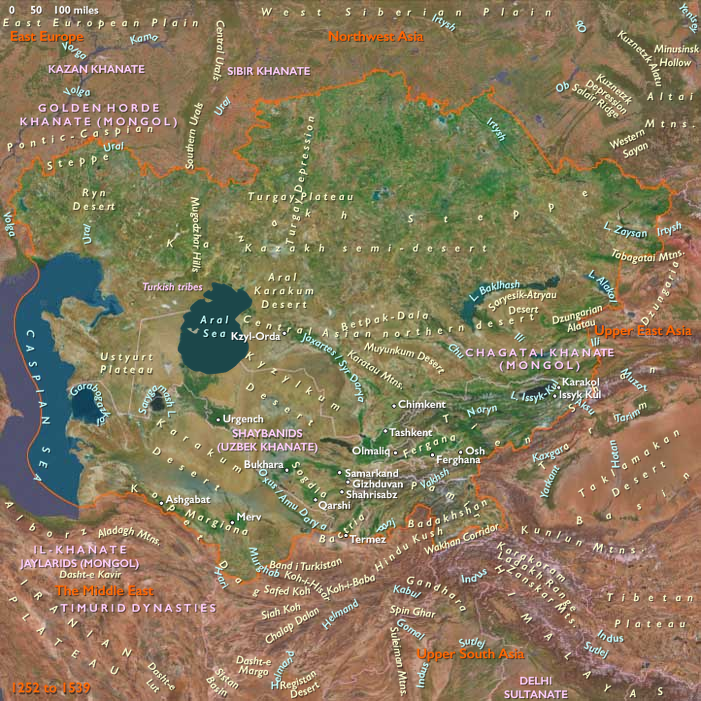
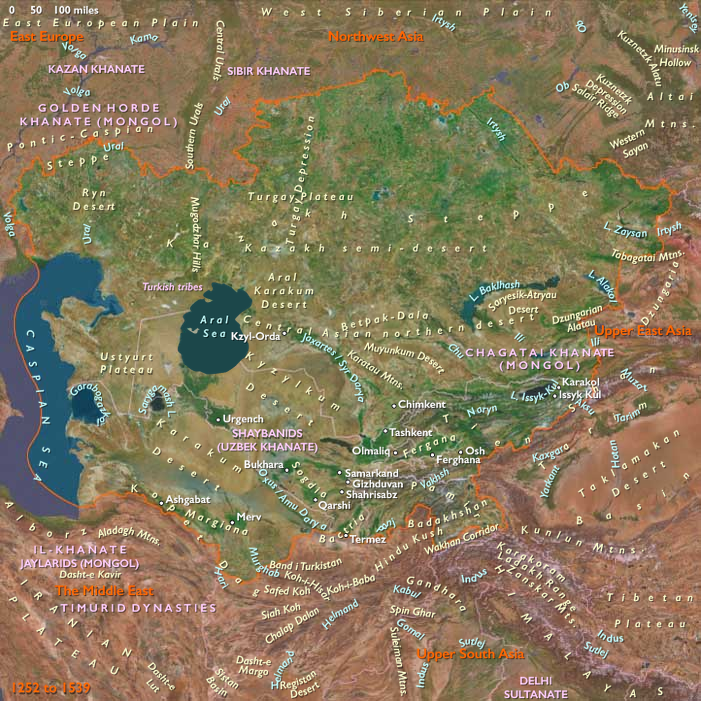
The Chaudor tribe leads a powerful Turkmen tribal union in the north of present Turkmenistan during the sixteenth and seventeenth centuries, while the Salor tribe is dominant in the south.
One of the Turkmens' principal occupations for centuries after the decline of Mongol rule has been robbing passing caravans.
Their organization is exclusively tribal, and the tribes are either nomadic and independent or subject to neighboring Persia or to the khanates of Khiva and Bukhara.
Locations
Groups
- Persian people
- Turkmen people
- Uzbeks
- Bukhara, Uzbek (Shaybanid) Khanate of
- Persia, Safavid Kingdom of
- Khiva, Khanate of (Khwarezm)
Subjects
Regions
Subregions
Related Events
Filter results
Showing 10 events out of 11 total
The famous pun, "give great praise to the Lord, and little laud to the devil" is a warning to King Charles attributed to the official court jester Archie Armstrong.
Laud is known to be touchy about his diminutive stature.
Whereas Strafford sees the political dangers of Puritanism, Laud sees the threat to the episcopacy.
But the Puritans themselves feel threatened: the Counter-Reformation is succeeding abroad and the Thirty Years' War is not progressing to the advantage of the Protestants.
Laud's high church policy is seen in this climate as a sinister development.
A year after Laud's appointment as Archbishop of Canterbury, the ship Griffin leaves for America, carrying religious dissidents such as Anne Hutchinson, the Reverend John Lothropp and the Reverend Zechariah Symmes.
Anne Hutchinson, born Anne Marbury in Alford, Lincolnshire, England, and baptized there on July 20, 1591, was the daughter of Francis Marbury, a dissident Puritan clergyman, and Bridget (Dryden) Marbury.
Anne was educated at home and read from her father's library.
Anne had married William (Will) Hutchinson at St. Mary Woolnoth, London on August 9, 1612 at the age of twenty-one.
She and her family had followed the sermons of John Cotton, a Protestant minister whose teachings echoed those of her father's.
Cotton had left England because of his persecution by the bishops.
Anne and her family had likewise emigrated from England to Massachusetts in 1634, together with other colonists.
Extremely outspoken about some of her most controversial views, Anne Hutchinson is an avid student of the Bible, which she freely interprets in the light of what she terms her "divine inspiration."
She generally adheres to the principles of Puritan orthodoxy.
Notably, however, she holds enormously progressive, ahead-of-her-times notions about the equality and rights of women, in contradiction of both Puritan and prevailing cultural attitudes.
She is forthright and compelling in proclaiming these beliefs, which put her in considerable tension not only with the Massachusetts Bay Colony's government, who are accountable to the established Church of England (Anglicans), but also with other Puritans, especially the clergy.
She had begun conducting informal Bible studies and discussion groups in her home, something that gives scope to Puritan intellects.
Hutchinson invites her friends and neighbors, at first all of them women.
Participants felt free to question religious beliefs and to decry racial prejudice, including enslavement of Native Americans.
In particular, Hutchinson constantly challenges the standard interpretation of the story of Adam and Eve.
This is a vital text for the Puritans, key to the doctrine of original sin, but it is regularly cited to assign special blame to women as the source of sin and to justify the extremely patriarchal structure of Puritan society.
As word of her teachings spread, she attracts new followers, including many men.
Among them are men like Henry Vane, the Younger, who becomes the governor of the Massachusetts Bay Colony in 1636 as a short-tenured successor to John Haynes.
Attendance at her home study group grows to upwards of eighty people and has to be moved to the local church.

The ministers increasingly oppose Hutchinson’s meetings, initially on the ostensible grounds that such “unauthorized” religious gatherings might confuse the faithful, but gradually the opposition is expressed in openly misogynistic terms.
Hutchinson pays no attention to her critics.
When they cite the biblical texts on the need for women to keep silent in church, she rejoins with a verse from Titus permitting that “the elder women should instruct the younger".
To the chagrin of clergy and colony officials, Hutchinson interprets the doctrine of the Perseverance of the saints according to the Free Grace model, which teaches that the saved could sin freely without endangering their salvation, instead of the Lordship salvation model prevalent then and now, which notes that those who are truly saved will demonstrate by seeking to follow the ways of their Savior.
She also claims that she can identify "the elect" among the colonists.
These positions cause John Cotton, John Winthrop, and other former friends to view her as an antinomian heretic.
She is brought to civil trial in 1637 by the General Court of Massachusetts, presided over by Winthrop, on the charge of “traducing the ministers".
The Court includes both government officials and Puritan clergy.
Although she is forty-six and advanced in her fifteenth pregnancy, she is forced to stand for several days before a board of male interrogators as they try desperately to get her to admit her secret blasphemies.
They accuse her of violating the fifth commandment—to “honor the father and mother”—accusing her of encouraging dissent against the fathers of the commonwealth.
It is charged that by attending her gatherings women are being tempted to neglect the care of their own families.
Hutchinson skillfully defends herself until it is clear that there was no escape from the court’s predetermined judgment.
Cornered, she addressed the court with her own judgment: “...you have no power over my body, neither can you do me any harme, for I am in the hands of the eternall Jehovah my Saviour, I am at his appointment, the bounds of my habitation are cast in heaven, no further doe I esteeme of any mortal man than creatures in his hand, I feare none but the great Jehovah, which hath foretold me of these things, and I doe verily beleeve that he will deliver me out of our hands, therefore take heed how you proceed against me; for I know that for this you goe about to doe to me, God will ruine you and your posterity, and this whole state.” This outburst brings forth angry jeers.
She is called a heretic and an instrument of the devil.
In the words of one minister, “You have stepped out of your place, you have rather been a husband than a wife, a preacher than a hearer, and a magistrate than a subject".
She is condemned in August 1637 by the Court that includes John Eliot, famous missionary to Massachusetts Bay Colony natives, and translator of the first complete Bible printed in America.
They vote to banish her from the colony "as being a woman not fit for our society."
She is put under house arrest to await her religious trial.
Some of the leaders of the Hutchinsonian movement during Anne Hutchinson’s imprisonment have prepared to leave the colony and settle elsewhere.
Nineteen men, including William Hutchinson and John Clarke, a medical doctor and Baptist minister, meet on March 7, 1638, at the home of the wealthy Boston merchant William Coddington.
The men form themselves into a "Bodie Politick" and elect Coddington their judge.
They had initially planned to move to Long Island or present New Jersey, but Roger Williams has persuaded them to settle in the area of Rhode Island, near Williams' Providence Plantations settlement.
Coddington purchases Aquidneck island from the natives and the settlement of Pocasset (now Portsmouth) is founded.
The First Church in Boston conducts a religious trial in 1638, having accused Hutchinson of blasphemy.
They also accuse her of "lewd and lascivious conduct" for having men and women in her house at the same time during her Sunday meetings.
This religious court finds her guilty and votes to excommunicate her from the Puritan Church for dissenting from Puritan orthodoxy.
All had gone well with Reverend Wheelwright for a time, but he, with his sister-in-law Anne Hutchinson, and Henry Vane, Governor of the Colony, were soon in hot controversy with the conservative part—the “Covenant of Grace versus the Covenant of Works.” The party that Wheelwright stoutly defends stands for freedom of speech and opinion, but there is a great deal of political partisanship mixed with these theological disputes, and the controversy between Wheelwright and the conservatives is the principal issue in John Winthrop’s candidacy for governor of the colony against Vane.
Winthrop is elected, and Vane returns to England, while Wheelwright is banished from Massachusetts along with Anne Hutchinson and other friends.
Wheelwright with some loyal friends removes to ...
...the Piscataqua region, about fifty miles (eighty kilometers) north of Boston and purchases the rights of the native sagamore of Wehanownouit and his son and founded the town of Exeter, New Hampshire on April 3, 1638.
He is the leader in the foundation of the town, where he fills the office of pastor of the church and active citizen.
He purchases four hundred acres (one point six square kilometers) of land on the Ogunquit River and builds a one-story house and sawmill.
Anne Hutchinson had followed in April, after the conclusion of her trial.
After enduring months of persecution and suffering while pregnant, Hutchinson suffers a miscarriage.
The Puritan leaders of the Massachusetts Bay Colony gloat in her suffering and that of Mary Dyer, one of her followers who also suffers a miscarriage, labeling their misfortunes as the judgment of God.
Massachusetts Bay continues to persecute Hutchinson's followers who had not followed her, and send church leaders from Boston to Aquidneck in an attempt to persuade her of the correctness of their doctrine.
Hutchinson expels the delegates from her home, denouncing the Boston church as a "whore and a strumpet".
Meanwhile, Judge Coddington begins to instigate theocratic policies in the government of the Pocasset colony.
Coddington declares that he is permitted to exercise his interpretations of the "word of God" on the settlers and to see himself as a feudal lord ruling the island, with the settlers as his tenants.
Anne Hutchinson successfully leads a movement to amend the Pocasset constitution to allow the freemen the power to veto the governor's actions and establishes the positions of three "elders" to be elected by the freemen to share the powers of the governor and thus check his power.
Hutchinson and the freemen demand an election for a government to replace Coddington, who is forced to concede.
William Hutchinson is elected governor and Coddington leaves the colony along with some of his followers, who establish the settlement of Newport at the south end of the island.
The freemen of Pocasset change the name of their town to Portsmouth, after Portsmouth, Hampshire, England, on May 12, 1639, and adopt a new government that provides for trial by jury and separation of church and state.
William Hutchinson is chosen as governor.
Coddington had returned with an armed force, which was initially repelled, but soon he arrested William Hutchinson and ordered his disenfranchisement.
The towns of Portsmouth and ...
...Newport agree to re-unite peacefully on March 12, 1640, a year after the attack.
Coddington is to be governor and William Hutchinson is chosen as one of his assistants.
The towns are to remain autonomous with laws made by the citizens.
Soon after, Anne Hutchinson comes to a new result of her philosophy.
She persuades her husband to resign from his position, as Roger Williams put it, "because of the opinion, which she had newly taken up, of the unlawfulness of magistry."
Anne Hutchinson has been led by her conscience and by meditation on the Scripture and logic to the conclusion of individualist anarchism.
Years: 1516 - 1527
Locations
Groups
- Persian people
- Turkmen people
- Uzbeks
- Bukhara, Uzbek (Shaybanid) Khanate of
- Persia, Safavid Kingdom of
- Khiva, Khanate of (Khwarezm)