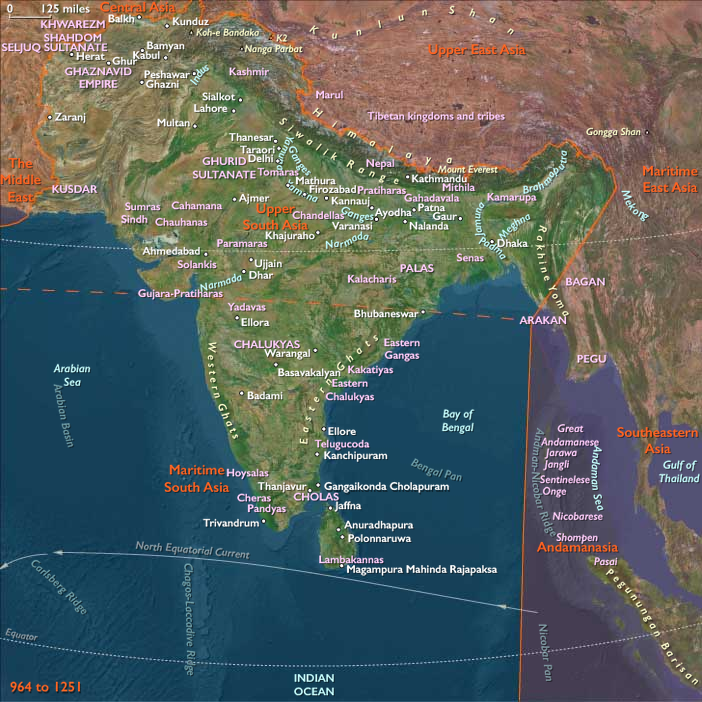
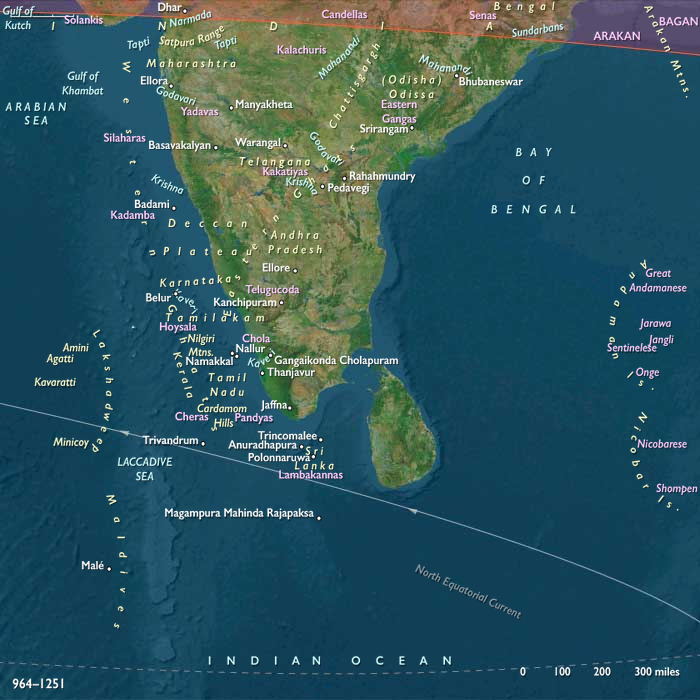
…the Chalukyas begin in 975 to fight …
Years: 975 - 975
…the Chalukyas begin in 975 to fight the Cholas for control over India’s prosperous east coast.
Locations
People
Groups
Topics
Commodoties
Subjects
Regions
Subregions
Related Events
Filter results
Showing 10 events out of 52436 total
The Song army has crisscrossed China, conquering one kingdom after another; the Southern Tang kingdom falls in 975.
Within two decades, the Song state has been able to incorporate the southern kingdoms into its realm, unifying nearly all of traditional Chinese lands.
Southern Tang poet-king Li Yu, reportedly virtuous and skilled in letters, calligraphy, and painting, has passed his idyllic life in his palace in Nanjing (Nanking), reading Buddhist texts, drinking with his officials, and watching dancing girls.
Following his kingdom’s defeat by the Song in 975, he is imprisoned in the Song capital, and begins writing a series of lyrically beautiful poems in the ci style (forty-five of which survive) expressing his deep longing for the life that could no longer be.
It is not known when and how the kingdom of Sweden was born, but the list of Swedish monarchs is drawn from the first kings known to have ruled both Svealand (Sweden) and Götaland (Gothia) as one province, beginning with Eric the Victorious.
Sweden and Gothia were two separate nations long before that into antiquity.
It is not known how long they existed: the epic poem Beowulf describes semi-legendary Swedish-Geatish wars in the sixth century.
"Götaland" in this sense, mainly included the provinces of Östergötland (East Gothia) and Västergötland (West Gothia).
The island of Gotland is disputed by other than Swedes, at this time (Danish, Hanseatic, and Gotland-domestic).
Småland is at this time of little interest to anyone due to the deep pine forests, and only city, Kalmar with its castle, is of importance.
The southwest parts of the Scandinavian peninsula consist of three Danish provinces (Scania, Blekinge and Halland).
North of Halland, Denmark has a direct border to Norway and its province Bohuslän.
There are Swedish settlements in southwest Finland, and along the southern coastline of Norrland.
The culture and history of Svealand has been preserved better than that of Götaland.
The Imperial abbeys and the Imperial court have become the centers of religious and spiritual life, led by the example of women of the royal family.
A limited renaissance of the arts and architecture has depended on court patronage of Otto I and his immediate successors.
The "Ottonian Renaissance" is manifest in some revived cathedral schools, such as that of Bruno I, Archbishop of Cologne, who died in 965, and in the production of illuminated manuscripts, the major art form of the age, from a handful of elite scriptoria, such as that at Quedlinburg Abbey, founded by Otto in 936.
Ottonian illuminators are less concerned with naturalism and more with expression through sober, dramatic gesture and heightened coloration.
The energetic Boleslaus the Cruel, the Czech Przemysl dynasty’s prince of Bohemia from 929 or 935, is notorious for the murder of his brother (Saint) Wenceslas, through which he had become prince of Bohemia.
Boleslaus may never have become a vassal of the German king, but it is known that he led a Czech force in alliance with Otto at the great victory over the Magyars at the Lech river on August 10, 955.
He had also helped Otto to crush an uprising of Slavs on the Lower Elbe in 953.
Seeing the growth of Polish strength to the north of his borders, he had accordingly arranged for his daughter Dubrawka to marry the Piast prince Mieszko I in 965.
Dying two years later, he is succeeded by his son, Boleslaus II, whose reign is most notable for founding of the diocese of Prague in 973, which has been placed within the jurisdiction of the Archbishop of Mainz.
Called ”The Pious”, Boleslaus maintains good relations with the Ottonian German kings, and in 975 supports Otto II during his civil war against Henry II, Duke of Bavaria.
The Magyars have meanwhile established pacific, almost friendly relations with the duchy of Bavaria, which they had earlier in the century constantly ravaged and all but depopulated.
New influences, in particular Christianity, have begun to operate on this coalescent new nation of east-central Europe.
Both the Eastern and Western churches strive to draw them, with the other peoples of the region, into their orbits.
Géza, a great-grandson of Árpád, succeeds to the hereditary leadership in 972 and reestablishes the authority of that office over the tribal chiefs; he is the first to consolidate the Magyar tribes north and west of the Danube.
Géza is the son of Taksony of Hungary, Grand Prince of the Hungarians and his Cuman, Pecheneg, or Bulgur wife.
His marriage with Sarolt, the daughter of Gyula of Transylvania, had been arranged by his father.
After his father's death (before 972), Géza had followed him as Grand Prince of the Magyars.
Shortly afterwards, a Benedictine monk of the Abbey of Sankt Gallen, Bruno, who had been ordained Bishop of the Hungarians, arrived to his court where he baptized Géza. (His father-in-law Gyula, descended from a family whose members held the hereditary title gyula, which was the second in rank among the leaders of the Hungarian tribal federation, had traveled to Constantinople to be baptized; Emperor Constantine VII had lifted him from the baptismal font.)
Although Géza probably never becomes a convinced Christian, during his rule Christianity begins to spread among the Magyars.
According to Thietmar of Merseburg, Géza continued to worship pagan gods; a chronicle claims that when he was questioned about this he stated he is rich enough to sacrifice to both the old gods and the new one.
Taking the decisive step in 973, Géza had sent an embassy to the German emperor Otto II at Quedlinburg (now in Germany), and in 975, Géza and his family are received into the Western church.

Emperor John has meanwhile turned to the East.
The Fatimid caliphate, ruling Egypt, Palestine, and the nearer parts of Arabia from Cairo, has managed to establish a precarious control over Palestine, where they face opposition from the Qarmatians, whose invasions they have repelled in 971 and 974, and the Empire, as well as periodic Bedouin opposition.
They have sued for peace with Constantinople, but John reduces Fatimid strength around Antioch in 974-975, taking this city, as well as …
…Damascus, and others in Syria.
The region of Malwa had in 786 been captured by the Rashtrakuta kings of the Deccan, and has been disputed between the Rashtrakutas and the Pratihara kings of Kannauj until the early part of the tenth century.
From the mid-tenth century, Malwa has been ruled by the Paramara clan of Rajputs, whose chief Vairisimha II had transferred his headquarters from Ujjain to Dhar at the close of the ninth century.
Still ruled by the Paramaras, Malwa achieves complete independence following the collapse of the Rashtrakuta empire in 975.
Malwa and its capital Dhar are to become one of the chief intellectual centers of India.
The Eastern Chalukyas under Tailapa II, having in 973 initiated a military campaign against the Rashtrakutas, based at Ellora (near Hyderabad), reduce them to vassalage after two years of warfare and establish a second western Chalukya dynasty; …
Abdallah, the heir to the Fatimid throne, had died before his father Al-Mu'izz li-Din Allah (953-975); therefore, his brother Abu Mansur Nizar al-Azizbillah accedes to the Caliphate on the death of Al-Muizz with the help of Jawhar as-Siqilli.
The reign of Al-Aziz will be primarily significant for the strengthening of Fatimid power in Egypt and Syria.