
The Chaldean (or Neo-Babylonian, as some historians …
Years: 597BCE - 586BCE
The Chaldean (or Neo-Babylonian, as some historians call it) Empire that has replaced the Assyrian Empire insists, like its predecessor, on control of Judah.
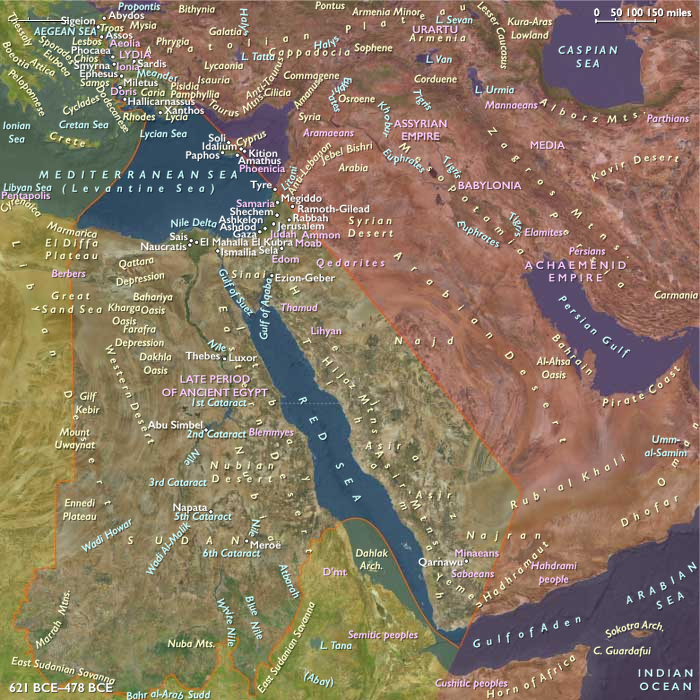
Nebuchadnezzar II, with Syrian and Ammonite allies, attacks Judah and on March 16, 597 BCE captures Jerusalem, deporting the newly installed teenage King Jehoiachin (whose father Jehoiakim had died during the siege) to Babylon, together with ten thousand of his subjects.
Nebuchadnezzar installs Mattaniah, a grandson of Josiah and the uncle of Jehoiachin, as regent under the name Zedekiah.
Nebuchadrezzar's further military activities are known not from extant chronicles but from other sources, particularly the Bible, which records another attack on Jerusalem.
Psamtik II in 591 BCE, during the fourth year of his reign, launches an expedition into Palestine "to foment a general Levantine revolt against the Babylonians" that involves, among others, Zedekiah.
The Egyptian invasion pushes as far as Sidon.
Nebuchadrezzar, thus provoked, invades Judah in 589, the ninth year of Zedekiah's rule.
Zedekiah and the citizens of Jerusalem defy the Assyrians, leading to a siege of the city in 588.
The prophet Jeremiah urges the Jerusalemites to surrender the city to prevent its destruction, but the citizens hold out, hoping for Egyptian relief.
During the siege, the prophet Jeremiah, according to the Bible, urges patient submission to the dominion of the Babylonians, which he regards as the will of God.
The Israelites, he says, do not need a state to carry out the mission given to them by God, but royal officials and Judahite notables denounce him and he is accused of desertion and imprisoned.
Nebuchadrezzar after eighteen months breaches the walls of a starving Jerusalem, then burns the Temple and destroys the city, leveling its walls.
Zedekiah and others flee by night toward Jericho, hoping to regroup, but are captured.
Zedekiah and his leaders are taken before Nebuchadrezzar at Riblah, in Syria, where Zedekiah's sons are slain in his presence and he, a disloyal vassal, is blinded.
Nebuchadnezzar, in standard Near Eastern practice, now deports him, along with the rest of Judah’s royalty, nobility, and skilled artisans, to various Babylonian cities, leaving only the poor, who number about twenty thousand, to inhabit Judah.
The Edomites, long-standing enemies of the Jews, cooperate with Judah’s Babylonian conquerors.
Locations
People
Groups
- Ammonites, Kingdom of the
- Edomites, Kingdom of the
- Hebrews
- Judah, Kingdom of
- Neo-Babylonian, or Chaldean, Empire
- Judahites
- Syrian people
Topics
- Younger Subboreal Period
- Iron Age, Near and Middle East
- Iron Age Cold Epoch
- Classical antiquity
- Babylonian Captivity
Commodoties
Subjects
Regions
Subregions
Years: 597BCE - 586BCE
Locations
People
Groups
- Ammonites, Kingdom of the
- Edomites, Kingdom of the
- Hebrews
- Judah, Kingdom of
- Neo-Babylonian, or Chaldean, Empire
- Judahites
- Syrian people
Topics
- Younger Subboreal Period
- Iron Age, Near and Middle East
- Iron Age Cold Epoch
- Classical antiquity
- Babylonian Captivity
Commodoties
Subjects
Regions
Subregions