The First Bulgarian Empire, East Francia, and …
Years: 892 - 903
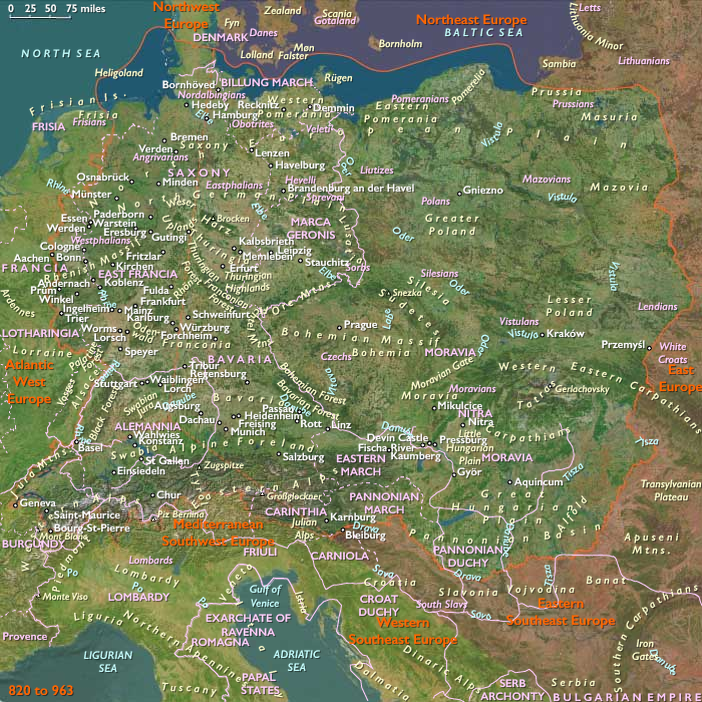
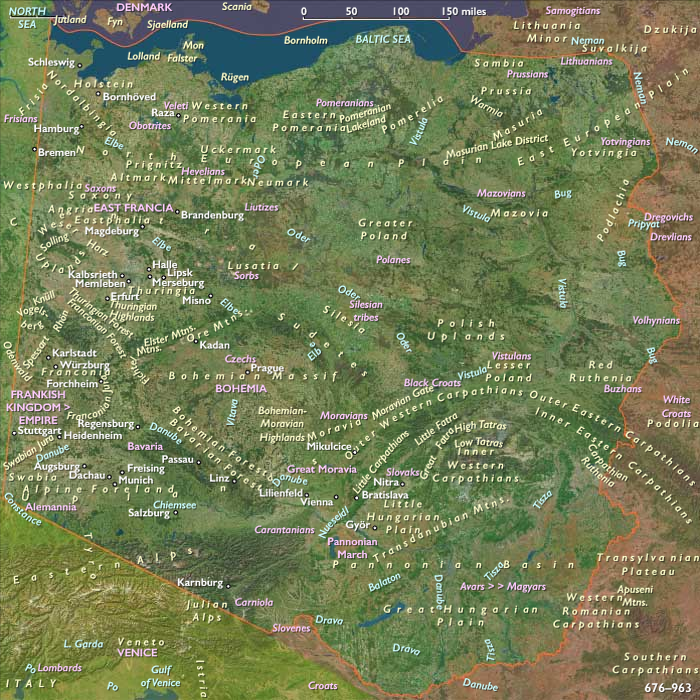
The First Bulgarian Empire, East Francia, and Moravia, which had fought each other for control of the Carpathian Basin, had occasionally hired Hungarian horsemen as soldiers.
The Hungarians who dwelt in the eastern regions of the Pontic steppes were therefore familiar with their future homeland when they started their their "land-taking".
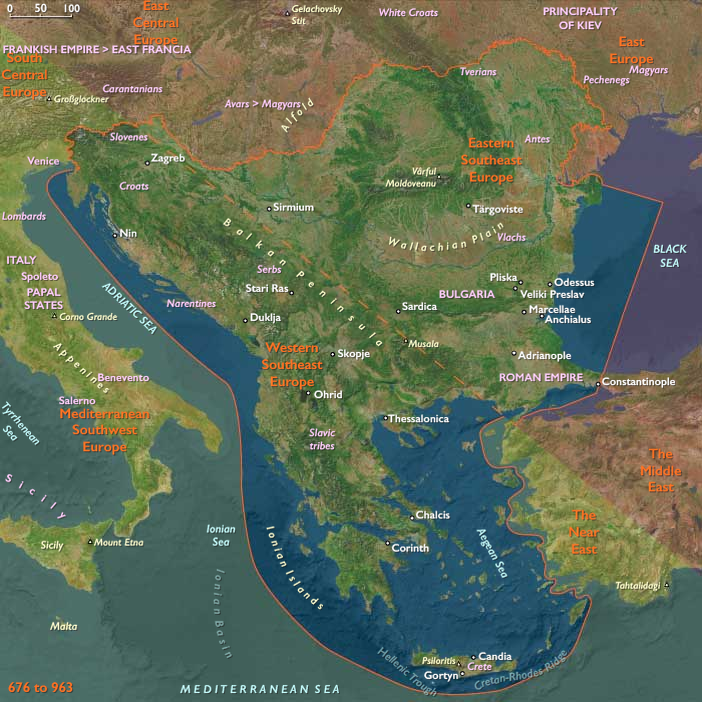
The ethnic configuration of the northern Balkans is altered permanently by invasions of Magyars from the steppe, who settle the Plain of Hungary, named for these fierce tribes of mounted nomads, and gain full control of the Carpathian Basin, including Transylvania.
The Hungarian conquest starts in the context of a "late or 'small' migration of peoples".
Contemporary sources attest that the Hungarians crossed the Carpathian Mountains following a joint attack in 894 or 895 by the Pechenegs and Bulgarians against them.
They first take control over the lowlands east of the River Danube and attack and in 900 occupy Pannonia (the region to the west of the river).
Exploiting internal conflicts in Moravia sometime between 902 and 906, the Hungarians annihilate this state.
Groups
- Hungarian people
- Bulgarian Empire (First)
- Hungarians, Realm of the (Etelköz)
- Moravia, Great, Kingdom of
- Francia Orientalis (East Francia), Kingdom of
- Bulgarian Empire (First)
Topics
Commodoties
Subjects
Regions
Subregions
Related Events
Filter results
Showing 8 events out of 8 total
John II’s Ruthless Purge of the Nobility: The Fall of the House of Braganza (1483–1484)
After securing his throne in 1481, King John II of Portugal launched a systematic campaign to weaken the nobility, targeting the two most powerful noble houses:
- The House of Braganza (Fernando II, Duke of Braganza)
- The House of Viseu and Beja (Diogo, Duke of Viseu and Beja)
These houses had become too powerful under Afonso V, and John II, determined to establish absolute royal authority, moved against them ruthlessly and decisively.
The Execution of Fernando II, Duke of Braganza (1483)
- Fernando II of Braganza (b. 1430) had been a loyal supporter of Afonso V, participating in the Moroccan campaigns and the War of the Castilian Succession (1475–1479).
- After Afonso V’s failed attempt to claim Castile, John II came to power and saw Braganza as a direct threatdue to his vast landholdings and Castilian connections.
- The Duke of Braganza was accused of high treason, with John II presenting forged letters as evidence that Braganza was conspiring with Isabella I of Castile.
- In 1483, John II had Fernando II executed in Évora, marking the beginning of his brutal crackdown on the nobility.
Confiscation of Braganza Estates and the Family’s Exile
- After the execution of Fernando II, John II confiscated all Braganza estates, stripping the family of its wealth and power.
- The remaining members of the House of Braganza fled to Castile, seeking refuge under Queen Isabella and King Ferdinand.
- This was a major victory for John II, as he had successfully neutralized the most powerful noble house in Portugal.
The Execution of Diogo, Duke of Viseu (1484)
- Not satisfied with eliminating one major noble house, John II turned against Diogo, Duke of Viseu, the leader of the House of Viseu and Beja.
- In 1484, John II personally stabbed and killed Diogo in the palace, further demonstrating his absolute authority.
- He then confiscated Diogo’s vast estates, ensuring that no noble family could rival the Crown.
Consequences of John II’s Actions
-
End of Noble Resistance
- With Braganza exiled and Viseu eliminated, John II destroyed Portugal’s feudal aristocracy, making the monarchy unquestionably supreme.
-
Royal Wealth and Power
- The confiscated Braganza and Viseu estates provided massive financial resources for the Crown.
-
Focus on Maritime Expansion
- With internal threats crushed, John II invested in Portuguese exploration, leading to:
- Bartolomeu Dias rounding the Cape of Good Hope (1488).
- Vasco da Gama reaching India (1498, under Manuel I).
- With internal threats crushed, John II invested in Portuguese exploration, leading to:
-
The Braganza Family’s Future Rise
- The Braganzas remained in exile until 1498, when King Manuel I pardoned them.
- In 1640, the House of Braganza overthrew Spanish rule, and Duke João IV of Braganza became King of Portugal, establishing the Braganza dynasty (1640–1910).
John II: The Perfect Prince and Absolute Monarch
By eliminating the feudal power of the nobility, John II secured absolute royal control, shaping Portugal into a centralized and efficient monarchy, paving the way for its Golden Age of Exploration and Empire.
King John II’s Campaign Against the Nobility: The Fall of the Dukes of Braganza and Viseu
Upon his succession in 1477 and full assumption of power in 1481, King John II of Portugal launched a determined effort to weaken the Portuguese nobility, particularly the two most powerful noble houses:
- House of Braganza (Fernando II, Duke of Braganza)
- House of Beja and Viseu (Diogo, Duke of Viseu and Beja)
These houses had amassed immense wealth and influence under Afonso V’s reign, leading John II to view them as threats to the Crown’s authority.
The Downfall of Fernando II, Duke of Braganza (1483)
- Fernando II of Braganza (b. 1430) had been a loyal companion to Afonso V, participating in the Moroccan campaigns and the War of the Castilian Succession (1475–1479).
- After the Portuguese defeat in the Castilian War, Fernando maintained correspondence with Isabella I of Castile, which John II saw as treasonous.
- In 1483, John II arrested and charged Fernando with treason, using forged letters as evidence.
- Fernando II was executed in Évora, and his vast lands and estates were confiscated, destroying the power of the House of Braganza for the next century.
The Assassination of Diogo, Duke of Viseu and Beja (1484)
- Diogo, Duke of Viseu and Beja, had inherited great power in 1472 and became a popular court figure.
- Unlike Fernando II, Diogo believed he was safe due to his sister Eleanor’s marriage to King John II (since 1470).
- However, he was suspected of conspiring against the king, particularly after two assassination attempts on John II’s life.
- In 1484, John II accused Diogo of high treason.
- The king personally stabbed and killed Diogo himself, sending a powerful message to the nobility.
The Rise of Manuel I, Duke of Beja and Viseu (1484)
- After Diogo’s execution, John II summoned his younger brother, Infante Manuel of Viseu.
- Showing him Diogo’s body, the king declared he would treat Manuel as his own son.
- Manuel inherited his brother’s titles and estates, becoming Duke of Beja and Viseu, but he remained loyal to John II, avoiding his brother’s fate.
Consequences of John II’s Purge of the Nobility
- Complete Suppression of the Aristocracy – The executions of Fernando II of Braganza (1483) and Diogo of Viseu (1484) ensured that no noble family could challenge the Crown’s power.
- Royal Centralization – John II seized vast noble estates, making the monarchy the wealthiest power in Portugal.
- Military and Economic Strengthening – With noble resistance crushed, John II refocused resources on maritime expansion, leading to Bartolomeu Dias’s voyage around the Cape of Good Hope (1488).
- The Future Rise of Manuel I – Though spared by John II, Infante Manuel would later become King of Portugal (1495–1521), beginning the Portuguese Golden Age.
John II: The Perfect Prince and Absolute Monarch
By crushing the nobility, John II transformed Portugal into a centralized state, where the king ruled without aristocratic interference. His reign paved the way for Portugal’s dominance in global exploration, ensuring that the Crown, and not the nobility, controlled the vast wealth of the Portuguese Empire.
Manuel I of Portugal: "The Fortunate" and His Unexpected Rise to the Throne
Manuel I of Portugal (r. 1495–1521), later known as "the Fortunate" (O Venturoso), was never expected to become king. However, due to political purges, the untimely deaths of key heirs, and the favor of King John II, Manuel unexpectedly became the heir to the Portuguese throne in 1493.
Royal Lineage and Family Background
- Manuel’s mother, Beatriz of Portugal, was the granddaughter of King John I, giving him strong royal connections.
- His father, Infante Fernando, Duke of Beja, was the second surviving son of King Edward and the younger brother of King Afonso V.
- This made Manuel a nephew of King Afonso V and a cousin of King John II.
Growing Up Amidst Conspiracies and Noble Purges
- Manuel came of age during King John II’s ruthless crackdown on the nobility (1483–1484).
- His older brother, Diogo, Duke of Viseu, was personally stabbed to death by John II in 1484, accused of leading a noble conspiracy against the Crown.
- Many other nobles were executed, exiled, or had their lands confiscated, leaving Manuel to witness the dangerous political environment of his time.
A Shocking Royal Summons (1493)
- Given his family history, Manuel had every reason to fear for his life when he was summoned by King John II in 1493.
- However, instead of punishment, he received extraordinary news—John II wanted to name him heir to the throne.
Why Was Manuel Chosen as Heir?
-
Death of Prince Afonso (1491)
- John II’s only legitimate son, Prince Afonso, died in a horse-riding accident in 1491, leaving the king without a direct heir.
-
Failed Attempts to Legitimize Jorge, Duke of Coimbra
- John II attempted to legitimize his illegitimate son, Jorge, Duke of Coimbra, as heir.
- However, this move faced opposition from the nobility and Queen Leonor (Manuel’s sister).
-
Manuel’s Political Neutrality
- Unlike other nobles, Manuel had never conspired against the king.
- His lack of political ambition and royal bloodline made him a safe choice.
Manuel I: "The Fortunate"
- Manuel’s unexpected rise to power earned him the nickname "O Venturoso" (The Fortunate).
- In 1495, John II died, and Manuel I became King of Portugal, ushering in Portugal’s Golden Age of Exploration.
Legacy and Impact
- Under Manuel I, Portugal expanded its global empire, with Vasco da Gama reaching India (1498) and Pedro Álvares Cabral discovering Brazil (1500).
- He continued centralizing royal authority while maintaining noble support, ensuring a stable reign.
- His selection as heir marked the final success of John II’s effort to weaken the aristocracy, as Manuel owed his throne to the king’s favor rather than noble alliances.
Thus, Manuel’s extraordinary luck in 1493 transformed his fate, making him one of Portugal’s most consequential monarchs.
Columbus’s Arrival in Lisbon (March 4, 1493) and His Encounter with the Portuguese Court
After completing his first transatlantic voyage (1492–1493), Christopher Columbus set sail for Spain aboard the Niña. However, after stopping in the Azores, a violent storm forced him to take refuge in Lisbon on March 4, 1493. His unplanned arrival in Portugal, a kingdom deeply invested in overseas exploration, led to significant diplomatic interactions.
Columbus’s Arrival in Lisbon
- Upon reaching Lisbon, Columbus anchored next to the King’s harbor patrol ship, drawing immediate attention.
- The Portuguese were well aware of Columbus’s ambitions, and his arrival was treated with great curiosity.
- Columbus was soon interviewed by Bartolomeu Dias, the Portuguese explorer who had rounded the Cape of Good Hope in 1488, proving that India could be reached by sailing east.
Diplomatic Encounters: Columbus and the Portuguese Court
- Columbus spent over a week in Portugal, where he:
- Paid his respects to Queen Eleanor of Viseu, wife of King John II of Portugal.
- Likely met high-ranking Portuguese officials, including navigators and royal advisors.
- King John II summoned Columbus to court to discuss his discoveries.
- Portugal had previously rejected Columbus’s westward route proposal in 1484, favoring its own exploration around Africa.
- Now that Spain had backed him, Columbus’s discoveries posed a direct challenge to Portugal’s claimsunder the Treaty of Alcáçovas (1479), which had given Portugal control over Atlantic exploration.
A Young Ferdinand Magellan Observes Columbus
- During Columbus’s stay in Lisbon, a young Ferdinand Magellan (born c. 1480) was a ward of Queen Eleanor’s court.
- It is likely that Magellan saw Columbus during this visit, sparking his lifelong interest in navigation and exploration.
- Magellan would later become the first explorer to lead a circumnavigation of the Earth (1519–1522), proving that Columbus’s westward route ultimately led to the Pacific and Asia.
Columbus Departs for Spain
- After his time in Lisbon, Columbus set sail for Spain, eager to report his findings to Ferdinand and Isabella.
- His encounter with the Portuguese court heightened tensions, eventually leading to the Treaty of Tordesillas (1494), which formally divided the newly discovered lands between Spain and Portugal.
Significance of Columbus’s Stop in Lisbon
- Portuguese Interest in the New World – Portugal, realizing Spain’s discoveries threatened its monopoly on exploration, quickly negotiated the Treaty of Tordesillas.
- The Future of Magellan – Columbus’s visit may have inspired the young Magellan, influencing his later circumnavigation voyage under Spain’s flag.
- A Shift in Global Power – Portugal’s dominance in the east and Spain’s newly claimed lands in the west set the stage for global competition in the Age of Exploration.
Columbus’s unexpected arrival in Portugal in 1493 was a pivotal moment, as it alerted the Portuguese monarchy to Spain’s growing ambitions and influenced the territorial agreements that shaped the modern world.
Columbus, after departing Lisbon, and after reportedly being saved from assassins by John II of Portugal, crosses the bar of Saltes and enters the harbor of Palos on March 15, 1493.
The disobedient Pinzon may have hoped to reach home ahead of Columbus, thereby winning royal favor, but Columbus had arrived in Palos a few hours before the Pinta.
Word of his finding new lands rapidly spreads throughout Europe.
From Palos, Columbus crosses Spain to Barcelona, where the monarchs Isabella and Ferdinand welcome him.
Claiming to have reached islands just off the coast of Asia, Columbus has brought with him Arawaks, artifacts, and some gold.
The royal couple agrees to back a second expedition.
Although Columbus had been sponsored by the Castilian queen, treasury accounts show no royal payments to him until 1493, after his first voyage is complete.
Spain now enters a Golden Age of exploration and colonization, the period of the Spanish Empire.
Isabella of Aragon: The Tragic Spanish Princess and Queen of Portugal
Isabella of Aragon (1470–1498), the eldest child of Ferdinand II of Aragon and Isabella I of Castile, lived a life shaped by political alliances, war, religious devotion, and personal tragedy. Despite being born into one of Europe’s most powerful royal families, her fate was marked by loss, heartbreak, and sacrifice.
Early Life and Political Significance
- Born during the reign of Henry IV of Castile, her early years were dominated by the tensions between her mother and uncle, as Henry resented Isabella I’s marriage to Ferdinand of Aragon without his consent.
- When Henry IV died in 1474, Isabella I claimed the throne of Castile, and young Isabella was immediately recognized as heiress.
- During the War of the Castilian Succession (1475–1479) between her mother and Joanna la Beltraneja, Isabella experienced firsthand the chaos of civil war:
- She was left in Segovia, under the guardianship of Andrés de Cabrera and Beatriz de Bobadilla.
- The city rebelled against her protectors, and seven-year-old Isabella was trapped in a tower until her mother restored order.
First Engagement and Time in Portugal (1479–1484)
- The Treaty of Alcáçovas (1479) ended the war and arranged Isabella’s marriage to Afonso, grandson of Afonso V of Portugal.
- In 1481, at age 10, she moved to Moura, Portugal, to be raised alongside her future husband.
- After three years, she returned to Castile, but her time in Portugal gave her fluency in the language and an understanding of its culture, which later endeared her to the Portuguese court.
A Princess on Campaign: The Granada War (1484–1492)
- Isabella accompanied her parents on their military campaigns during the final phase of the Reconquista.
- She was present when her mother accepted the surrender of Baza in 1489, witnessing firsthand the unification of Spain under Christian rule.
- The conquest of Granada (1492) marked her parents’ greatest triumph, securing Castile and Aragon as dominant powers in Iberia.
First Marriage: Queen of Portugal (1490–1491)
- Isabella married Prince Afonso of Portugal, son and heir of King John II, in 1490.
- The proxy wedding took place in Seville, and she joined the Portuguese court in November 1490, where she was warmly received.
- Unlike many arranged royal marriages, the couple quickly fell in love, and Isabella was genuinely happy in Portugal.
- In July 1491, tragedy struck when Afonso died in a riding accident, leaving Isabella devastated.
- She returned to Spain, mourning intensely, engaging in self-imposed starvation and physical penance for the rest of her life.
- She swore never to remarry, dedicating herself to religion and grief.
Second Marriage: Queen of Portugal Once Again (1497)
- In 1495, King John II of Portugal died, and his successor, Manuel I, immediately sought Isabella’s hand.
- Her parents offered her younger sister Maria, but Manuel insisted on marrying Isabella.
- After much hesitation, Isabella agreed—but only on the condition that Manuel expel all unconverted Jews from Portugal.
- Manuel accepted this demand, issuing the Edict of Expulsion in 1496, leading to mass forced conversions and the eventual Portuguese Inquisition.
- Isabella married Manuel I of Portugal in September 1497, once again becoming Queen of Portugal.
Tragic Death and Legacy (1498)
- In 1498, Isabella became pregnant with her first child.
- She gave birth to Miguel da Paz, heir to Portugal, Castile, and Aragon, in August 1498, but suffered complications during childbirth.
- She died shortly after, leaving Manuel a widower and her parents grief-stricken.
- Her infant son Miguel was declared heir to the Spanish and Portuguese crowns, but he died at age two in 1500, ending hopes of a unified Iberian kingdom.
Conclusion: A Life of Duty and Sacrifice
- Isabella’s life was shaped by political alliances, serving as a pawn in Spain’s dynastic ambitions.
- She was a devoted daughter, a loyal queen, and a deeply religious woman, but her life was filled with sorrow and loss.
- Her early death at age 27 cut short her potential to be a great queen of both Spain and Portugal.
Despite her tragic fate, Isabella of Aragon remains an important historical figure, symbolizing dynastic ambition, devotion, and the human cost of royal politics in the late 15th century.
Gil Vicente: The Father of Portuguese and Spanish Drama
Gil Vicente (c. 1465–1536/37) is regarded as the founder of Portuguese theater and a key figure in the early Spanish Golden Age of drama. His literary career began with courtly performances, but he later developed a sharp satirical voice, critiquing the clergy, nobility, and social customs of his time.
Education and Early Career
- It is assumed that Vicente studied at the University of Salamanca, initially focusing on law before abandoning it for literature.
- His first known work, O Monólogo do Vaqueiro ("Monologue of the Cowherd"), was written in Spanish and performed in the royal court of Portugal.
Courtly Beginnings: O Monólogo do Vaqueiro (1502)
- Commissioned to celebrate the birth of Prince John (later John III of Portugal), Vicente performed his first known play on June 8, 1502 before:
- King Manuel I and Queen Maria of Aragon.
- Eleanor of Viseu, widow of King John II.
- Beatriz of Portugal, Manuel I’s mother.
- The play was inspired by the Adoration of the Shepherds, featuring simple, rustic gifts offered to the newborn prince.
- The queen, Eleanor of Viseu, was so impressed that she requested an encore performance for Christmas.
- Instead of repeating his work, Vicente wrote a new play, Auto Pastoril Castelhano ("Castilian Pastoral Act"), marking his commitment to playwriting.
Rise as a Playwright and Court Entertainer
- Over the years, Queen Eleanor became Vicente’s greatest patron, influencing him to develop his talent further.
- He became the official playwright and event organizer of the Portuguese court, directing major royal festivities, including:
- The 1520 commemoration honoring Eleanor of Spain, the third wife of Manuel I.
The Satirist of Portuguese Society
- In 1521, with the death of Manuel I, Vicente began serving John III of Portugal.
- His elevated court status allowed him to satirize the clergy and nobility freely, making him one of Portugal’s first great social critics.
- His sharp wit is best displayed in his comedy Farsa de Inês Pereira (1523), which:
- Mocked women’s roles in marriage.
- Criticized corruption and hypocrisy among the elite.
Legacy: The Founder of Iberian Theater
- Vicente’s blend of Portuguese and Spanish influences made him a pioneer in both literary traditions.
- He is considered the bridge between medieval religious theater and Renaissance humanist drama.
- His works laid the foundation for later Spanish and Portuguese drama, influencing Lope de Vega, Cervantes, and Camões.
Conclusion: The Evolution from Court Performer to Social Critic
Gil Vicente’s career began in royal celebrations but evolved into sharp satire, making him one of the most important dramatists of the early Iberian Renaissance. His ability to both entertain and critique society secured his place as the father of Portuguese theater and a leading figure of Spanish drama.
Years: 892 - 903
Groups
- Hungarian people
- Bulgarian Empire (First)
- Hungarians, Realm of the (Etelköz)
- Moravia, Great, Kingdom of
- Francia Orientalis (East Francia), Kingdom of
- Bulgarian Empire (First)