
The center of art patronage has shifted …
Years: 1493 - 1493
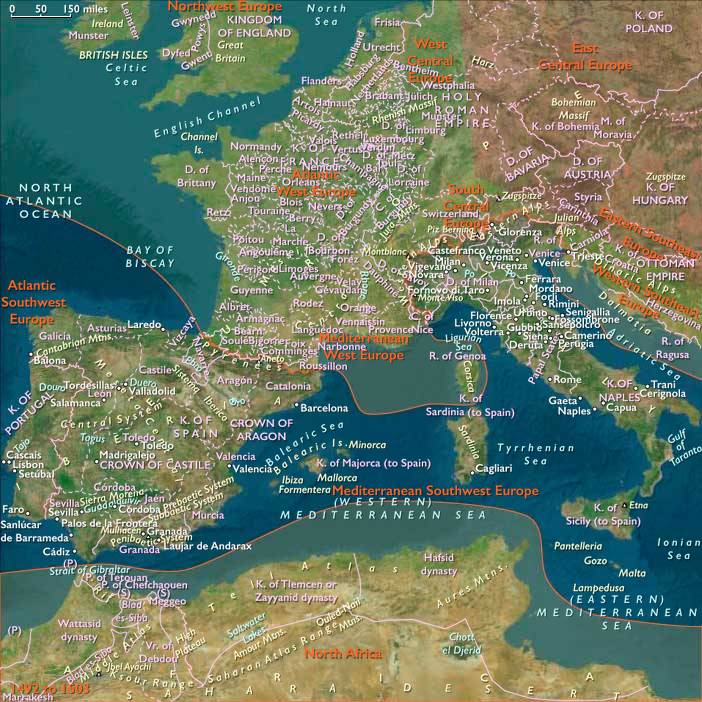
The center of art patronage has shifted from Florence to Rome following the death in 1492 of Medici dynast Lorenzo the Magnificent.
Cesare Borgia, an illegitimate son of Rodrigo de Borgia, the recently elected Pope Alexander VI, is in 1493 created a cardinal at eighteen by his father.
The same year, twenty-five-year-old Alessandro Farnese, a worldly member of the influential Farnese family who has received a thorough education in Rome and Florence, is created a cardinal-deacon.
The new pope, upon receiving the news of Columbus’s landing in the New World, is asked by the Spanish monarchy to confirm their ownership of these newly found lands.
The bulls issued by Pope Alexander VI: Eximiae devotionis (May 3, 1493), Inter Caetera (May 4, 1493) and Dudum Siquidem (September 23, 1493), grant rights to Spain with respect to the newly discovered lands in the Americas similar to those Pope Nicholas V had previously conferred with the bulls Romanus Pontifex and Dum Diversas.
While the enterprising explorers of Spain and Portugal are quick to enslave the indigenous peoples they meet in Africa and the New World, some popes spoke out against the practice.
Pope Eugene IV in 1435 had issued an attack on slavery in his papal bull Sicut Dudum, which included the excommunication of all those who engaged in the slave trade.
A form of indentured servitude is allowed, being similar to a peasant's duty to his liege lord in Europe.
Locations
People
- Cesare Borgia
- Christopher Columbus
- Ferdinand II of Aragon
- Isabella I of Castile
- Pope Alexander VI
- Pope Paul III
Groups
- Papal States (Republic of St. Peter)
- Christians, Roman Catholic
- Aragón, Kingdom of
- Aragon, Crown of
- Castile, Crown of
Topics
- Age of Discovery
- Renaissance Papacy
- Colonization of the Americas, Portuguese
- Colonization of the Americas, Spanish
Commodoties
Subjects
Regions
Subregions
Years: 1493 - 1493
Locations
People
- Cesare Borgia
- Christopher Columbus
- Ferdinand II of Aragon
- Isabella I of Castile
- Pope Alexander VI
- Pope Paul III
Groups
- Papal States (Republic of St. Peter)
- Christians, Roman Catholic
- Aragón, Kingdom of
- Aragon, Crown of
- Castile, Crown of
Topics
- Age of Discovery
- Renaissance Papacy
- Colonization of the Americas, Portuguese
- Colonization of the Americas, Spanish
Commodoties
Subjects
Regions
Subregions