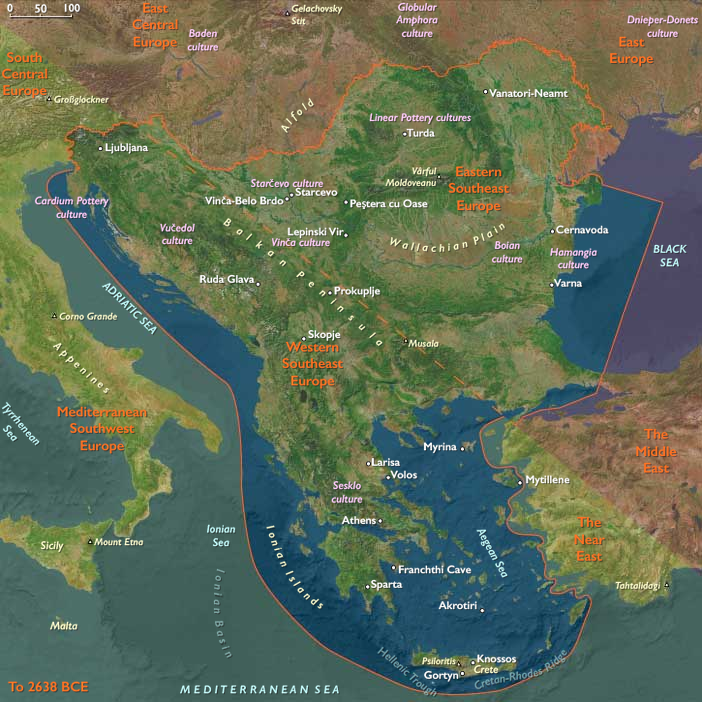
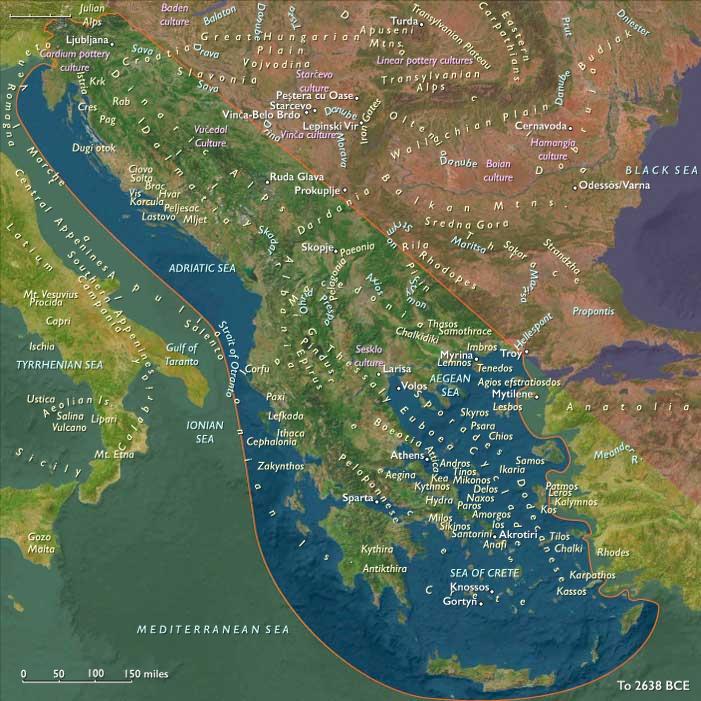
The cave of Šandalja near Pula/Pola bears …
Years: 1000000BCE - 1000000BCE
The cave of Šandalja near Pula/Pola bears evidence of the presence of Homo erectus from about one million years BP, the earliest traces of human life in this part of Europe.
Locations
Groups
Topics
Regions
Subregions
Related Events
Filter results
Showing 10 events out of 69774 total
Genetic studies suggest that the functional DNA of modern humans and Homo neanderthalensis diverged five hundred thousand years before the present time.
Similarly, the few specimens of Homo rhodesiensis have also occasionally been classified as a subspecies, but this is not widely accepted.
The analysis indicated that modern humans, Neanderthals, and the Denisova hominin last shared a common ancestor around one million years ago and that this new hominin species was the result of an early migration out of Africa, distinct from the later out-of-Africa migrations associated with Neanderthals and modern humans, but also distinct from the earlier African exodus of Homo erectus.
The estimated time of divergence between Denisovans and Neanderthals is six hundred and forty thousand years ago.
That between both these groups and modern Africans is eight hundred and four thousand years ago.
The divergence of the Denisova mtDNA may result either from the persistence of a lineage purged from the other branches of humanity through genetic drift or else an introgression from an older hominin lineage.
The so-called Peking Man, discovered in 1923-27 at Zhoukoudian, near Beijing, is perhaps the most famous specimen of Homo erectus found in China.
More recently, the finds have been dated from roughly five hundred thousand years ago, although a new 26Al/10Be dating suggests the remains may be as much as six hundred and eighty thousand to seven hundred and eighty thousand years old.
A huge length of time, it sees many changes in the environment, encompassing several glacial and interglacial periods that greatly affect human settlement in the region.
Providing dating for this distant period is difficult and contentious.
The inhabitants of the region at this time are bands of hunter-gatherers who roam northern Europe following herds of animals, or who support themselves by fishing.
Recent (2006) scientific evidence regarding mitochondrial DNA sequences from ancient and modern Europe has shown a distinct pattern for the different time periods sampled in the course of the study.
Despite some limitations regarding sample sizes, the results were found to be non-random.
As such, the results indicate that, in addition to populations in Europe expanding from southern refugia after the last glacial maximum (especially the Franco-Cantabrian region), evidence also exists for various northern refugia.
Southern and eastern Britain at this time are linked to continental Europe by a wide land bridge allowing humans to move freely.
The current position of the English Channel is a large river flowing westwards and fed by tributaries that will later become the Thames and Seine.
Reconstructing this ancient environment has provided clues to the route first visitors took to arrive at what was then a peninsula of the Eurasian continent.
There is evidence from bones and flint tools found in coastal deposits near Happisburgh in Norfolk and Pakefield in Suffolk that a species of Homo was present in what is now Britain around seven hundred thousand years ago.

The Palaeolithic (Old Stone Age) sees many changes in the environment, encompassing several glacial and interglacial periods that greatly affect human settlement.
In addition to populations in Europe expanding from southern refugia (especially the Franco-Cantabrian region) after the last glacial maximum, evidence also exists for various northern refugia.
Southern and eastern Britain are linked to continental Europe at this time by a wide land bridge allowing bands of hunter-gatherers to move freely, following herds of animals, or supporting themselves by fishing.
The current position of the English Channel is a large river flowing westwards and fed by tributaries that will later become the Thames and Seine.
Cranial capacity has again doubled within the Homo genus from H. habilis to an archaic Homo species called Homo heidelbergensis by six hundred thousand years ago.
The cranial capacity of H. heidelbergensis overlaps with the range found in modern humans.
Sites such as Boxgrove in Sussex illustrate the later arrival in the archaeological record of H. heidelbergensis around five hundred thousand years years ago.
Homo heidelbergensis is the second human wave to be pumped from Africa into the Middle East and Western Europe.
These early peoples make Acheulean flint tools (hand axes) and hunt the large native mammals of the period.
They are thought to have driven elephants, rhinoceroses, and hippopotamuses over the tops of cliffs or into bogs to kill them more easily.
These kill sites, often at waterholes where animals would gather to drink, were interpreted up until the 1970s as being where Acheulean tool users killed game, butchered their carcasses, and then discarded the tools they had used.
Since the advent of zooarchaeology, which has placed greater emphasis on studying animal bones from archaeological sites, this view has changed.
Many of the animals at these kill sites have been found to have been killed by other predator animals, so it is likely that humans of the period supplemented hunting with scavenging from already dead animals.
The extreme cold of the Anglian Stage, from four hundred and seventy-eight thousand to four hundred and twenty-four thousand years ago, is likely to have driven humans out of Britain altogether and the region does not appear to have been occupied again until the ice receded during the Hoxnian Stage.
Homo ergaster (or erectus) makes large stone hand-axes out of flint and quartzite, at first quite rough and later "retouched" by additional, more subtle strikes at the sides of the flakes during the period known as the Acheulean, from seven hundred thousand to three hundred thousand years before the present.
Paleolithic sites in Potohar near Pakistan's capital Islamabad, will yield the stone tools of the Soan Culture, an archaeological culture of the Lower Paleolithic (from around 1,800,000 to about 300,000 BP) in Pakistan, contemporary to the Acheulean.
It is named after the Soan River Valley in the Sivalik Hills, Pakistan.
The bearers of this culture are thought to be Homo erectus.
Hundreds of edged pebble tools will be discovered in Adiyala and Khasala, about sixteen kilometers (ten miles) from Rawalpindi terrace on the bend of the river.
Hand axes and cleavers will be found at Chauntra.
No human skeletons of this age have yet been found.
The fossil was discovered by archeologist Italo Biddittu and was nicknamed "Ceprano Man" after a nearby town in the province of Frosinone, eighty-nine kilometers southeast of Rome, Italy.
The age of the fossil is estimated to be between three hundred and fifty thousand to five hundred thousand years old.
An adjacent site, Fontana Ranuccio, was dated to 487,000 +/- 6000 years and Muttoni, et al., suggest that Ceprano is most likely four hundred and fifty thousand years old.
The cranial features on the bone seem to be intermediate between those found on Homo erectus and those of later species such as Homo heidelbergensis, which dominated Europe long before Homo neanderthalensis.
There is yet not enough material to make a complete analysis of the individual.
Cranial capacity had again doubled within the Homo genus by six hundred thousand years ago, from H. habilis to an archaic Homo species called Homo heidelbergensis, the second human wave to be pumped from Africa into the Middle East and Western Europe.
Sites such as Boxgrove in Sussex illustrate the later arrival in the archaeological record of heidelbergensis around five hundred thousand years ago.
The cranial capacity of H. heidelbergensis overlaps with the range found in modern humans; these early peoples make Acheulean flint tools (hand axes) and hunt the large native mammals of the period.
They are thought to have driven elephants, rhinoceroses, and hippopotamuses over the tops of cliffs or into bogs to kill them more easily.
Up until the 1970s, these kill sites, often at waterholes where animals would gather to drink, were interpreted as being where Acheulean tool users killed game, butchered their carcasses, and then discarded the tools they had used.
Since the advent of zooarchaeology, which has placed greater emphasis on studying animal bones from archaeological sites, this view has changed.
Many of the animals at these kill sites have been found to have been killed by other predator animals, so it is likely that humans of the period supplemented hunting with scavenging from already dead animals.
The extreme cold of the Anglian Stage, from four hundred and seventy-eight thousand to four hundred and twenty-four thousand years ago, is likely to have driven humans out of Britain altogether and the region will apparently be unoccupied until the ice recedes during the Hoxnian Stage.
The Middle Pleistocene, which began approximately seven hundred and eighty-one thousand thousand years ago, to the Late Pleistocene around one hundred and twenty-six thousand years ago.
The change to a cooler, dry, seasonal climate has considerable impacts on Pliocene vegetation, reducing tropical species worldwide.
Deciduous forests proliferate, coniferous forests and tundra cover much of the north, and grasslands spread on all continents (except Antarctica).
Tropical forests are limited to a tight band around the equator, and in addition to dry savannas, deserts appear in Asia and Africa.