
The causes of the Polish-Ottoman War of …
Years: 1672 - 1672
August
The causes of the Polish-Ottoman War of 1672 to 1767 can be traced to 1666, when Petro Doroshenko, Hetman of Right-bank Ukraine, had aimed to gain control of Ukraine but suffered defeats from other factions struggling over control of that region.
Hetman Doroshenko, in final bid to preserve his power in Ukraine, had signed a treaty with Sultan Mehmed IV that recognized the Cossack Hetmanate as a vassal of the Ottoman Empire.
Commonwealth forces had in the meantime been trying to put down unrest in Ukraine, but had been weakened by decades-long wars (the Khmelnytsky Uprising, The Deluge, and the Russo-Polish War of 1654–1667).
Trying to capitalize on that weakness, Tatars, who commonly raid across the Commonwealth borders in search of loot and plunder, had invaded, this time allying themselves with Cossacks under Doroshenko.
They had been stopped, however, by Commonwealth forces under hetman Jan Sobieski, who halted their first push (1666–67), defeating them several times, and finally gaining an armistice after the battle of Podhajce.
Hetman Doroshenko had in 1670, however, tried once again to take over Ukraine, and in 1671 the Khan of Crimea, Adil Giray, supportive of the Commonwealth, had been replaced with a new khan, Selim I Giray, by the Ottoman sultan.
Selim has entered into an alliance with the Doroshenko's Cossacks; but again, as in 1666–67, the Cossack-Tatar forces had been dealt defeats by Sobieski.
Selim now renews his oath of allegiance to the Ottoman Sultan and pleads for assistance, to which the Sultan agrees.
Thus an irregular border conflict escalates into a regular war, as the Ottoman Empire is now prepared to send its regular units onto the battlefield in a bid to try to gain control of this region for itself.
Ottoman forces, numbering eighty thousand men and led by Grand Vizier Köprülü Fazıl Ahmed and Ottoman sultan Mehmed IV, invade the province of Podolia in August, take the Commonwealth fortress at Kamianets-Podilskyi and ...
Locations
People
Groups
- Crimean Khanate
- Ottoman Empire
- Cossacks, Zaporozhian
- Polish-Lithuanian Commonwealth (Commonwealth of the Two Nations)
- France, (Bourbon) Kingdom of
- Habsburg Monarchy, or Empire
Topics
Commodoties
Subjects
Regions
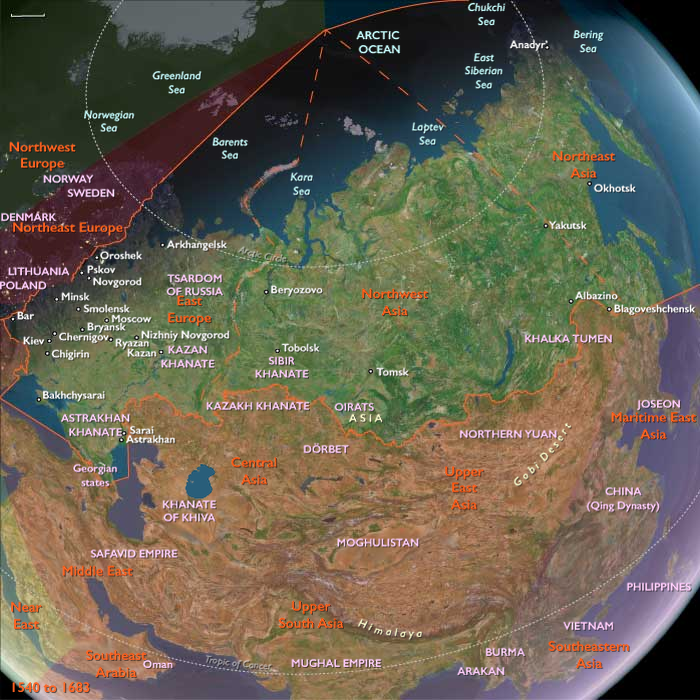
Subregions
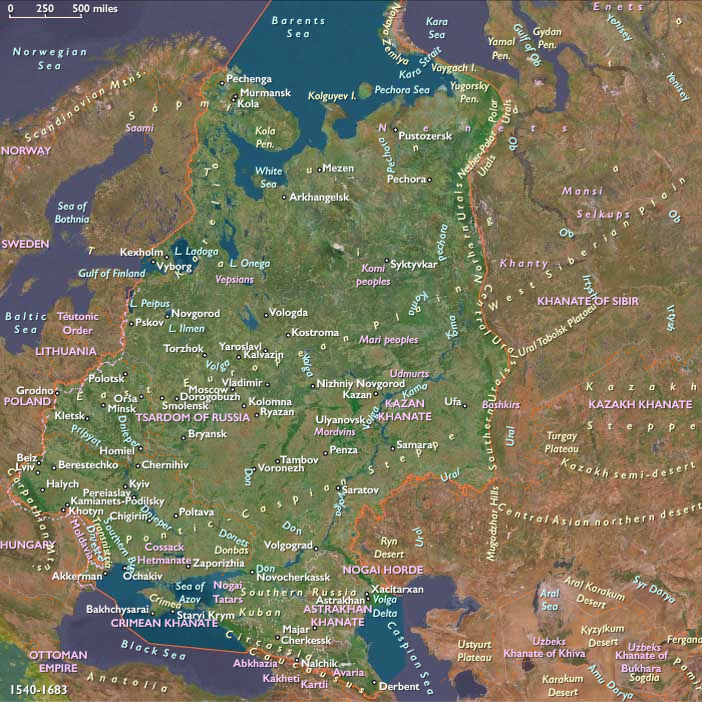
Related Events
Filter results
Showing 10 events out of 30765 total
Eastern West Indies (1672–1683 CE): Sugar Economies, Consolidation, and Demographic Transformation
Expansion of the Sugar Economy
Between 1672 and 1683, the Eastern West Indies solidified their position as a crucial component of Europe's burgeoning sugar-based economy. Sugar, increasingly popular in Europe, became a prime commodity due to its favorable balance between bulk and value—an essential consideration given the era's limitations in shipping technology and the high costs of transoceanic transport. This transformation dramatically reshaped landholding patterns and economic dynamics across the region.
Concentration of Wealth and Land
The shift toward sugar cultivation significantly altered local socio-economic structures. For instance, in Barbados, a representative case, the sugar revolutions profoundly changed ownership patterns. In 1640, Barbados had approximately ten thousand settlers, predominantly small white landholders. By 1680, a small elite of one hundred seventy-five planters controlled about fifty-four percent of the island’s land, servants, and enslaved Africans. The island's demographics had drastically changed, now comprising around thirty-eight thousand enslaved Africans and more than two thousand landless English servants. Families such as the Rous family exemplified this shift: from modest beginnings in the 1640s, by 1680, they had acquired extensive sugar plantations, hundreds of enslaved laborers, and considerable economic power.
Growth of the Transatlantic Slave Trade
This era saw an exponential increase in the importation of enslaved Africans to sustain the labor-intensive sugar economy. The Dutch West India Company remained critical in supplying enslaved Africans, further embedding the tragic and exploitative triangular trade system that connected Africa, the Caribbean, and Europe. Conditions for enslaved individuals were harsh and oppressive, characterized by grueling labor, rampant disease, and high mortality rates.
Rivalries and Military Fortifications
The increasing wealth generated by the sugar industry attracted persistent threats from rival European powers and pirates. To safeguard their interests, European colonial governments intensified efforts to fortify strategic locations. Santo Domingo and San Juan, Puerto Rico maintained and expanded their network of fortifications, crucial in defending the Spanish colonies from naval threats and piracy.
Decline of Indigenous Populations
By the end of this era, the indigenous Taíno populations had nearly vanished due to a combination of European diseases, harsh labor conditions, social disruption, and the encomienda system. Despite sporadic legislative attempts to protect indigenous peoples, such as the Laws of Burgos from 1512–1513, effective enforcement was virtually nonexistent, leading to near-total demographic collapse and cultural erasure.
Cultural and Ecclesiastical Consolidation
The Roman Catholic Church remained central to the cultural and social organization of the colonies. Ecclesiastical influence was manifested in the continuation and completion of significant religious edifices, notably the cathedrals in Santo Domingo and San Juan, constructed in the distinct Plateresque style.
Conclusion
The period from 1672 to 1683 marked a culmination of the transformations initiated by the sugar revolutions. Economic prosperity driven by sugar cultivation significantly benefited a small colonial elite while intensifying the inhuman conditions faced by the enslaved African population. Simultaneously, European colonial competition and military fortifications continued to shape the geopolitical landscape of the Eastern West Indies, setting enduring patterns of social inequality and economic dependency.
Eastern West Indies (1672–1683 CE): Sugar Economies, Consolidation, and Demographic Transformation
Expansion of the Sugar Economy
Between 1672 and 1683, the Eastern West Indies solidified their position as a crucial component of Europe's burgeoning sugar-based economy. Sugar, increasingly popular in Europe, became a prime commodity due to its favorable balance between bulk and value—an essential consideration given the era's limitations in shipping technology and the high costs of transoceanic transport. This transformation dramatically reshaped landholding patterns and economic dynamics across the region.
Concentration of Wealth and Land
The shift toward sugar cultivation significantly altered local socio-economic structures. For instance, in Barbados, a representative case, the sugar revolutions profoundly changed ownership patterns. In 1640, Barbados had approximately ten thousand settlers, predominantly small white landholders. By 1680, a small elite of one hundred seventy-five planters controlled about fifty-four percent of the island’s land, servants, and enslaved Africans. The island's demographics had drastically changed, now comprising around thirty-eight thousand enslaved Africans and more than two thousand landless English servants. Families such as the Rous family exemplified this shift: from modest beginnings in the 1640s, by 1680, they had acquired extensive sugar plantations, hundreds of enslaved laborers, and considerable economic power.
Growth of the Transatlantic Slave Trade
This era saw an exponential increase in the importation of enslaved Africans to sustain the labor-intensive sugar economy. The Dutch West India Company remained critical in supplying enslaved Africans, further embedding the tragic and exploitative triangular trade system that connected Africa, the Caribbean, and Europe. Conditions for enslaved individuals were harsh and oppressive, characterized by grueling labor, rampant disease, and high mortality rates.
Rivalries and Military Fortifications
The increasing wealth generated by the sugar industry attracted persistent threats from rival European powers and pirates. To safeguard their interests, European colonial governments intensified efforts to fortify strategic locations. Santo Domingo and San Juan, Puerto Rico maintained and expanded their network of fortifications, crucial in defending the Spanish colonies from naval threats and piracy.
Decline of Indigenous Populations
By the end of this era, the indigenous Taíno populations had nearly vanished due to a combination of European diseases, harsh labor conditions, social disruption, and the encomienda system. Despite sporadic legislative attempts to protect indigenous peoples, such as the Laws of Burgos from 1512–1513, effective enforcement was virtually nonexistent, leading to near-total demographic collapse and cultural erasure.
Cultural and Ecclesiastical Consolidation
The Roman Catholic Church remained central to the cultural and social organization of the colonies. Ecclesiastical influence was manifested in the continuation and completion of significant religious edifices, notably the cathedrals in Santo Domingo and San Juan, constructed in the distinct Plateresque style.
Conclusion
The period from 1672 to 1683 marked a culmination of the transformations initiated by the sugar revolutions. Economic prosperity driven by sugar cultivation significantly benefited a small colonial elite while intensifying the inhuman conditions faced by the enslaved African population. Simultaneously, European colonial competition and military fortifications continued to shape the geopolitical landscape of the Eastern West Indies, setting enduring patterns of social inequality and economic dependency.
Russian exploration and annexation by the middle of the seventeenth century had become very worrisome to the Mongols and the Turks to the southwest.
In response to this pressure, in 1672 Ayuka Khan of the Torgut Mongols raids through western Siberia, across the Urals and the Volga, and into Russia.
He then makes peace with the Russians on terms that enable him to continue to control his lands in relative tranquility for the remainder of the century.
East Europe (1672–1683 CE): Expansion, Diplomacy, and Cultural Maturation
Political and Military Developments
Continued Territorial Expansion
Between 1672 and 1683 CE, Muscovy pursued further territorial expansion, reinforcing its dominance in East Europe. The continued integration of new regions solidified political authority and enhanced administrative cohesion.
Complex Diplomatic Relations
Diplomatic interactions intensified, notably with the Ottoman Empire, Poland-Lithuania, and Sweden. Strategic diplomacy and occasional military conflicts shaped regional alliances and established a more secure geopolitical landscape for Muscovy.
Military Modernization and Strategic Fortifications
Muscovy invested significantly in modernizing its military forces, refining tactics, and strengthening fortifications. These advancements provided enhanced security, protecting territories and supporting further expansion.
Economic and Technological Developments
Economic Strength and Trade Expansion
Economic prosperity continued, bolstered by stable trade routes and increased commerce with neighboring regions. The robust economy contributed significantly to urban growth and regional development.
Innovations in Infrastructure and Technology
Technological advancements in infrastructure, agriculture, and military capabilities persisted, further stabilizing and enhancing regional economic strength and security.
Cultural and Artistic Developments
Cultural Patronage and Flourishing
The Romanov dynasty continued its substantial cultural patronage, leading to remarkable achievements in architecture, religious art, and secular cultural expressions. These efforts deepened Muscovy's rich cultural identity.
Vibrant Intellectual and Literary Culture
Intellectual and literary activities thrived, with scholars and chroniclers actively documenting political, social, and cultural developments, thus preserving historical memory and enriching cultural traditions.
Settlement Patterns and Urban Development
Urban Growth and Strategic Development
Urban centers, particularly Moscow, continued their robust expansion, benefiting from strategic urban planning and substantial infrastructure projects. Enhanced administrative efficiency and economic growth supported ongoing urban prosperity.
Strengthened Urban Defenses
Further improvements in urban fortifications reinforced security, safeguarding cities from external threats and internal instability, crucial for regional development and stability.
Social and Religious Developments
Increasing Social Cohesion
Social cohesion and integration continued to improve, supported by inclusive administrative policies that effectively incorporated diverse ethnic groups into Muscovite society, enhancing overall societal stability.
Expanding Influence of the Orthodox Church
The Orthodox Church expanded its societal role further, significantly influencing education, community values, and cultural practices across Muscovy’s territories. Its contributions were vital to regional unity and cultural coherence.
Long-Term Consequences and Historical Significance
The era from 1672 to 1683 CE was marked by strategic expansion, sophisticated diplomacy, and significant cultural advancements. These developments further solidified Muscovy’s regional dominance and laid robust foundations for future political, economic, and cultural maturation.
Muscovy's southwestern expansion, particularly its incorporation of eastern Ukraine, has unintended consequences.
Most Ukrainians are Orthodox, but their close contact with the Roman Catholic Polish Counter-Reformation had also brought them Western intellectual currents.
Through Kiev, Muscovy gains links to Polish and Central European influences and to the wider Orthodox world.
Although the Ukrainian link stimulates creativity in many areas, it also undermines traditional Russian religious practices and culture.
The Russian Orthodox Church discovers that its isolation from Constantinople has caused variations to creep into its liturgical books and practices.
The Russian Orthodox patriarch, Nikon, is determined to bring the Russian texts back into conformity with the Greek originals, but Nikon encounters fierce opposition among the many Russians who view the corrections as improper foreign intrusions, or perhaps the work of the devil.
When the Orthodox Church forces Nikon's reforms, a schism results in 1667.
Those who do not accept the reforms come to be called the Old Believers (starovery); they are officially pronounced heretics and are persecuted by the church and the state.
The chief opposition figure, the archpriest Avvakum, is burned at the stake.
The split subsequently becomes permanent, and many merchants and peasants join the Old Believers.
Northeast Europe (1672–1683 CE): Regional Rivalries, Diplomatic Shifts, and Cultural Continuity
Between 1672 and 1683 CE, Northeast Europe experienced renewed regional rivalries, significant diplomatic shifts, and sustained cultural and economic developments. This era marked the maturation of Swedish absolutism, intensified Danish–Swedish tensions, continued cautious Muscovite expansion, and the steady economic and intellectual growth of urban centers.
Swedish Absolutism and Military Reforms
Under King Charles XI (r. 1672–1697), Sweden solidified its absolutist monarchy, strengthening royal authority through significant administrative and military reforms. Charles XI implemented a comprehensive military reorganization, bolstering Sweden’s defensive capabilities and reinforcing control over Baltic territories, notably Estonia, Livonia, Scania, and key urban centers like Reval (Tallinn), Riga, and Narva.
Danish–Swedish Rivalry and Strategic Maneuvering
Denmark–Norway, under King Christian V (r. 1670–1699), intensified efforts to counterbalance Sweden’s regional dominance. Strategic military preparations and diplomatic maneuvers characterized Danish policies, aiming to reclaim territories lost to Sweden and protect vital Baltic maritime interests, significantly increasing regional tensions.
Polish–Lithuanian Commonwealth's Continued Challenges
The Polish–Lithuanian Commonwealth, under King John III Sobieski (r. 1674–1696), struggled with internal political fragmentation and external pressures from Sweden, Muscovy, and the Ottoman Empire. Despite these challenges, Sobieski’s diplomatic skill and military successes stabilized the Commonwealth's territories, preserving its critical geopolitical role in Northeast Europe.
Muscovy’s Steady Expansion and Diplomacy
Under Tsar Alexis I until 1676, followed by his successor Feodor III, Muscovy maintained cautious territorial ambitions, gradually expanding influence in contested frontier regions. Strategic diplomatic engagements sought incremental gains without provoking large-scale conflicts, laying foundations for future territorial aspirations in the Baltic.
Prussian Consolidation and Economic Strength
The Duchy of Prussia, led by Frederick William I (the Great Elector), further consolidated internal governance, strengthened military capabilities, and maintained strategic neutrality. Königsberg and other Prussian cities flourished economically, reinforcing Prussia’s position as a stable and influential player amid broader regional tensions.
Economic Prosperity and Urban Stability
Major cities including Reval (Tallinn), Riga, Königsberg, and Visby continued to experience economic prosperity. Maritime commerce, active merchant communities, and efficient urban administration ensured sustained economic stability and integration, serving as significant regional economic anchors despite geopolitical uncertainties.
Cultural and Intellectual Continuity
Protestant educational institutions, particularly influenced by Lutheranism, continued flourishing, enhancing literacy rates, scholarly achievements, and cultural expression. Universities and academies supported ongoing intellectual innovation and cultural development, enriching Northeast Europe's cultural identity.
Scientific and Scholarly Developments
Northeast Europe maintained a robust tradition in scientific inquiry and scholarship, building upon intellectual legacies from earlier periods. Continued advancements in astronomy, mathematics, and natural sciences reinforced the region’s reputation as a significant center for early modern intellectual and scientific progress.
Diplomatic Complexity and Strategic Alliances
Diplomatic interactions during this era remained strategically complex, characterized by shifting alliances, cautious negotiations, and careful balancing of territorial ambitions. Relations among Sweden, Denmark–Norway, Poland–Lithuania, Muscovy, and Prussia demonstrated ongoing regional caution, highlighting the delicate diplomatic management necessary for maintaining regional stability.
Legacy of the Era
The period from 1672 to 1683 CE profoundly shaped Northeast Europe through intensified regional rivalries, diplomatic realignments, and sustained cultural and economic advancements. These developments significantly influenced subsequent historical trajectories, establishing enduring regional boundaries, political alliances, and cultural identities for future generations.
During this time power becomes increasingly centralized in Copenhagen.
Frederick IV's government has reorganized itself in a much more hierarchical manner, built around the king as a focal point of administration.
Crown officials dominate the administration, as well as a new group of bureaucrats, much to the dismay of the traditional aristocracy, who see their own influence curtailed even further.
The absolutist kings of Denmark are quite weak compared to their Swedish counterparts, and non-noble landlords become the real rulers of the country.
They use their influence to pass laws that favor themselves.
The administration and laws undergo "modernization" during this period.
In 1683 the Danske lov 1683 (Danish Code) standardizes and collects all the old provincial laws.
Other initiatives include the standardization of all weights and measures throughout the kingdom, and an agricultural survey and registry.
This survey allows the government to begin taxing landowners directly, moving it beyond dependence on revenue from crown lands.
In De jure naturae et gentium, Pufendorf had taken up in great measure the theories of Hugo Grotius and sought to complete them by means of the doctrines of Thomas Hobbes and of his own ideas on jus gentium.
His first important point is that natural law does not extend beyond the limits of this life and that it confines itself to regulating external acts.
He disputes Hobbes's conception of the state of nature and concludes that the state of nature is not one of war but of peace.
But this peace is feeble and insecure, and if something else does not come to its aid it can do very little for the preservation of mankind.
As regards public law, Pufendorf, while recognizing in the state (civitas) a moral person (persona moralis), teaches that the will of the state is but the sum of the individual wills that constitute it, and that this association explains the state.
In this a priori conception, in which he scarcely gives proof of historical insight, he shows himself as one of the precursors of Jean-jacques Rousseau and of the Contrat social.
Pufendorf powerfully defends the idea that international law is not restricted to Christendom, but constitutes a common bond between all nations because all nations form part of humanity.
East Central Europe (1672–1683 CE): Ottoman Wars, Polish-Lithuanian Struggles, and Prelude to Vienna
Between 1672 and 1683 CE, East Central Europe—covering modern-day Poland, Czechia, Slovakia, Hungary, and eastern Germany and Austria east of 10°E and north of the defined boundary—faced intensified Ottoman expansion, deepening political instability in the Polish-Lithuanian Commonwealth, and a critical period of preparation culminating in the decisive Battle of Vienna (1683). This era was marked by significant military confrontations, shifting alliances, and intensified defense efforts that profoundly shaped regional stability and geopolitical alignments.
Political and Military Developments
Ottoman Invasions and Polish-Lithuanian Decline
-
The Ottoman Empire, under Sultan Mehmed IV, launched a significant invasion of the Polish-Lithuanian Commonwealth in 1672, capturing the strategic fortress-city of Kamianets-Podilskyi.
-
Poland-Lithuania, weakened by internal divisions, signed the unfavorable Treaty of Buchach (1672), ceding Podolia and agreeing to pay tribute to the Ottoman Empire. King Michał Korybut Wiśniowiecki’s reign (1669–1673) witnessed severe internal strife and declining royal authority.
-
King John III Sobieski (r. 1674–1696) ascended the throne in 1674, gradually stabilizing Poland’s military and political situation, most notably achieving victory against Ottoman forces at the Battle of Chocim (Khotyn, 1673), restoring some regional authority.
Rising Ottoman Pressure on Habsburg Hungary
-
The Ottomans intensified their incursions into Habsburg-controlled Royal Hungary, capturing key fortresses and borderlands.
-
Habsburg Emperor Leopold I (r. 1658–1705) responded by forming defensive alliances, notably with Poland-Lithuania, preparing military fortifications, and strengthening Habsburg defensive strategies along Hungary’s vulnerable border.
Brandenburg-Prussian Diplomatic Realignment
-
Brandenburg-Prussia, under Frederick William, the Great Elector, pursued strategic diplomatic neutrality and careful positioning between the Ottoman Empire, Poland-Lithuania, and Habsburg Austria. His policy reinforced Brandenburg’s growing military strength and diplomatic influence.
Economic and Technological Developments
Economic Strain from Warfare
-
Continuous warfare disrupted trade networks, particularly affecting Hungary, southern Poland, and the Carpathian regions, although German states further west (such as Saxony and Brandenburg) managed modest economic stability and growth.
-
Agricultural productivity and artisanal production were negatively impacted in areas directly affected by Ottoman invasions, particularly southern Poland and Hungary, where rural devastation was substantial.
Cultural and Artistic Developments
Baroque Cultural Resilience
-
Despite disruptions, cultural patronage persisted, particularly in less-affected areas like Bohemia and Austria, where Baroque architecture, religious artwork, and music thrived in major centers such as Prague and Vienna.
-
Ecclesiastical institutions continued promoting religious education, artistic patronage, and literary production, contributing to cultural resilience amidst regional instability.
Settlement and Urban Development
Defensive Urbanization and Fortifications
-
Significant investments in fortifications occurred in cities such as Vienna, Pressburg (Bratislava), Győr, Kraków, and Wrocław, reflecting intensified military preparations against Ottoman invasions.
-
Urban centers away from conflict zones, particularly in Brandenburg-Prussia and Bohemia, continued expanding economically, benefiting from comparative stability.
Social and Religious Developments
Religious Mobilization and Unity
-
Ottoman threats galvanized Catholic religious mobilization, significantly strengthening ecclesiastical influence in Habsburg territories and Poland-Lithuania, reinforcing Catholic cultural and social cohesion.
-
Protestant populations within Brandenburg-Prussia and Saxony maintained relative religious stability, protected under the Westphalian settlement, facilitating regional coexistence.
Prelude to the Battle of Vienna
-
By 1682–1683, Ottoman forces under Grand Vizier Kara Mustafa Pasha mobilized a massive army targeting Vienna, directly threatening Habsburg heartlands.
-
Emperor Leopold I sought alliances, notably with King John III Sobieski of Poland and various German princes, leading to a significant European coalition preparing for the coming decisive confrontation at Vienna.
Long-Term Consequences and Historical Significance
The period 1672–1683 CE represented a critical juncture in East Central European history, characterized by intensified Ottoman aggression, Polish-Lithuanian internal struggles, and extensive military preparations culminating in the 1683 Siege of Vienna. This era's diplomatic realignments, economic disruptions, and defensive strategies significantly reshaped regional alliances and geopolitical dynamics. The preparations and alliances formed in response to the Ottoman threat set the stage for the decisive Christian coalition victory at Vienna, profoundly influencing subsequent European history and halting Ottoman expansion into Central Europe.
Years: 1672 - 1672
August
Locations
People
Groups
- Crimean Khanate
- Ottoman Empire
- Cossacks, Zaporozhian
- Polish-Lithuanian Commonwealth (Commonwealth of the Two Nations)
- France, (Bourbon) Kingdom of
- Habsburg Monarchy, or Empire
