
The Cathedral of Santa Maria Assunta (Cattedrale …
Years: 639 - 639
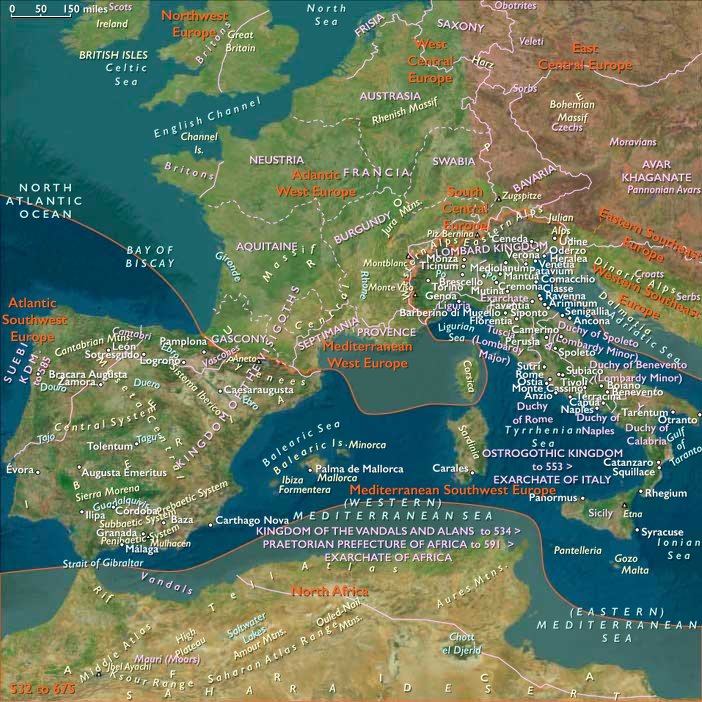
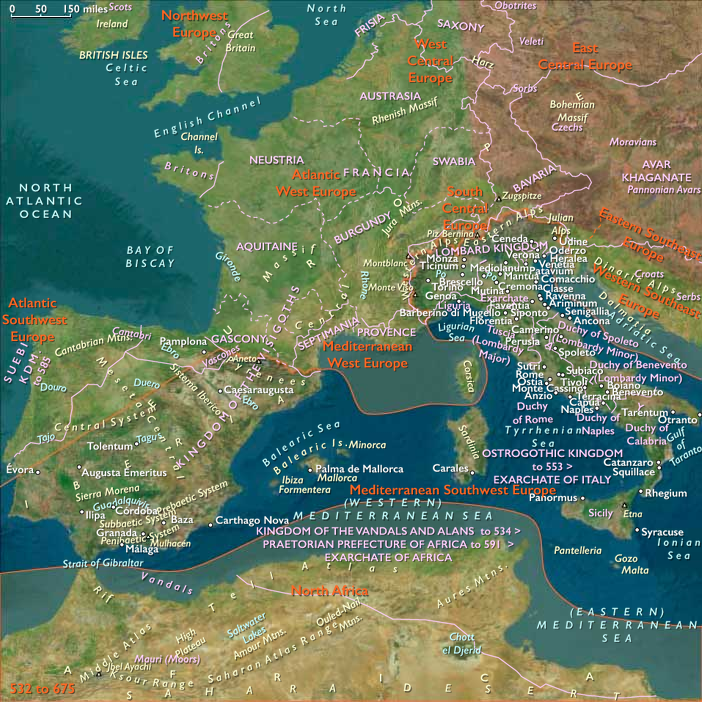
The Cathedral of Santa Maria Assunta (Cattedrale di Santa Maria Assunta), a basilica church on the Venetian island of Torcello, is a notable example of Venetian-Byzantine architecture.
One of the most ancient religious edifices in the Veneto, it is founded by the exarch Isaac of Ravenna in 639, confirming the island's importance as a center of population in Venice at this date.
Locations
People
Groups
- Christianity, Chalcedonian
- Greeks, Medieval (Byzantines)
- Ravenna, Exarchate of
- Roman Empire, Eastern: Heraclian dynasty
Topics
Commodoties
Subjects
Regions
Subregions
Related Events
Filter results
Showing 10 events out of 56588 total
Ashina Jiesheshuai had not been favored by Emperor Taizong of Tang because he had falsely accused his brother Ashina Shibobi of treason, which Emperor Taizong found despicable.
He has by late spring 639 formed a conspiracy with Ashina Shibobi's son Ashina Hexiangu to assassinate Emperor Taizong at his summer palace, Jiucheng Palace (in modern Linyou County, Shaanxi).
They had planned to wait for Li Zhi the Prince of Jin to depart from the palace in the morning and use that opportunity to attack the palace.
Li Zhi does not leave the palace on the day they plan, May 19, however, due to a storm and heavy rain immediately afterwards.
Ashina Jiesheshuai attacks the palace anyway, engaging the palace guards, but the palace guards are supported by other nearby troops.
Ashina Jiesheshuai and his comrades go to the stable and steal some twenty horses.
They flee to the north but are arrested by pursuers near the Wei River and killed.
Ashina Hexiangu is exiled to Lingbiao.
After this incident, however, the officials begin advocating sending Turks (or Tujue as they are known to the Chinese) away from the heart of the state.
Emperor Taizong in autumn 639 creates Li Simo (né Ashina Simo), a Göktürk-Tujue prince who had served him faithfully, as the khan of a newly recreated Eastern Tujue state (as Qilibi Khan), giving him all of the Tujue and Hu who had surrendered as his subordinates, to be settled north of the Great Wall and the Yellow River.
The Tujue people are fearful of Xueyantuo however and initially refuse to head to their new location.
Emperor Taizong issues an edict to Xueyantuo's khan Yi'nan that he and Li Simo will keep their peace and not attack each other, and after receiving from Yi'nan the assurance that he will not attack, the Tujue people advance to the new location.
The Muslim commander Utbah ibn Ghazwan, while defeating the forces of the Sassanid Empire in the vicinity of present Basra, on the Shatt al-Arab at the head of the Persian Gulf, had erected his camp on the site of an old Persian settlement called Vahestabad Ardashir, which the Arabs had destroyed.
The name Al-Basrah, which in Arabic means "the over watching" or "the seeing everything", was given to it because of its role as a military base against the Sassanid Empire.
However, other sources claim the name originates from the Persian word Bas-rah or Bassorah, meaning "where many ways come together".
Umar establishes this encampment in 639 as a city with five districts, and appoints Abu Musa al-Ash'ari as its first governor.
The port will become a major trading center for commodities from Arabia, India, and Persia.
An epidemic disease breaks out in Emmaus (Imwas) in Palestine, striking the city and the military camps of the Muslim Arabs, killing most of its population (probably an estimated twenty-five thousand people).
The Plague of Emmaus causes the death of many prominent companions of Muhammad, drawn from the muhajirun or "migrants"—those who had faith in Muhammad when he began to preach in Mecca who fled with him when he was persecuted there—the ansar—people of Medina who welcomed Muhammad and his companions and stood as their protectors, and the badriyun, who had fought at the Battle of Badr.
A four-thousand-man Rashidun army under the command of 'Amr ibn al-'As invades Egypt, capturing the strategic Delta town of Pelusium after a two-month siege.
Arab reinforcements led by Zubayr ibn al-Awam are sent from Medina to assist Amr's army.
The losses incurred by the Muslims are ameliorated by Sinai Bedouins, who join the invaders in the conquest of Egypt from the Empire.
Chintila never solves the many problems which plague his time in office and, as the chroniclers of the age tell us, this includes rebellions in Septimania and Gallaecia.
In the three years of his reign, he has permitted the bishops wide authority and they are the monarchs de facto, if not de jure.
He has dedicated his time to councils, the Fifth Council of Toledo in June 636 and the Sixth Council of Toledo in June 638.
These meetings covered many topics and legislated many new regulations.
The king has to be chosen from among the nobility; never a tonsurado (cleric), member of the servile classes (peasants), or foreigners.
They dictated the penalties for insurrection and determined that property acquired justly by the king could not be confiscated by his successor.
Finally, they decided the kings should die in peace, and declared their persons sacred, seeking to end the violence and regicides of the past.
Despite all this, another coup takes place: Chintila is deposed at the end of 639, and Tulga succeeds him.
Moreover, the councils have outlawed non-Catholics within the frontiers of the kingdom, which has resulted in many forced conversions.
he Death of Dagobert I and the Division of the Frankish Kingdom (639 CE)
After a decade of prosperous rule, Dagobert I dies on January 17, 639 CE, marking the end of the last strong Merovingian king. His death results in the division of the Frankish realm between his two sons:
- Sigebert III becomes independent ruler of Austrasia.
- Clovis II, an infant at the time, inherits Neustria and Burgundy, with his mother, Queen Nanthild, serving as regent.
However, real power begins shifting away from the Merovingian kings. Under the leadership of Pepin of Landen, the Mayor of the Palace, the Frankish nobility starts to control royal affairs, setting the stage for the rise of the Mayors of the Palace as the true rulers of the Frankish realms.
1. The Division of the Frankish Kingdom
- The Merovingian custom of dividing the realm among heirs continues, with Dagobert’s death leading to a renewed partition of the Frankish world.
- Sigebert III rules Austrasia independently, marking the first clear instance of the Austrasian nobility exerting direct control over the kingdom.
- Clovis II inherits Neustria and Burgundy, but as he is still an infant, his mother, Queen Nanthild, governs as regent.
2. The Rise of Pepin of Landen and the Mayors of the Palace
- Pepin of Landen, the hereditary Mayor of the Palace of Austrasia, emerges as the true power behind the throne.
- He is instrumental in distributing the royal treasury among the two kings and Queen Nanthild, ensuring the nobility remains loyal to him.
- His control over Austrasia marks the beginning of the increasing dominance of the Mayors of the Palace, which will eventually lead to the Carolingian rise to power.
3. The Decline of Merovingian Royal Authority
- With both kings being minors, the actual governance of the Frankish kingdoms falls to their noble guardians, particularly Pepin in Austrasia and the Neustrian aristocracy under Nanthild.
- This shift weakens Merovingian kingship, accelerating the transition from monarchical rule to aristocratic control.
- The term “rois fainéants” (do-nothing kings) becomes increasingly applicable, as real authority now lies with the Mayors of the Palace.
Conclusion: The Turning Point in Frankish Power
Dagobert I’s death in 639 CE marks a critical shift in Merovingian rule, as power begins transitioning from the monarchy to the nobility. With Pepin of Landen consolidating influence in Austrasia and Queen Nanthild ruling as regent in Neustria, the role of the Mayors of the Palace becomes increasingly dominant, setting the stage for the eventual rise of the Carolingians.
Acarius and Eligius: Missionaries, Bishops, and Royal Advisors in Merovingian Gaul
In the early seventh century, the expansion of Christianity in Frankish Gaul was significantly influenced by figures like Acarius, Bishop of Doornik and Noyon, and his successor, Eligius of Limoges. Both men played crucial roles in spreading Christianity, advising Merovingian kings, and promoting monasticism and social reforms.
1. Acarius of Doornik and Noyon: The Early Missionary Bishop
- Acarius was a pupil of Saint Columbanus around 594, being deeply influenced by Irish monastic traditions brought to Gaul.
- His diocese included Doornik (Tournai) and Noyon, situated on either side of the modern Franco-Belgian border.
- The inhabitants of the region—including Flemings, Frisians, Suevi, and other Germanic tribes—remained largely pagan, making his missionary work essential.
Acarius and Saint Amand
- Acarius was a staunch supporter of Saint Amand, another major Frankish missionary.
- Despite his influence, Acarius could not prevent King Dagobert I from banishing Amand, likely due to noble opposition to aggressive Christianization efforts.
- However, Acarius was widely recognized for his role in spreading Christianity in Belgic Gaul, and was venerated as a saint soon after his death in 639 CE.
2. Eligius: Goldsmith, Royal Advisor, and Bishop of Noyon-Doornik
Upon Acarius' death, Eligius was unanimously chosen as his successor, further strengthening the Christian presence in pagan territories.
Eligius' Early Life and Rise to Prominence
- Born in Chaptelat, near Limoges, into a wealthy and influential Gallo-Roman family.
- Trained as a goldsmith under Abbo, master of the mint at Limoges.
- His craftsmanship gained royal attention, and he was invited to work under Babo, royal treasurer of Clothar II.
- His work included the golden throne for Clothar II, as well as bas-reliefs for the tomb of Saint Germain of Paris.
Eligius in the Frankish Court
- Following Clothar II’s death in 629 CE, Dagobert I appointed Eligius as his chief councilor.
- His reputation was so great that ambassadors first sought Eligius' counsel before meeting with the king.
- His influence earned him both admiration and enemies at court, particularly among secular noble factions.
Eligius' Role in Diplomacy and Slave Redemption
- Helped negotiate a treaty between King Dagobert I and Breton Prince Judicael ap Hoel, bringing Brittany under Frankish suzerainty.
- Used his royal favor to secure alms for the poor and ransom captives, including Romans, Gauls, Bretons, Moors, and Saxons from the Marseilles slave market.
Eligius’ Monastic Foundations and Religious Patronage
- Founded the monastery of Solignac near Limoges (632 CE), introducing Irish monastic rules from Columbanus' tradition.
- Established a convent in Paris that housed 300 nuns, led by Abbess Aurea.
- Restored and built basilicas, including:
- St. Paul’s Basilica.
- The Parisian basilica of Saint Martial, patron of Limoges.
- Tombs and churches dedicated to Saint Martin of Tours and Saint Denis, reinforcing their importance as Frankish patron saints.
3. Legacy of Acarius and Eligius
- Acarius and Eligius played a critical role in Christianizing the pagan regions of northern Gaul, particularly in the Flemish and Frisian lands.
- Their missionary efforts, royal influence, and monastic foundations ensured that Frankish Christianity continued to expand under the Merovingians.
- Eligius’ deep involvement in royal politics foreshadowed the increasing power of bishops in the Frankish court, a trend that would shape medieval European governance.
- Their work laid the foundation for the later Carolingian missionary movements, which would fully integrate pagan Germanic tribes into Christendom.
Conclusion: Pillars of Frankish Christian Expansion
Both Acarius and Eligius were instrumental in consolidating Christianity in Frankish Gaul, bridging the gap between royal power, missionary efforts, and monastic reform. Their influence helped shape Merovingian religious policies, reinforcing the Church’s growing political and social dominance in early medieval Europe.
Srivijaya, centered in today’s Palembang, South Sumatra, launches a military expedition against Java, according to the seventh century Kota Kapur inscription; the period coincides with the decline of Tarumanagara.
It is very likely that the Taruma Kingdom is attacked and defeated by Srivijaya around 650 CE.
Tarumanegara's influence over its neighbors begins to decline after this.
Years: 639 - 639
Locations
People
Groups
- Christianity, Chalcedonian
- Greeks, Medieval (Byzantines)
- Ravenna, Exarchate of
- Roman Empire, Eastern: Heraclian dynasty
