
The Carthaginians are alarmed by Timoleon's success …
Years: 339BCE - 339BCE
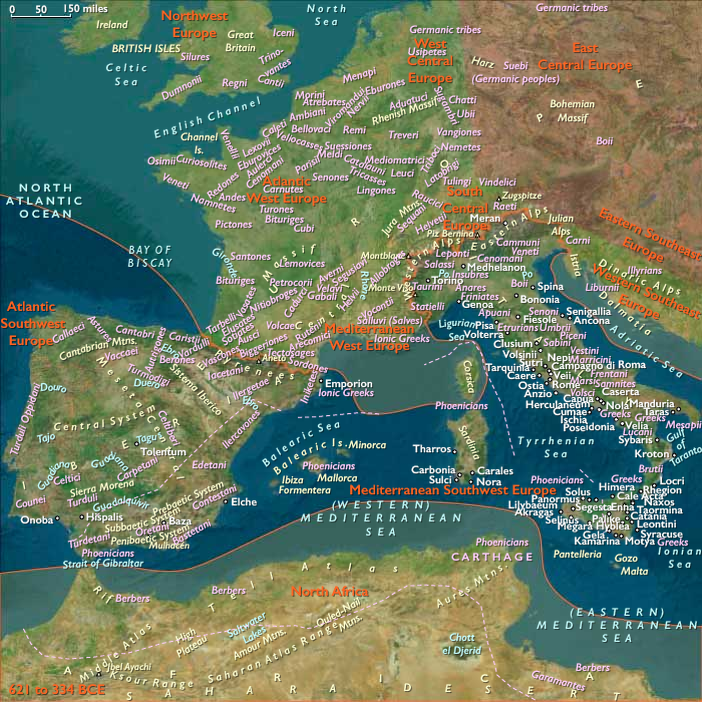
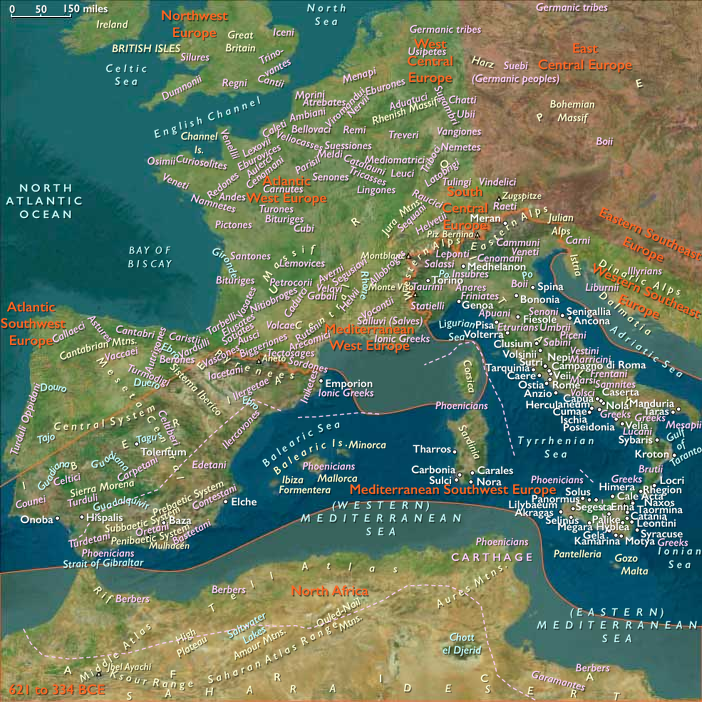
The Carthaginians are alarmed by Timoleon's success and ship a large army to Lilybaeum.
According to Plutarch it numbered seventy thousand men and included siege engines and chariots with four horses each.
Their army is large enough to conquer Sicily in its entirety, even with the Greeks united under Timoleon.
When they receive news that their territory is being raided by Timoleon's mercenaries, they march against them immediately under the command of Hasdrubal and Hamilcar.
When the Syracusans hear about the coming of the huge Carthaginian army they are terrified; Timoleon can gather no more than three thousand of them to march against the Carthaginians.
While on the march, one thousand of Timoleon's four thousand mercenaries desert him and return to Syracuse.
He leads his army, now numbering five thousand foot and one thousand horse, on a march of eight days away from Syracuse towards the river Crimissus, where the Carthaginians are concentrating.
Diodorus Siculus reports a greater size of Timoleon's army, giving a number of twelve thousand men.
Timoleon is positioned on a hill with his army, overlooking a plain were the Carthaginian army is located, in early June 339 BCE.
The Crimissus river separates the two armies and covers the plain in a thick fog, making it impossible to see the Carthaginian camp.
However, the noise signals the Greeks that the Carthaginians are going to cross the river.
The sun has risen higher in the sky and dissipated the fog in the plain, making the Carthaginian troops visible.
The four-horse chariots are at the vanguard of the army.
Behind them is infantry, who the Greeks identify as Carthaginian citizens, and at the rear are the foreign troops.
Timoleon notices the army is separated by the river, giving him a good opportunity to attack.
He decides to send the cavalry ahead to prevent the Carthaginian citizen infantry from forming their phalanx.
Timoleon now commands his army to descend into the plain, assigning the other Sicilian Greeks and a few of his mercenaries to his wings.
He commands the center, which is composed of the Syracusans and his best mercenaries.
Seeing that his cavalry cannot attack the enemy infantry because of the chariots, he orders his cavalry to ride past the line of chariots to attack the infantry on the flank, then charges the enemy with the infantry.
The Carthaginian citizen infantry resists the Greeks sturdily however, thanks to their excellent armor and large shields.
Fortunately for the Greeks, a thunderstorm rises up behind them and starts a shower of hail and rain.
The storm hits the Greeks in the back and the Carthaginians in the face, putting the latter at a severe disadvantage: the water and mud makes them ineffective fighters because of their heavy armor.
To make things worse for the Carthaginians, the storm causes the Crimissus to overflow from its banks and many smaller streams to flow over the plain.
The Carthaginian army flees when the Greeks defeat the first rank of four hundred men.
Many of those who flee over the plain are overtaken by the Greeks and killed.
Some drown in the river when they meet the part of the Carthaginian army that still tries to cross the river.
Of the ten thousand casualties for the Carthaginian army, three thousand are Carthaginian citizens.
Carthage, having been used to employing Libyans, Numidians and Iberians for its armies, has never lost so many of its own citizens before because it At least five thousand prisoners are accounted for, and many more are hidden or stolen by the Greek soldiers.
As they strip the dead bodies of their armor and possessions, the Greeks acquire a great deal of gold and silver from the rich Carthaginian citizens.
After the Greek army captures the Carthaginian camp, so much effort is required to gather the spoils that it takes until the third day to erect a trophy on the site.
Diodorus Siculus, calling the Carthaginian citizen infantry as the Sacred Band of Carthage, puts their number at twenty-five hundred and states that they all fought to the death.
Of the other nationalities of the army, more than ten thousand have perished and fifteen thousand have been taken captive.
Locations
Groups
- Iberians
- Greece, classical
- Sicily, classical
- Italy, classical
- Berber people (also called Amazigh people or Imazighen, "free men", singular Amazigh)
- Carthage, Kingdom of
- Syracuse, Corinthian city-state of
- Libu (Libyans)
Topics
- Iron Age Europe
- Iron Age Cold Epoch
- Classical antiquity
- Sicilian Wars, or Carthaginian-Syracusan Wars
- Timoleon's War
- Crimissus, Battle of the
Commodoties
Subjects
Regions
Subregions
Years: 339BCE - 339BCE
Locations
Groups
- Iberians
- Greece, classical
- Sicily, classical
- Italy, classical
- Berber people (also called Amazigh people or Imazighen, "free men", singular Amazigh)
- Carthage, Kingdom of
- Syracuse, Corinthian city-state of
- Libu (Libyans)
Topics
- Iron Age Europe
- Iron Age Cold Epoch
- Classical antiquity
- Sicilian Wars, or Carthaginian-Syracusan Wars
- Timoleon's War
- Crimissus, Battle of the
Commodoties
Subjects
Regions
Subregions