The Transfer of Béarn's Capital to Pau …
Years: 1460 - 1460
The Transfer of Béarn's Capital to Pau (1459)
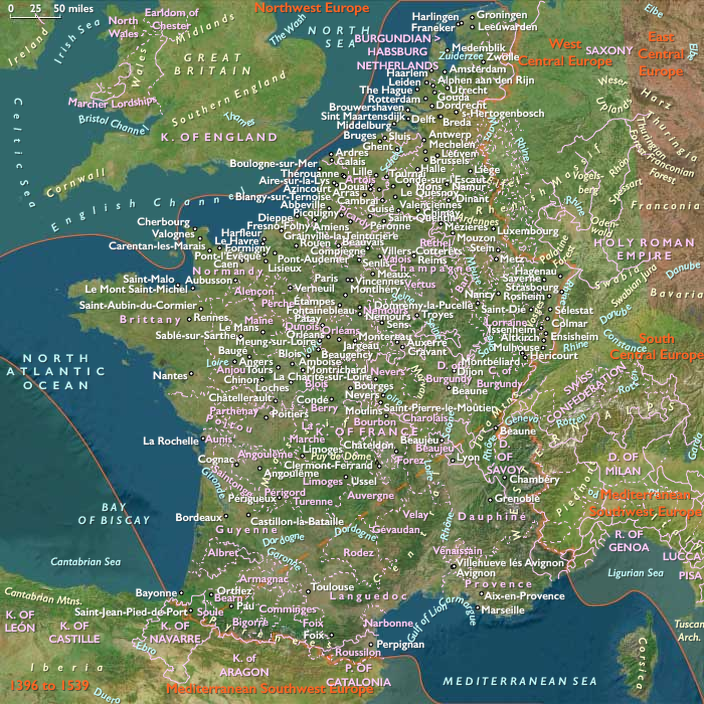
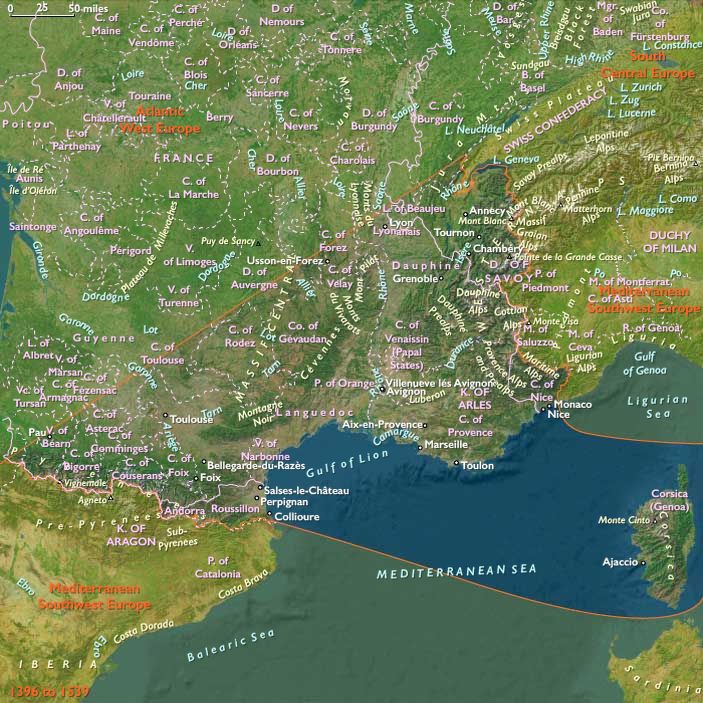
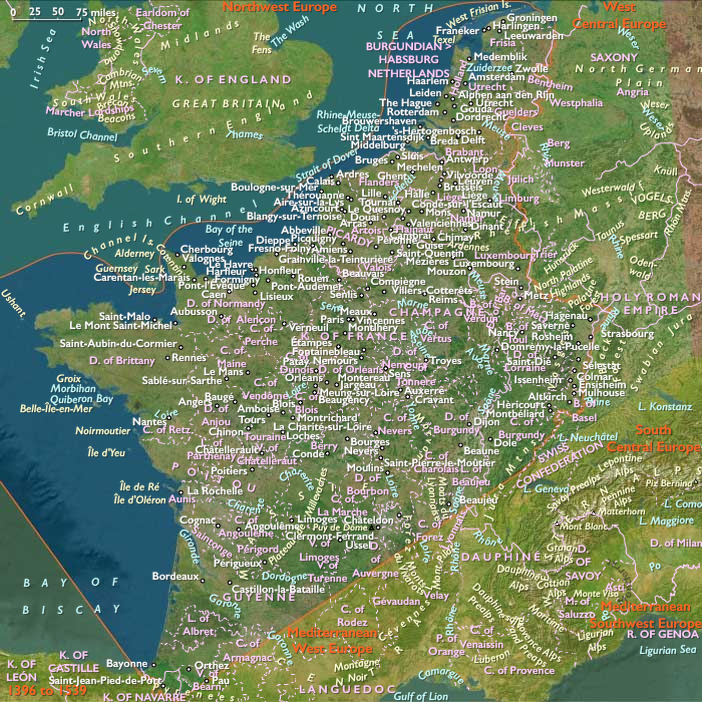
In 1459, the sovereign principality of Béarn, a strategically significant territory in the foothills of the Pyrenees, shifted its capital from Orthez to ...
Locations
People
Groups
- Navarre, Kingdom of
- Béarn, Viscountcy of
- France, (Valois) Kingdom of
- England, (Plantagenet, Lancastrian) Kingdom of
Subjects
Regions
Subregions
Related Events
Filter results
Showing 10 events out of 41276 total
Wallachia’s Vlad Ţepeş, whom the Pope holds in high regard, is the only European leader to have shown enthusiasm for the Pope’s crusade against the Ottomans.
Because of a lack of enthusiasm showed by Europeans for the crusade, Mehmed takes the opportunity to take an offensive stand.
Ţepeş's only ally, Mihály Szilágyi, is captured by the Turks while traversing Bulgaria in 1460.
Szilágyi's men are tortured to death, while Szilágyi is killed by being sawn in half.
Later this year, Mehmed sends envoys to Ţepeş to urge him to pay the delayed tribute.
Ţepeş provokes Mehmed by having the envoys killed and in a letter dated September 10, 1460, addressed to the Transylvanian Saxons of Kronstadt, he warns them of Mehmed's invasion plans and asks for their support.
Ţepeş has not paid the annual tribute of ten thousand ducats since 1459.
In addition to this, Mehmed has asked him for five hundred boys that are to be trained as janissaries.
Ţepeş refuses the demand, and the Turks cross the Danube and start to do their own recruiting, to which Ţepeş reacts by capturing the Turks and impaling them.
Portuguese king Afonso V supports the exploration of the Atlantic Ocean led by Prince Henry the Navigator.
Four years after the Portuguese discovery of the uninhabited Cape Verde Islands off the western tip of Africa, Portuguese mariner Pedro de Sintra reaches the region of present Sierra Leone.
By the death of Henry the Navigator at sixty-six on November 13, 1460, the Portuguese have rounded the bulge of West Africa and reached the Guinea coast, but from this point forward Afonso will do nothing to pursue this course of action.
The two Greek despots of Morea surrender in 1460 to the Ottomans.
Thomas Palaiologos flees to Italy, his brother Demetrius to the Sultan's court.
Sigismund, the Habsburg Duke of Austria, had inherited from his father rulership over Tyrol in 1446, together with (other) Further Austria Vorderösterreich, which include the Sundgau in the Alsace, the Breisgau, and some possessions in Swabia.
Emperor Frederick III, of a rival branch of this expansionist family, backs his cousin’s family claim rather than assert imperial rights in the region.
Frederick attempts to split the Swiss Confederation, which now includes the abbeys of Saint Gall, Rapperswill, and Stein am Rhein as allies and Appenzell and Steinhausen as members.
When Pope Pius II excommunicates Duke Sigismund over the investiture issue in 1460, the Swiss, not yet under attack, act against the imperial menace by dispatching their troops north as far as the Rhine River, meeting with scarcely any opposition.
Occupying Frauenfeld and taking Thurgau canton from Sigismund’s forces, …
…Swiss troops unsuccessfully besiege Winterthur.
...the burgeoning town of Pau. This pivotal relocation, spearheaded by Gaston IV of Foix-Béarn, marked a decisive moment in Béarn's assertion of its autonomy during a period when powerful neighbors—particularly the English, Spanish, and French crowns—were increasingly encroaching upon its independence.
Political and Military Context
Moving the capital to Pau allowed Béarn to assert greater administrative and military control at a crucial geographic crossroads, fortifying the principality’s defensive position against rival regional powers. The new capital, strategically positioned near the mountains, facilitated more effective governance and stronger defense networks, crucial for Béarn's continued autonomy amidst the shifting alliances and territorial ambitions of England, France, and Castile-Aragon.
Cultural and Economic Impact
The establishment of Pau as the new administrative center encouraged cultural and economic growth. It quickly evolved into a regional hub for commerce and diplomacy, drawing merchants, artisans, and scholars from throughout Atlantic Southwest Europe. This shift fostered cultural development and economic prosperity, enhancing Béarn’s reputation as a stable, influential entity amid the fractious political landscape of late medieval Europe.
Artistic and Cultural Significance
The relocation to Pau prompted significant cultural developments, transforming the city into a dynamic cultural and intellectual center. Enhanced patronage led to architectural expansions, including the construction of significant structures such as the fortified Château de Pau, later famous as the birthplace of future French King Henry IV. This period laid foundations for Pau's later prominence in art, architecture, and cultural identity within the region.
Long-Term Consequences
The principality's choice to relocate its capital to Pau solidified Béarn's autonomy and resilience during a turbulent period, shaping its distinctive regional identity. Béarn would continue to navigate complex relationships with neighboring powers, including France, Spain, and England, maintaining its cultural and political distinctiveness into subsequent centuries. This historical shift in 1459 remains emblematic of Béarn’s enduring determination to retain its independence amid broader geopolitical transformations in Atlantic West Europe.

Nicolas Froment, a member of the Avignonese school, gains renown for a major altarpieces, “The Raising of Lazarus.”
His Triptych of the Burning Bush, today installed in Aix Cathedral, had originally been painted for a Carmelite convent, destroyed during the French Revolution.
The central panel represents the Virgin and Child seen on the burning bush.
In the foreground, Moses, guarding his flock, is amazed by the vision.
The two other parts of the triptych show the patrons of the work, René of Anjou, ruler of Provence and titular king of Naples, and his consort Queen Jeanne, in devotional attitudes.
Charles leaves Majorca unauthorized in 1460 and lands in Barcelona, where he is welcomed by the two chief factions, the Busca and the Biga.
John does not initially react to the situation, but he calls Charles to his court at Lleida to discuss the proposed marriage of Charles to Isabella, infanta of Castile.
He still refuses to recognize Charles as his "first born", probably seeking to reserve that title for Ferdinand, but arousing opposition in the meantime.
Charles opens negotiations with Henry IV of Castile, his father's inveterate enemy.
At Lleida on December 2, 1460, he is arrested and imprisoned in Morella.
This causes an uproar in Catalonia, where Charles is immensely popular, and the king is forced to suspend court.
The Generalitat and the Diputació, the municipal council of Barcelona, create a Consell del Principat ("Council of the Principality") to settle the matter of the rightful succession.
A parliament is called for January 8, 1461.
Domenico da Piacenza, now around sixty, writes one of the first dance manuals in 1460: De arte saltandi and choreas ducendi, the first to survive into the modern era.
Cosimo Tura appears to have been influenced by the Quattrocento styles of Andrea Mantegna and Piero della Francesca.
Born in Ferrara, he had been a student of Francesco Squarcione of Padua, and later obtaining patronage from both Dukes Borso and his eventual successor, Ercole I d'Este, and by 1460 receives a stipend by the Ferrarese Court.
His pupils include Francesco del Cossa and Francesco Bianchi.
Years: 1460 - 1460
Locations
People
Groups
- Navarre, Kingdom of
- Béarn, Viscountcy of
- France, (Valois) Kingdom of
- England, (Plantagenet, Lancastrian) Kingdom of