
The Cape Verde Islands, an arid, mountainous …
Years: 1456 - 1456
December
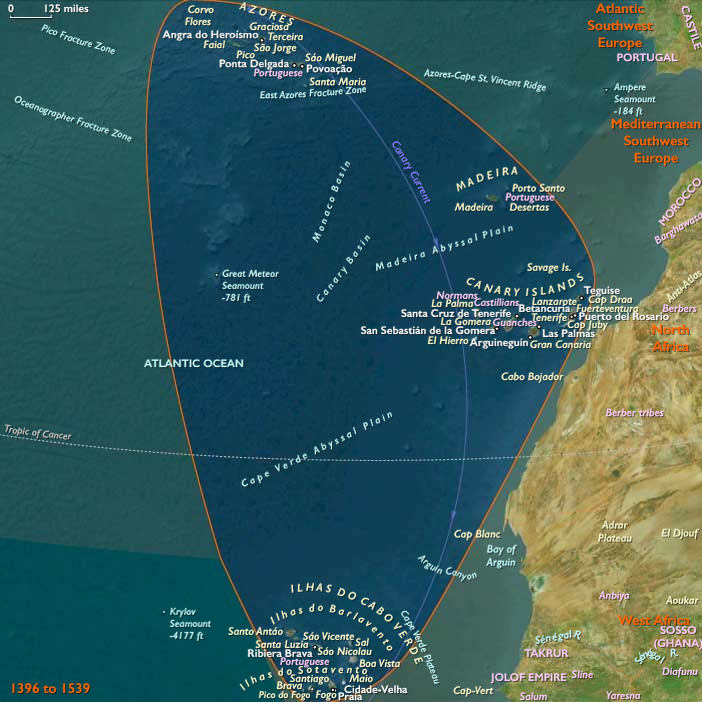
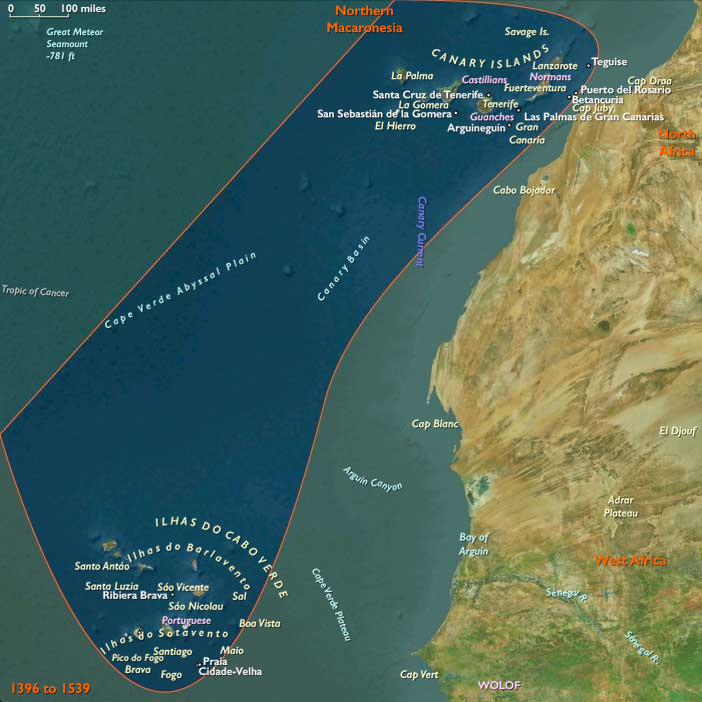
The Cape Verde Islands, an arid, mountainous archipelago, volcanic in origin, consist of ten main islands and five islets located in the Atlantic Ocean some four hundred and fifty miles (seven hundred and twenty-five kilometers) west of their namesake, Cape Verde ("Green Cape"), the western tip of Africa.
The first written record of Cape Verde can be found in the works De choreographia by Pomponius Mela and Historia naturalis by Pliny the Elder, who called the islands "Gorgades" in remembering the home of the mythical Gorgons killed by Perseus and afterwards interpreted (against the written original statement) as the site where the Carthaginian Hanno slew two female "Gorillai" and brought their skins into the temple of the female deity Tanit (the Carthaginian Juno) in Carthage.
According to Pliny the Elder, the Greek Xenophon Lampsacenus states that the Gorgades (Cape Verde) were situated two days from "Hesperu Ceras"—today called Cap-Vert, the westernmost part of the African continent.
According to Pliny the Elder and his citation by Solinus, the sea voyage time from Atlantis (Madeira) crossing the Gorgades to the islands of the Ladies of the West (Hesperides) was around forty days.
The Isles of the Blessed written of by Marinos of Tyre and referenced by Ptolemy in his Geographia may have been the Cape Verde islands.
The islands of the Cape Verde archipelago are rediscovered around 1456 by Genoese and Portuguese navigators, who describe them as "uninhabited".
However, given the prevailing winds and ocean currents in the region, the islands may well have been visited by Moors or Wolof, Serer, or perhaps Lebou fishermen from the Guinea Coast.
Folklore suggests that the islands may have been visited by Arabs, centuries before the arrival of the Europeans.
The Portuguese explorer Jaime Cortesão reported a story that Arabs were known to have visited an island which they referred to as "Aulil" or "Ulil" where they took salt from naturally occurring salinas.
Some believe they may have been referring to Sal Island.
Whatever the case may have been, the population (if there is any) at the time of arrival of the Portuguese is insufficiently well established to resist their complete penetration.
According to Portuguese official records, the first discoveries were made by Genoa-born António de Noli, who is afterwards appointed governor of Cape Verde by Portuguese King Afonso V. Other navigators mentioned as contributing to discoveries in the Cape Verde archipelago are Diogo Gomes (who was with António de Noli and claimed to have been the first to land on and name Santiago island), Diogo Dias, Diogo Afonso and the Italian (Venice-born) Alvise Cadamosto.
Locations
People
Groups
- Moors
- Wolof people
- Serer people
- Lebou people
- Portugal, Avizan (Joannine) Kingdom of
- Portuguese Empire
Topics
Commodoties
Subjects
Regions
Subregions
Years: 1456 - 1456
December
Locations
People
Groups
- Moors
- Wolof people
- Serer people
- Lebou people
- Portugal, Avizan (Joannine) Kingdom of
- Portuguese Empire
Topics
Commodoties
Subjects
Regions
Subregions