
The Canary Islands were apparently known to …
Years: 1339 - 1339
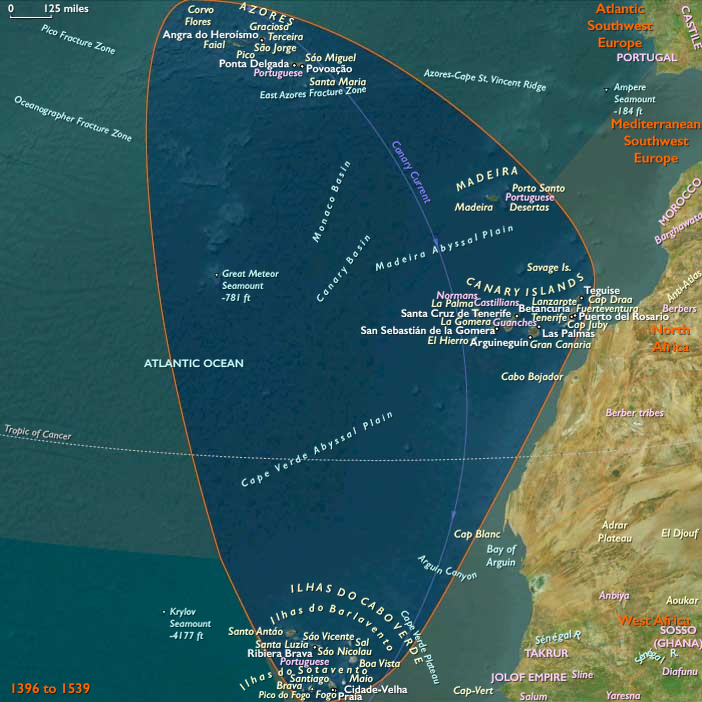
The Canary Islands were apparently known to the Carthaginians of Cadiz.
The Roman writer Pliny called them "the Fortunate Islands".
Genoese navigator Lancelotto Malocello is credited with the rediscovery in 1312 of the Canary Islands.
Malocello, according to some sources, led a return expedition to the Canaries, sponsored by King Afonso IV of Portugal, in 1336 shortly after his return to Europe.
The existence of this expedition has been dismissed by most modern historians, however, as being based on later forged documents.
Majorcan Angelino Dulcert in 1339 draws the first map of the Canaries, labeling one of the islands "Lanzarote" (named Insula de Lanzarotus Marocelus and marked by a Genoese shield).
Evidently drawing from the information provided by Malocello, Dulcert of Majorca also shows the island of Forte Vetura (Fuerteventura) and Vegi Mari (Lobos).
Although earlier maps had shown fantastical depictions of the "Fortunate Islands" (on the basis of their mention in Pliny), this is the first European map where the actual Canary islands make a solid appearance (although Dulcert also includes some fantastic islands himself, notably Saint Brendan's Island, and three islands he names Primaria, Capraria and Canaria).
Locations
People
Groups
- Canary Islands, precolonial
- Guanches
- Genoa, (Most Serene) Republic of
- Portugal, Burgundian (Alfonsine) Kingdom of
Topics
Commodoties
Subjects
- Origins
- Commerce
- Painting and Drawing
- Labor and Service
- Conflict
- Exploration
- Faith
- Government
- Technology
- Movements
- Cartography
Regions
Subregions
Years: 1339 - 1339
Locations
People
Groups
- Canary Islands, precolonial
- Guanches
- Genoa, (Most Serene) Republic of
- Portugal, Burgundian (Alfonsine) Kingdom of
Topics
Commodoties
Subjects
- Origins
- Commerce
- Painting and Drawing
- Labor and Service
- Conflict
- Exploration
- Faith
- Government
- Technology
- Movements
- Cartography
Regions
Subregions