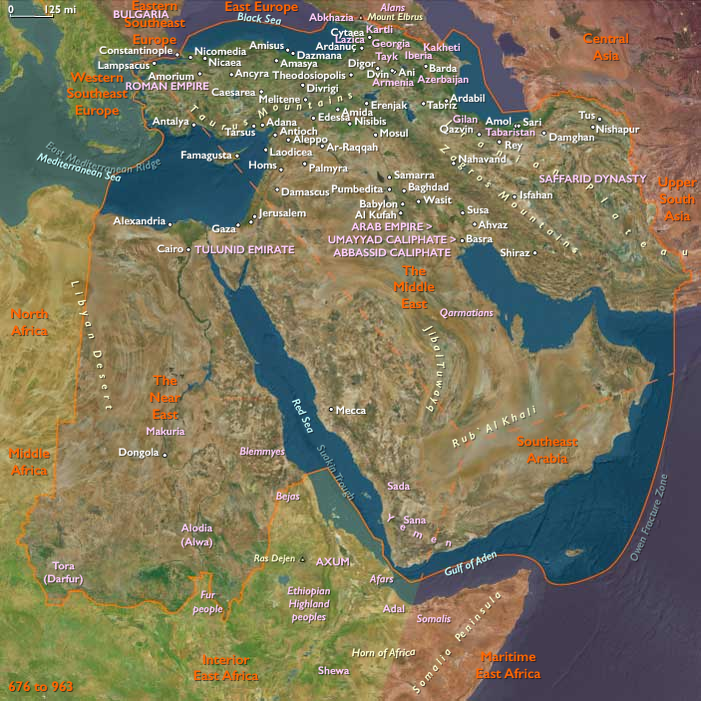
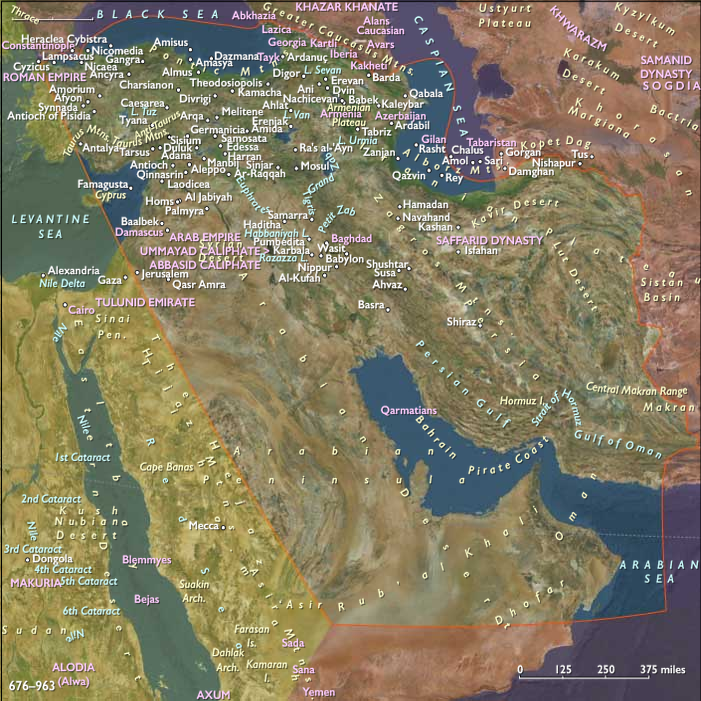
The campaign against Mus'ab again proves fruitless …
Years: 690 - 690
The campaign against Mus'ab again proves fruitless in 690.
Locations
People
Groups
Topics
- Migration Period
- Fitna, Second, or Second Islamic Civil War
- Azraqi Khariji Revolt against the Umayyad Caliphate
Commodoties
Subjects
Regions
Subregions
Related Events
Filter results
Showing 10 events out of 55945 total
Empress Dowager Wu had been set to make sacrifices in 688 to the deity of the Luo River (flowing through the Henan province city of Luoyang, at this time the "Eastern Capital").
Wu had summoned senior members of Tang's Li imperial clan to Luoyang.
The imperial princes, worried that she planned to slaughter them and secure the throne for herself, plotted to resist her.
However, before a rebellion could be comprehensively planned out, Li Zhen and his son Li Chong the Prince of Langye rose first, at their respective posts as prefects of Yu Prefecture (roughly modern Zhumadian, Henan) and Bo Prefecture (roughly modern Liaocheng, Shandong).
The other princes were not yet ready, however, and did not rise, and forces sent by Empress Dowager Wu and the local forces crushed Li Chong and Li Zhen's forces quickly.
Empress Dowager Wu took this opportunity to arrest Emperor Gaozong's granduncles Li Yuanjia the Prince of Han, Li Lingkui the Prince of Lu, and Princess Changle, as well as many other members of the Li clan and forced them to commit suicide.
Even Princess Taiping's husband Xue Shao is implicated and starved to death.
In the subsequent years, there will continue to be many politically motivated massacres of officials and Li clan members.
In 690, Wu takes the final step, taking the regnal name Wu Zetian, and the title huangdi, as the monarch of the newly proclaimed Zhou Dynasty.
Traditional Chinese order of succession (akin to the Salic law in Europe) does not allow a woman to ascend the throne, but Wu Zetian is determined to quash the opposition, and the use of the secret police does not subside, but continued, after her taking the throne.
However, while her organization of the civil service system is criticized for its laxity of the promotion of officials, Wu Zetian is considered capable of evaluating the performance of the officials once they are in office.
Egica was married around 670 to Cixilo (Cixilona, Cioxillo or Cixila), the daughter of his royal predecessor Erwig and wife Liuvigoto, who, on his deathbed on November 14, 687, had confirmed Egica as his heir and sent him with the royal court to Toledo to be crowned.
Here he had been anointed on November 24.
Upon Ergica's marriage to Cixilo, Erwig had made him swear an oath to protect Erwig's children.
Before his death, Erwig had required a second oath, swearing not to deny justice to the people.
Shortly after taking the throne, Ergica had called the Fifteenth Council of Toledo on May 11, 688, at which he had claimed the two oaths were contradictory (because to do justice to the people required "harming" Erwig's children) and had asked the council of bishops to release him from one or the other.
Egica, however, had met the opposition of Julian of Toledo.
When the council allowed Egica to abandon his wife but only partially rescinded the oath to protect Erwig's children, Ergica waited until Julian's death in 690 to call a second provincial council of Tarraconensis, which results in Erwig's widow, Liuvigoto, being sent to a convent.
The bishops of the diocese of Aquileia decide, at the Synod of Aquileia (also referred to as the Synod of Pavia), to end the Schism of the Three Chapters and return to communion with Rome.
The Arabs had gone too far in the conquest of the Maghreb by the 680s to be willing to accept defeat at the hands of a Berber leader, albeit one professing Islam, and 'Abd al-Malik resumes the conquest of North Africa.
A large army sent from Egypt, commanded by Zuhayr ibn Qais al-Balawi, reoccupies Al-Qayraw'n, …
…then pursues Kusaila westward to Mams, where he is defeated and killed.
The dates of these operations are uncertain, but they must have occurred before 691, when Zuhayr ibn Qais himself is killed in an attack on imperial positions in Cyrenaica.
Wu Zetian, shortly after taking the throne, had elevated the status of Buddhism to be above Taoism, officially sanctioning the religion by building temples named Dayun Temple in each prefecture belonging to the capital regions of the two capitals Luoyang and Chang'an, and also created nine senior monks dukes.
She also enshrines seven generations of Wu ancestors at the imperial ancestral temple, although she also continues to offer sacrifices to the Tang emperors Gaozu, Taizong, and Gaozong.
She faces the issue of succession.
At the time she took the throne, she had created Li Dan, the former Emperor Ruizong, crown prince, and bestowed the name of Wu on him.
However, the official Zhang Jiafu had instigated the commoner Wang Qingzhi into starting a petition drive to make her nephew Wu Chengsi crown prince, arguing that an emperor named Wu should pass the throne to a member of the Wu clan.
Wu Zetian is tempted to do so, and when the chancellors Cen Changqian and Ge Fuyuan oppose strongly, they, along with fellow chancellor Ouyang Tong, are executed.
Nevertheless, she declines Wang's request to make Wu Chengsi crown prince, but for a time allows Wang to freely enter the palace to see her.
On one occasion, however, when Wang angers her by coming to the palace too much, she asks the official Li Zhaode to batter Wang—and Li Zhaode takes the opportunity to batter Wang to death, and his group of petitioners scatters.
Li Zhaode then persuades Wu Zetian to keep Li Dan as crown prince—pointing out that a son is closer in relations than a nephew, and also that if Wu Chengsi became emperor, Emperor Gaozong would never again be worshiped.
Wu Zetian agrees, and for some time will not again consider the matter.
Further, at Li Zhaode's warning that Wu Chengsi is becoming too powerful, Wu Zetian strips Wu Chengsi of his chancellor authority and bestows on him largely honorific titles without actual authority.

Abd al-Malik is finally able to face Mus'ab only after the defeat of the northern Arab tribes in 691.
The decisive battle takes place at Dayr al-Ja Thaliq.
The forces of Mus'ab are weakened by their wars against the Kharijites, and 'Abd al-Malik bribes many of them to desert Mus'ab, who is then killed in battle.
The whole of Iraq now falls into his hands.
Subsequent Paulician leaders imitate the duality of names.
Symeon, the leader of the imperial force sent against the Paulicians in 685, had become a convert to Paulicianism, and has taken as his second name that of Saint Titus, a disciple of St. Paul, for whom he was secretary.
Symeon-Titus is himself martyred, burned alive in 690 when Emperor Justinian sends a second imperial expedition to suppress the heresy.
Palestine under the Umayyads, forms, with Syria, one of the main provinces of the empire.
An emir assisted by a financial officer administers each jund. (This pattern will continue, in general, up to the time of Ottoman rule.)
The Umayyads for various reasons pay special attention to Palestine, where the process of Arabization and Islamization is gaining momentum.
It is one of the mainstays of Umayyad power and important in their struggle against both Iraq and the Arabian Peninsula.
Caliph 'Abd al-Malik between 685 and 691 has erected a magnificent mosque (eventually known as the Dome of the Rock) on the site of the destroyed great Temple of Jerusalem, which is also the alleged nocturnal resting place of the Prophet Muhammad on his nocturnal journey to heaven.
Constructed not as a mosque for public worship but rather as a mashhad, a shrine for pilgrims, it is virtually the first monumental building in Islamic history (and the earliest Muslim monument still extant.)
The Church of San Pedro de la Nave: A Lasting Legacy of Visigothic Architecture
In 691 CE, during the reign of King Egica, construction begins on the Church of San Pedro de la Nave, one of the last major works of Visigothic architecture.
Located in Campillo, Zamora, on the banks of the Esla River, the church's original design follows a Roman cross plan, reflecting late Visigothic architectural traditions.
San Pedro de la Nave stands as a testament to the enduring artistic and religious heritage of the Visigothic kingdom, even as its political power wanes in the face of the coming Islamic conquest.
Years: 690 - 690
Locations
People
Groups
Topics
- Migration Period
- Fitna, Second, or Second Islamic Civil War
- Azraqi Khariji Revolt against the Umayyad Caliphate