
The Caledonians are next mentioned in 209, …
Years: 209 - 209
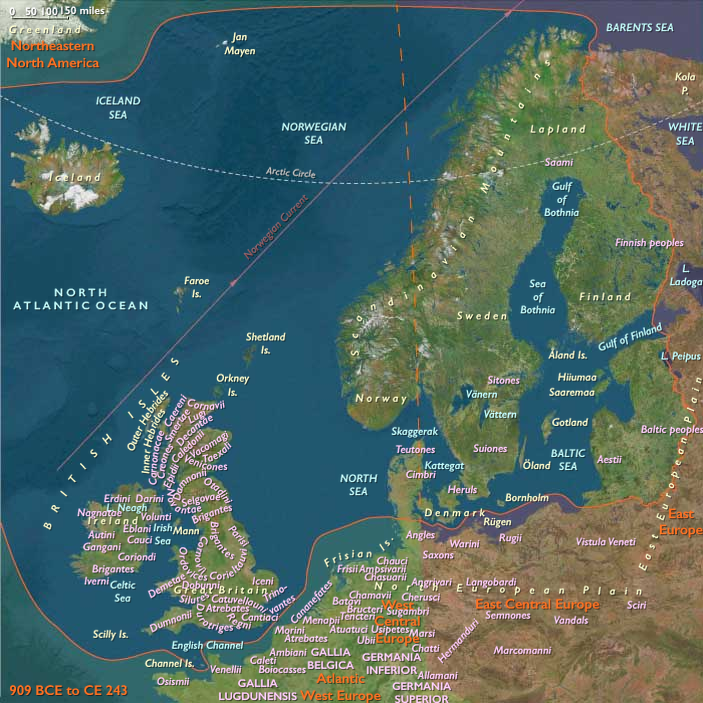
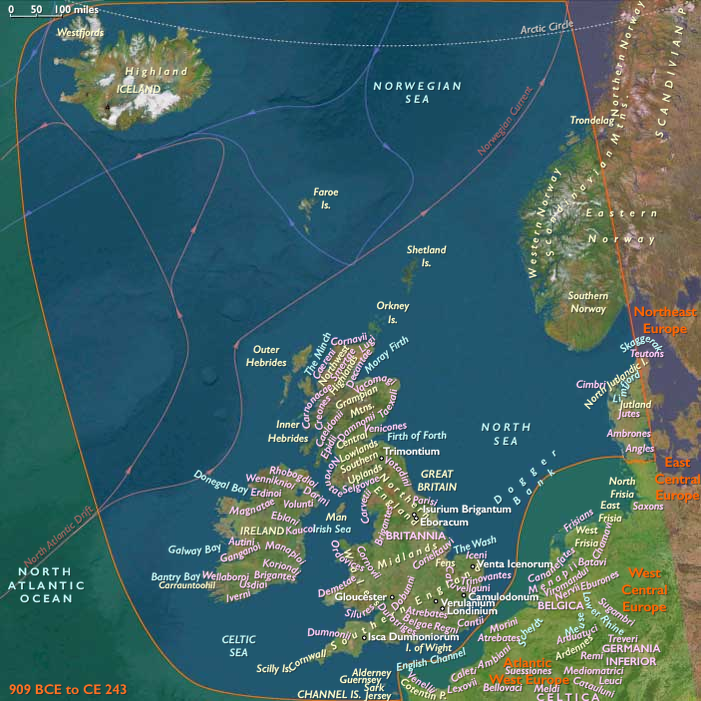
The Caledonians are next mentioned in 209, when they are said to have surrendered to Severus after he personally led a military expedition north of Hadrian's Wall, in search of a glorious military victory.
Herodian and Dio wrote only in passing of the campaign but describe the Caledonians ceding territory to Rome as being the result.
Cassius Dio records that the Caledonians inflicted fifty thousand Roman casualties due to attrition and unconventional tactics such as guerrilla warfare.
Dr. Colin Martin has suggested that the Severan campaigns did not seek a battle but instead sought to destroy the fertile agricultural land of eastern Scotland and thereby bring about genocide of the Caledonians through starvation. (British Archaeology, no. 6, July 1995: Features)
According to one story from around this time, when Severus' wife, Julia Domna, criticized the sexual morals of the Caledonian women, the wife of Caledonian chief Argentocoxos replied: "We fulfill the demands of nature in a much better way than do you Roman women; for we consort openly with the best men, whereas you let yourselves be debauched in secret by the vilest".
Cassius Dio's account of the invasion reads
"Severus, accordingly, desiring to subjugate the whole of it, invaded Caledonia.
But as he advanced through the country he experienced countless hardships in cutting down the forests, leveling the heights, filling up the swamps, and bridging the rivers; 2 but he fought no battle and beheld no enemy in battle array.
The enemy purposely put sheep and cattle in front of the soldiers for them to seize, in order that they might be lured on still further until they were worn out; for in fact the water caused great suffering to the Romans, and when they became scattered, they would be attacked.
Then, unable to walk, they would be slain by their own men, in order to avoid capture, so that a full fifty thousand died.
3 But Severus did not desist until he approached the extremity of the island.
Here he observed most accurately the variation of the sun's motion and the length of the days and the nights in summer and winter respectively.
4 Having thus been conveyed through practically the whole of the hostile country (for he actually was conveyed in a covered litter most of the way, on account of his infirmity), he returned to the friendly portion, after he had forced the Britons to come to terms, on the condition that they should abandon a large part of their territory."
Locations
People
Groups
- Britons (historical)
- Caledonians (Celtic confederacy)
- Britain, Roman
- Maeatae
- Roman Empire (Rome): Severan dynasty
Topics
Commodoties
Subjects
Regions
Subregions
Related Events
Showing 5 events out of 5 total
Years: 209 - 209
Locations
People
Groups
- Britons (historical)
- Caledonians (Celtic confederacy)
- Britain, Roman
- Maeatae
- Roman Empire (Rome): Severan dynasty
Topics
Commodoties
Subjects
Regions
Subregions