
The End of the Old Burgundian Line …
Years: 1363 - 1363
The End of the Old Burgundian Line and the Rise of Philip the Bold (1361–1363)
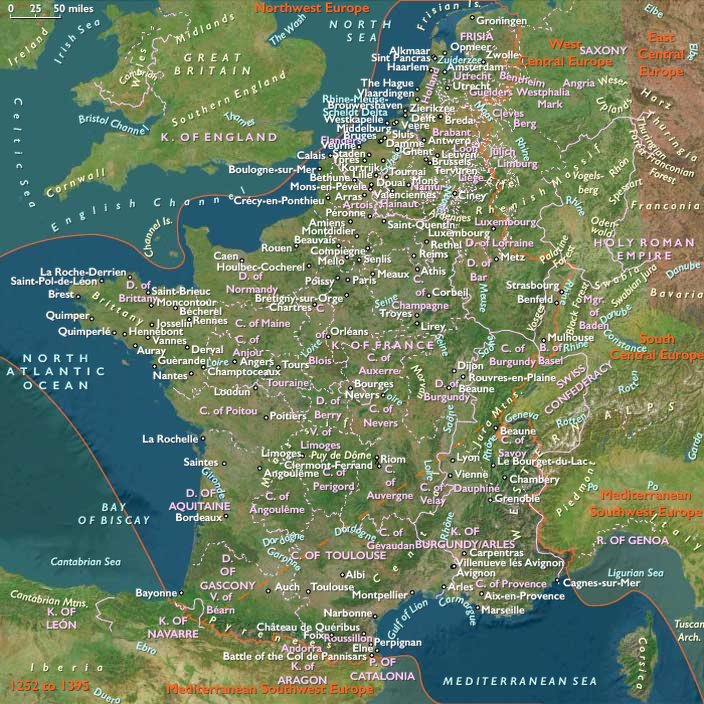
The duchy of Burgundy, ruled by a cadet branch of the Capetian dynasty since 1031, became vacant in 1361 when Philip of Rouvres, the last duke of the older Burgundian line, died without an heir. This led to Burgundy returning to the French Crown, but rather than permanently incorporating it into the royal domain, King John II of France granted the duchy as an appanage to his youngest son, Philip the Bold, in 1363.
Philip the Bold: From Prince to Duke of Burgundy
- Philip the Bold (Philippe le Hardi) was born in Pontoise in 1342, the fourth and youngest son of King John II of France and Bonne of Luxembourg.
- He earned his cognomen "the Bold" for his courage at the Battle of Poitiers (1356), where, at just fourteen years old, he fought beside his father and was captured alongside him by the English.
Previous Title: Duke of Touraine (1360–1363)
- In 1360, John II had granted Philip the Duchy of Touraine, an important territory in central France.
- However, in 1363, as a reward for his loyalty and bravery at Poitiers, Philip returned Touraine to the Crownin exchange for a greater prize—the Duchy of Burgundy.
The New Duke of Burgundy (1363–1404)
- With the death of Philip of Rouvres (1361), King John II took direct control of Burgundy before granting it to Philip the Bold in 1363.
- This marked the foundation of the Valois-Burgundy dynasty, which would become one of the most powerful ruling houses in medieval Europe.
- Philip ruled Burgundy as an independent power base, using it to expand his influence across France, the Low Countries, and beyond.
Impact and Legacy
- Philip the Bold’s rule over Burgundy (1363–1404) transformed the duchy into a major European power, leading to the rise of the Burgundian state, which would play a crucial role in French and European politics for over a century.
- His marriage to Margaret III of Flanders (1369) brought rich Flemish territories under Burgundian control, making the Duchy of Burgundy a rival to the French monarchy.
- The Valois Dukes of Burgundy would eventually challenge the French Crown, culminating in the Burgundian Wars of the 15th century.
The transfer of Burgundy to Philip the Bold in 1363 laid the foundation for a powerful and semi-independent Burgundian state, turning the duchy into a dominant political force that would shape the future of France and the Low Countries.
Locations
People
Groups
Topics
Commodoties
Subjects
Regions
Subregions

Related Events
Showing 10 events out of 43965 total
Years: 1363 - 1363
Locations
People
Groups
Topics
Commodoties
Subjects
Regions
Subregions