
Atlantic West Europe (1396–1539 CE): Burgundian Prestige, …
Years: 1396 - 1539
Atlantic West Europe (1396–1539 CE): Burgundian Prestige, French Recovery, and Netherlandish Flourishing
Geographic & Environmental Context
The subregion of Atlantic West Europe includes the Atlantic and Channel coasts of France, the Loire Valley, Burgundy, northern France (including Paris), and the Low Countries (Belgium, the Netherlands, Luxembourg). Anchors included the Channel ports (Calais, Rouen, Dieppe, Antwerp, Bruges, Amsterdam), the Loire valley (Orléans, Tours, Nantes), the Burgundian heartlands (Dijon, Beaune), and the Paris Basin. This zone blended coastal trade hubs, fertile river valleys, and political cores, linking France, England, and the Holy Roman Empire.
Climate & Environmental Shifts
The Little Ice Age imposed cooler winters and erratic harvests:
-
Paris Basin & Burgundy: Periodic frosts reduced wheat and grape harvests.
-
Loire valley: Vineyards and orchards remained productive in most decades but saw occasional setbacks from floods and cold snaps.
-
Low Countries: Waterlogged fields required dike maintenance; storm surges (notably 15th-century North Sea floods) devastated coastal settlements.
-
Atlantic coasts: Rough seas complicated fishing and shipping; herring and cod fisheries persisted, anchoring diets.
Subsistence & Settlement
-
Agriculture: Wheat, rye, oats, and barley; vineyards in Burgundy and the Loire; flax and hemp in Flanders; dairy and cattle in the Low Countries.
-
Fishing: Channel and North Sea fisheries for herring, cod, and flatfish; salted and barrelled for trade.
-
Urban centers: Paris as royal capital; Bruges, Antwerp, Ghent, and Brussels as mercantile and craft hubs; Rouen, Dieppe, and Bordeaux on the Atlantic coast.
-
Craft production: Flemish cloth, Burgundian wines, and Parisian luxury goods (illuminated manuscripts, metalwork).
Technology & Material Culture
-
Agrarian systems: Three-field rotation, water- and windmills, improved plows in northern France and the Low Countries.
-
Textiles: Flemish woolens, later outpaced by English cloth but still dominant; silk and luxury fabrics in Lyon by early 16th century.
-
Architecture: Gothic cathedrals (Rouen, Chartres), Burgundian ducal palaces, Flemish town halls, and belfries; early Renaissance style appeared in royal châteaux along the Loire.
-
Print: Presses in Paris, Lyon, Antwerp; humanist works circulated widely.
Movement & Interaction Corridors
-
Channel & Atlantic ports: Bruges (declining), Antwerp (rising after c.1500), and Rouen tied northern Europe to Iberia and the Mediterranean.
-
Loire River corridor: Linked Atlantic ports to Paris and Burgundy.
-
Burgundian roads: Connected Dijon and Brussels to the Empire and France.
-
Pilgrimage routes: To Chartres, Mont-Saint-Michel, and Santiago via Atlantic ports.
Cultural & Symbolic Expressions
-
Burgundian court culture: Centered at Dijon and Brussels under the Valois dukes (Philip the Good, Charles the Bold); patronized Jan van Eyck, Rogier van der Weyden, and courtly pageantry.
-
French monarchy: Reasserted authority after the Hundred Years’ War; patronage of the arts flourished under Francis I, who embraced the Renaissance.
-
Netherlandish art: Early Netherlandish painters pioneered oil painting; civic patronage in Ghent, Bruges, and Antwerp thrived.
-
Religious life: Catholic piety remained dominant; confraternities, processions, and urban guild altars structured devotion. Reformist murmurs appeared by early 16th century.
Environmental Adaptation & Resilience
-
Dike building & poldering: Secured farmland in the Low Countries; towns rebuilt after floods.
-
Diversification: Farmers planted grains, vines, flax, and maintained cattle to spread risk.
-
Grain storage & trade: Surpluses from fertile regions like Artois and Flanders mitigated poor harvests elsewhere.
-
Urban resilience: Guild charities, hospitals, and beguinages provided relief in lean years.
Technology & Power Shifts (Conflict Dynamics)
-
Hundred Years’ War (1337–1453): Culminated in Joan of Arc’s campaigns (1429) and the Battle of Castillon (1453), restoring French control of most territory.
-
Burgundian Wars (1474–1477): Charles the Bold fell at the Battle of Nancy (1477); his lands were split between France and the Habsburgs.
-
French monarchy: Consolidated Loire valley as a royal heartland; launched the Italian Wars (1494–1559)under Charles VIII, Louis XII, and Francis I, drawing Burgundy and French Atlantic ports into continental conflict.
-
Low Countries: Fell under Habsburg rule after the Burgundian inheritance (1477–1482); Antwerp rose as a Habsburg entrepôt, drawing Iberian spice and silver trades by 1500.
-
Franco-Imperial rivalry: Battle of Pavia (1525) saw Francis I captured by Charles V, marking Habsburg predominance; northern France became a frontier of war finance and recruitment.
Transition
By 1539 CE, Atlantic West Europe had shifted from Hundred Years’ War devastation to Renaissance resurgence and early global entanglement. France’s Loire valley glittered with Renaissance châteaux; Burgundy had been absorbed into Valois and Habsburg spheres; the Low Countries emerged as Europe’s commercial heart, with Antwerp surpassing Bruges. Coastal fisheries and Channel ports endured climatic strain, but shipping and finance tied the region ever more tightly to Iberian Atlantic empires. Rivalries between Valois France and Habsburg Spain–Netherlands shaped a region poised at the forefront of European conflict and global expansion.
People
- Charles V, Holy Roman Emperor
- Charles VIII of France
- Charles the Bold
- Clément Marot
- Desiderius Erasmus of Rotterdam
- Francesco Primaticcio
- Francis I of France
- Giovanni da Verrazzano
- Hieronymus Bosch
- Ignatius of Loyola
- Jacques Cartier
- Jan van Eyck
- Joan of Arc
- Louis XI of France
- Louis XII of France
- Paracelsus
- Philip the Good
- Rogier van der Weyden
- Rosso Fiorentino
Groups
- Dutch people
- Flanders, County of
- Habsburg, House of
- Burgundy, Duchy of
- Christians, Roman Catholic
- Holland, County of
- Franche-Comté
- England, (Plantagenet, Angevin) Kingdom of
- Brabant, Duchy of
- Holy Roman Empire
- France, (Valois) Kingdom of
- Hanseatic League
- Netherlands, Burgundian
- England, (Plantagenet, Lancastrian) Kingdom of
- Holy Roman Empire
- England, (Plantagenet, Yorkist) Kingdom of
- England, (Plantagenet, Lancastrian) Kingdom of
- England, (Plantagenet, Yorkist) Kingdom of
- Franche-Comté (province of the Holy Roman Empire)
- Netherlands, Habsburg
- England, (Tudor) Kingdom of
- Protestantism
Topics
- Hundred Years' War
- Humanism, Renaissance
- Renaissance Architecture
- Age of Discovery
- Agincourt, Battle of
- Northern Renaissance
- Hundred Years' War: French Victory
- Renaissance, Northern
- Burgundian Wars
- Burgundian Wars
- Burgundian Succession, War of the
- Renaissance in the Low Countries
- Renaissance, French
- Cartier's explorations of North America
Commodoties
- Fish and game
- Domestic animals
- Grains and produce
- Textiles
- Fibers
- Strategic metals
- Beer, wine, and spirits
- Manufactured goods
Subjects
- Commerce
- Architecture
- Painting and Drawing
- Conflict
- Exploration
- Faith
- Government
- Scholarship
- Custom and Law
- Medicine
- Alchemy
Regions
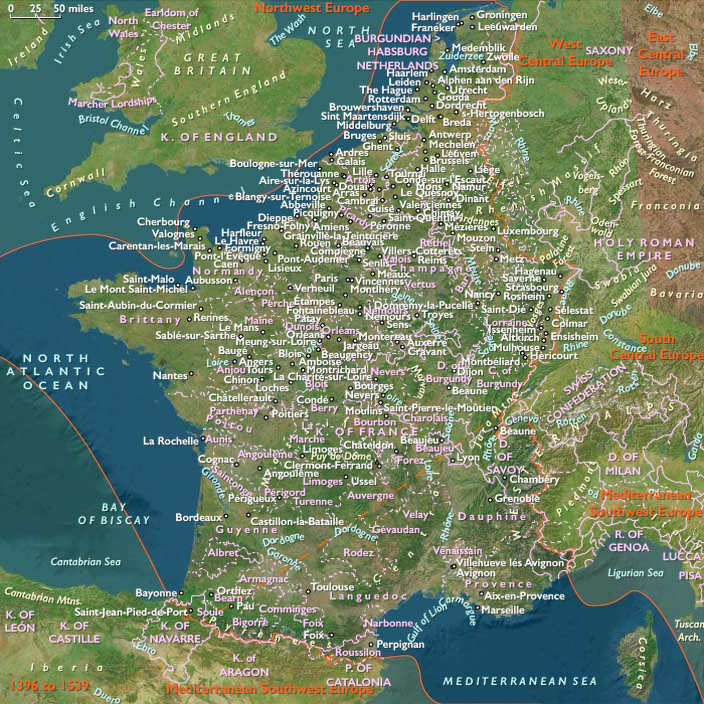
Subregions
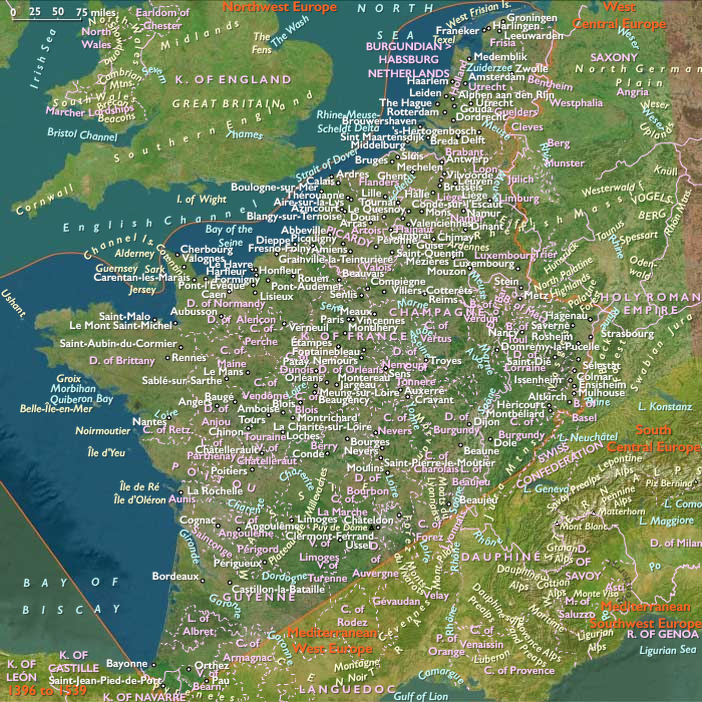
Years: 1396 - 1539
People
- Charles V, Holy Roman Emperor
- Charles VIII of France
- Charles the Bold
- Clément Marot
- Desiderius Erasmus of Rotterdam
- Francesco Primaticcio
- Francis I of France
- Giovanni da Verrazzano
- Hieronymus Bosch
- Ignatius of Loyola
- Jacques Cartier
- Jan van Eyck
- Joan of Arc
- Louis XI of France
- Louis XII of France
- Paracelsus
- Philip the Good
- Rogier van der Weyden
- Rosso Fiorentino
Groups
- Dutch people
- Flanders, County of
- Habsburg, House of
- Burgundy, Duchy of
- Christians, Roman Catholic
- Holland, County of
- Franche-Comté
- England, (Plantagenet, Angevin) Kingdom of
- Brabant, Duchy of
- Holy Roman Empire
- France, (Valois) Kingdom of
- Hanseatic League
- Netherlands, Burgundian
- England, (Plantagenet, Lancastrian) Kingdom of
- Holy Roman Empire
- England, (Plantagenet, Yorkist) Kingdom of
- England, (Plantagenet, Lancastrian) Kingdom of
- England, (Plantagenet, Yorkist) Kingdom of
- Franche-Comté (province of the Holy Roman Empire)
- Netherlands, Habsburg
- England, (Tudor) Kingdom of
- Protestantism
Topics
- Hundred Years' War
- Humanism, Renaissance
- Renaissance Architecture
- Age of Discovery
- Agincourt, Battle of
- Northern Renaissance
- Hundred Years' War: French Victory
- Renaissance, Northern
- Burgundian Wars
- Burgundian Wars
- Burgundian Succession, War of the
- Renaissance in the Low Countries
- Renaissance, French
- Cartier's explorations of North America
Commodoties
- Fish and game
- Domestic animals
- Grains and produce
- Textiles
- Fibers
- Strategic metals
- Beer, wine, and spirits
- Manufactured goods
Subjects
- Commerce
- Architecture
- Painting and Drawing
- Conflict
- Exploration
- Faith
- Government
- Scholarship
- Custom and Law
- Medicine
- Alchemy
Regions
Subregions