
The Bulgars, a Turkic people who are …
Years: 628 - 639
The Bulgars, a Turkic people who are first mentioned in the sources toward the end of the fifth century CE, live at this time in the steppes to the north of the Black Sea.
The Bulgar tribes are composed of skilled, warlike horsemen governed by khans (chiefs) and boyars (nobles).
The Avars had subdued the Bulgars in the sixth century.
Kubrat (also Kurt or Houvrat) is of the kingly Dulo clan, with the authority of the Western Turkic Khaganate, and the rightful heir of the Bulgar throne.
He had spent his adolescence in Constantinople, where he was educated and baptized, while his maternal uncle Organa ruled over his tribe.
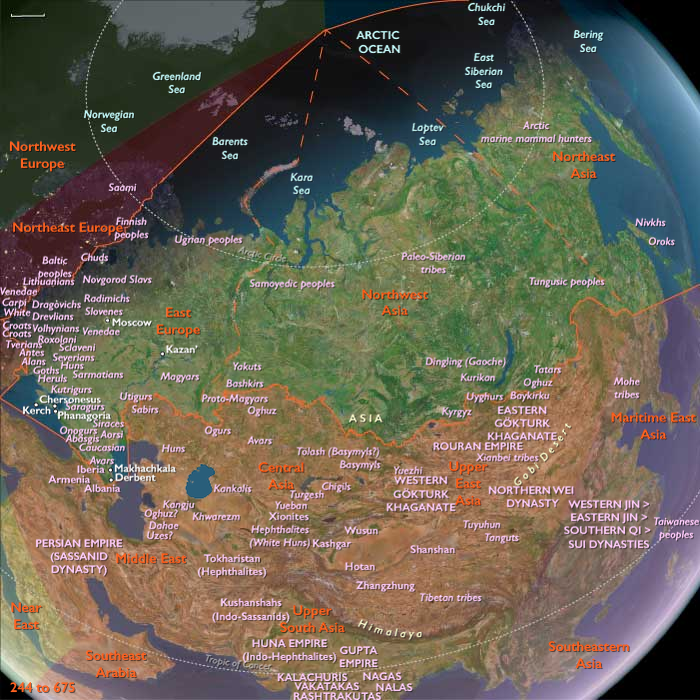
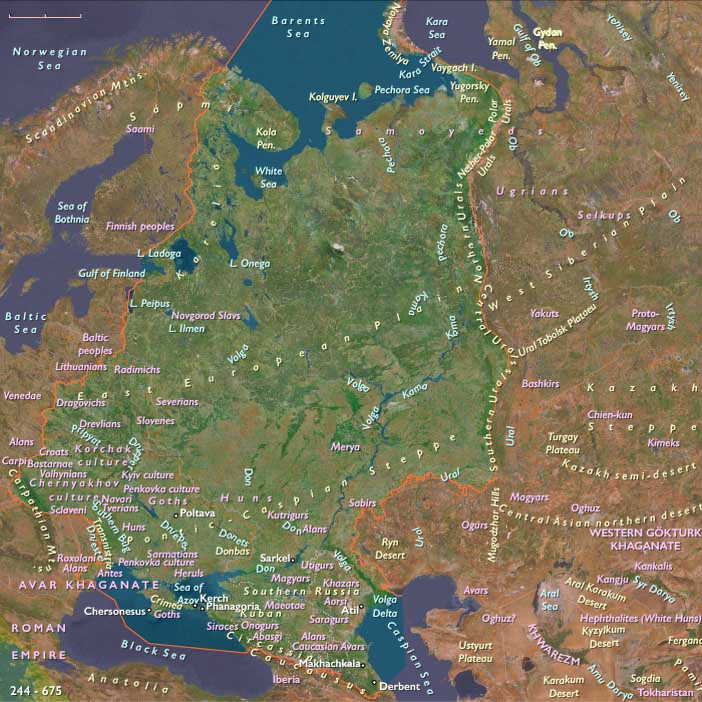
Kubrat returns to his fatherland around 628 to become khagan over the Crimean Huns with the support of the Onogur, who have always violently opposed the European Avar Khaganate.
Khan Kubrat manages to unite the two main Bulgar tribes of Kutrigur and Utigur under a single rule between 630 and 635, creating a powerful confederation which is referred to by the medieval authors as The Old Great Bulgaria and also known as The Onogundur-Bulgar Empire.
Some scholars assume that it also included among its subjects a significant portion of the defeated Avars and stretched as far west as the Pannonian plain.
It is presumed that Kubrat’s capital was the ancient city of Phanagoria on the Taman peninsula.
Locations
People
Groups
- Bulgars
- Wends, or Sorbs (West Slavs)
- Utigurs
- Kutrigurs
- Avar Khaganate (Eurasian Avars)
- Western Turkic Khaganate
- Roman Empire, Eastern: Heraclian dynasty
- Austrasia, Frankish Kingdom of
- Bulgaria, “the Old Great “, (Onogur) Khaganate of
Topics
Commodoties
Subjects
Regions
Subregions
Related Events
Showing 6 events out of 6 total
Years: 628 - 639
Locations
People
Groups
- Bulgars
- Wends, or Sorbs (West Slavs)
- Utigurs
- Kutrigurs
- Avar Khaganate (Eurasian Avars)
- Western Turkic Khaganate
- Roman Empire, Eastern: Heraclian dynasty
- Austrasia, Frankish Kingdom of
- Bulgaria, “the Old Great “, (Onogur) Khaganate of
Topics
Commodoties
Subjects
Regions
Subregions