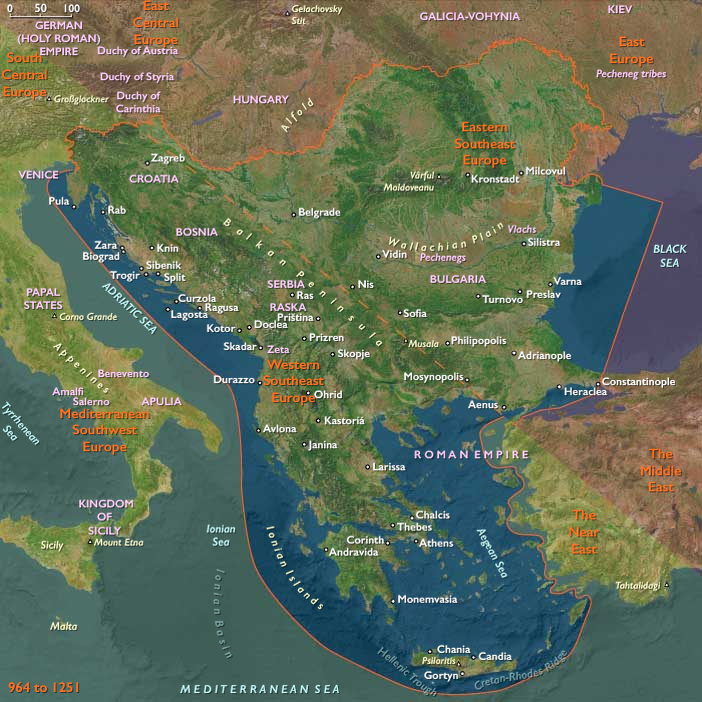
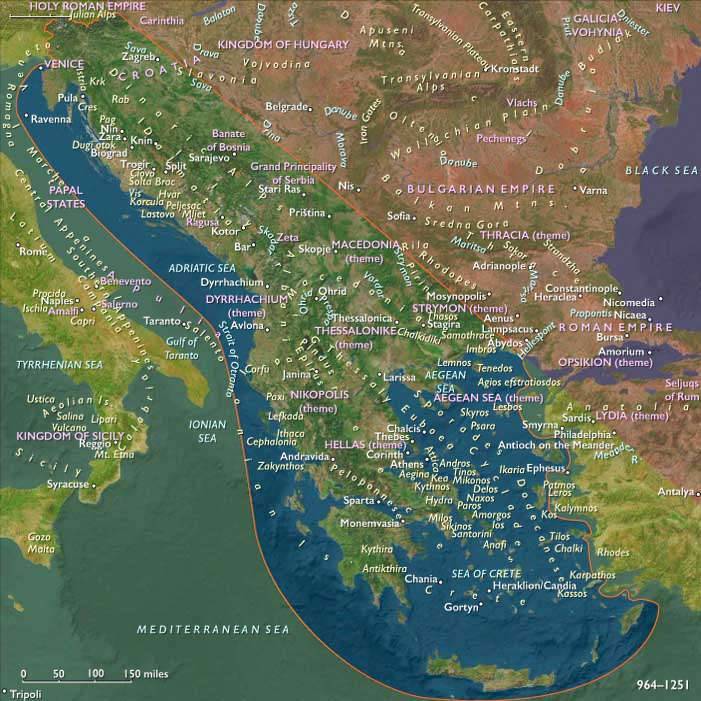
…the Bulgarians continue south. They march …
Years: 995 - 995
…the Bulgarians continue south.
They march through Thessaly, overcome the defensive wall at Thermopylae and …
Locations
People
Groups
- Arab people
- Greeks, Medieval (Byzantines)
- Bulgarians (South Slavs)
- Hellas, Theme of
- Peloponnese (theme)
- Thessalonica, East Roman Theme of
- Roman Empire, Eastern: Macedonian dynasty
- Bulgarian Empire, First
Topics
- Arab-Byzantine Wars
- Byzantine-Bulgarian Wars
- Bulgaria, Byzantine conquest of
- Bulgarian-Byzantine War of 981-1018
- Byzantine-Muslim War of 994-99
- Thessalonica, Battle of
Commodoties
Subjects
Regions
Subregions
Related Events
Filter results
Showing 10 events out of 52171 total
Rumors have begun to surface in Norway in 995 about a king in Ireland of Norwegian blood.
This catches the ear of Jarl Haakon, who had sent Thorer Klakka to Ireland, posing as a merchant, to see if he was the son of Tryggve Olafson.
Haakon told Thorer that if it were him, to lure him to Norway, so Haakon could have him under his power.
Thorer had befriended Olaf and told him of the situation in Norway, that Haakon Jarl had become unpopular with the populace, because he often took daughters of the elite as concubines, which was his right as ruler.
He quickly grew tired of them and sent them home after a week or two. (A number of textually related sources also recount Earl Haakon's predilection for raping women, whether the daughters of nobles or of commoners.)
He had also been weakened by his fighting with the Danish king, due to his rejection of the Christian faith.
Olaf seizes this opportunity, and sets sail for Norway.
A quarrel breaks out in spring 995 between Haakon II Sigurdsson Jarl, de facto ruler of Norway for a quarter-century, and the Trønders, the dominant tribe inhabiting central Norway and east central Sweden, just as Olaf Tryggvason arrives.
Haakon quickly loses all support and goes into hiding in a hole dug in a pigsty, together with one of his slaves, Tormod Kark.
When Olaf meets the rebels, they accept him as their king, and together they start to search for Haakon.
They eventually come to the farm where Haakon and Kark are hiding, but cannot find them.
Olaf hols a meeting just outside the pigsty and promises a great reward for the man who kills the Jarl.
The two men in the hole hear this speech, and Haakon becomes distrustful of Kark, fearing he will kill him to claim the price.
He cannot leave the sty, nor can he keep awake forever, and when he falls asleep Kark takes out a knife and cuts off Haakon's head.
The next day, the slave goes to meet Olaf and presents him with the head of Haakon.
The king does not reward him, and instead beheads the slave.
Olaf, after his confirmation as King of Norway, travels to the parts of Norway that had not been under the rule of Haakon but of that of the King of Denmark; they, too, swear allegiance to him.
He then demands that they all be baptized, and, most reluctantly, they agree.
Haakon’s two sons Eric and Sven, and several others, flee to …
…the new king of Sweden, Olof Skötkonung, and the Hakon Jarl Runestones may refer to them.
Eric I the Victorious is the first Swedish king about whom anything definite is known.
His original territory lay in Uppland and neighboring provinces.
He had been victorious over an invasion from the south in the Battle of the Fýrisvellir close to Uppsala.
The extent of his kingdom is unknown.
In addition to the Swedish heartland around Lake Mälaren, it may have extended down the Baltic Sea coast as far south as Blekinge.
According to the Flateyjarbok, his success was due to the fact that he allied with the peasants against the nobility, and it is obvious from archaeological findings that the influence of the latter diminished during the last part of the tenth century.
He was also, probably, the introducer of the famous medieval Scandinavian system of universal conscription known as the ledung in the provinces around Mälaren.
According to Adam of Bremen, Eric allied himself with the Polish prince Boleslav to conquer Denmark and chase away its king Sweyn Forkbeard.
He proclaimed himself the king of Sweden and Denmark which he ruled until his death, which would have taken place in the mid-990s.
Adam says that Eric was baptized in Denmark, but later returned to the Norse gods.
Adam of Bremen gives Emund Eriksson as Eric's predecessor.
In all probability he founded the town of Sigtuna, which still exists and where the first Swedish coins were stamped for Olof Skötkonung, Eric’s son by Sigrid the Haughty, who some sources say was the daughter of the powerful Swedish Viking Skoglar Toste.
According to the Sagas, Olof's father ruled together with Eric's brother Olof Björnsson.
When Olof Björnsson died, Olof had been proclaimed co-ruler instead of his cousin Styrbjörn Starke.
This happened before he was even born.
At his father's death, he inherits the throne of Sweden and becomes its sole ruler.
Olof is the first king known for certain to have ruled over both the Svear and the Götar, Sweden’s two main peoples.
Our knowledge of Olof is mostly based on Snorri Sturluson's and Adam of Bremen's accounts, which have been subject to criticism from scholars.
According to Adam of Bremen, Sweyn Forkbeard had been forced to defend his Danish kingdom from attacks by Olof who had claimed the Danish throne.
The conflict is resolved by Sweyn's marriage with Olof's mother and the two kings are hereafter allies.
Germany had suffered an outbreak of famine and pestilence in 993.
In 994 and 995, Otto III has led fruitless campaigns against the northern Slavs and the Vikings, but he had successfully reconquered Brandenburg in 993, and in 995 he subdues the Obotrite Slavs.
After Otto III reaches his majority in the autumn of 995, he again takes to the field against the Lutici, this time aided by the Polish Duke Boleslaw I Chrobry.
Boleslaw has spent the first years as ruler more concerned about gaining the throne and remaining on it than trying to increase the size of his dominion, or so it appears from the lack of any record of international activity.
It is during this period of consolidation of power that he allies himself with Otto III, and in 995 he aids the German Emperor in his expedition against the Lusatians.
Adalbert cannot stay in Bohemia after the tragedy and escapes from Prague, despite the Pope's call for him to return to his episcopal see.
Strachkvas is eventually appointed to be his successor.
However, when he is about to assume the bishopric, he suddenly dies during the ceremony.
Circumstances of his death remain unclear.
Gera, a city on the river Weiße Elster (literally the "White Magpie"), about thirty-five miles (fifty-five kilometers) southwest of Leipzig, is first mentioned in written sources in 995.
Gera is today the third largest city in the German state of Thuringia after Erfurt, the Thuringian capital, and Jena.
The Zličané, or Zlitschanen, one of the oldest Czech tribes, had settled in the eastern fold of Bohemia, are the second most powerful tribe in the region.
The Zličan princedom, centered upon the the gord of Libice located at the confluence of the rivers Cidlina and Elbe (Labe), rivals Prague.
Prince Slavník, the founder of the principality, governs the Zličané, as well as the Charvats and Doudlebs tribes, gord Stará (Old) Kouřim and probably also the Świdnica town.
Slavník, a rich and independent ruler who supposedly has consanguinity with the Babenberg Saxon kings, is married to Střezislava, a woman of remarkable beauty, allegedly from the Přemyslid house.
Slavník is also friendly with the Polish royal family, the Piasts.
Slavník has at least seven sons, among whom two —Vojtěch (Adalbert) and the illegitimate Radim (Gaudentius)—will later became saints.
According to Cosmas' Chronicle, Slavník was a happy man all his lifetime.
Vojtěch, who had been born around 956 in Libice nad Cidlinou, has five full brothers: Soběbor (Slavnik's heir), Spytimir, Pobraslav, Porej, Caslav and a half-brother, Radim, from his father's liaison with another woman.
Radim had chosen a clerical career, as had Vojtěch, and the name Gaudentius.
Adalbert is well-educated, having studied for about ten years under Adalbert of Magdeburg, who will later be canonized and be known as the Apostle of the Slavs.
After completing his studies at Magdeburg he had returned to Prague, where he had become a priest.
His father had died in 981, as had Adalbert; upon the death of his mentor, he had taken on the name Adalbert.
Adalbert, still not yet thirty years old, had become the Bishop of Prague in 982.
However, he strongly resented the participation of formally Christian inhabitants in the slave trade.
Although Adalbert descends from a rich family and could afford comfort and luxury, he lives poorly of his own free will.
Gifted and industrious, Adalbert had soon become well-known all over Europe, noted for charity, austerity, and zealous service to the Church.
His duty is difficult even in baptized Bohemia, as the pagan creed is deeply embedded in the peoples' minds.
Adalbert has complained of polygamy and idolatry, which still are not unusual among the Czechs.
Resigned his bishopric and leaving Prague in 989, he had gone to Rome to live as a hermit in St. Alexis Benedictine monastery.
Four years later, in 993, Pope John XV had sent him back to Bohemia, where Adalbert had again become Bishop, founding a monastery in Břevnov, near Prague, the first one for men in the Czech lands.
However, he has continued to meet with the same kind of opposition to his ministry from the nobility that he had faced earlier.
Also, according to Cosmas' chronicle, high clerical office is a burden to Adalbert, and in 994 he had offered it to Strachkvas, the brother of the Přemyslid Duke Boleslav, but Strachkvas refuses.
War between Poland and Bohemia is continual in this period and by 990 Boleslaus the Brave had occupied Silesia.
Meanwhile, Prince Soběbor had rushed to consolidate the princedom's independence, coining money in Libice, (known among numismatists as the silver senars), in spite of the primacy of Prague, and taking other separatist measures.
This is a direct challenge to Boleslav II, head of the Přemyslid family.
As the Přemyslids cannot afford any mighty rivals, Boleslav is determined to add the Slavniks lands to his kingdom.
On September 28, 995, Boleslaus and his confederates, the powerful Czech clan known as the Vršovci, storm Libice and massacre the Slavník dynasty, hunting them down and killing them where they find them, even in church.
Only three family members survive because they are absent from Libice: Soběbor, Radim (Gaudentius), the later archbishop of Gniezno (Hnězdno) and St. Adalbert, who damns the Vršovci in a church for their cruelty and predicts that they will be severely persecuted.
Soběbor, who had been in Germany during the massacre of his family, gains sanctuary in Poland from its Piast prince, Boleslaus.
Thus does the Zličan princedom becomes part of the Přemyslids' estate, Boleslaus' brutal triumph having ensured the unity of Bohemia under a single ruler.

Basil II aims solely at the extension and consolidation of imperial authority at home and abroad.
The main fields of external conflict are in Syria, Armenia, and Georgia on the eastern front, in the Balkans, and in southern Italy.
He has maintained the imperial position in Syria against aggression stirred up by the Fatimid dynasty in Egypt and on occasion has made forced marches from Constantinople across Asia Minor to relieve Antioch.
By aggression and by diplomacy, he has secured land from Georgia and from Armenia, with the promise of more to come on the death of the Armenian ruler.
Basil launches a lightning campaign against the Muslim Arabs in 995, personally leading an army of forty thousand men (with eighty thousand mules).
Riding through Anatolia in sixteen days, he reaches Aleppo in April 995, forcing the Fatimid army to retreat without giving battle, taking over the Orontes valley, and raiding further south.
The imperial army, after besieging Tripolis unsuccessfully, …
…occupies Tartus, which they refortify and garrison with Armenian troops.
Years: 995 - 995
Locations
People
Groups
- Arab people
- Greeks, Medieval (Byzantines)
- Bulgarians (South Slavs)
- Hellas, Theme of
- Peloponnese (theme)
- Thessalonica, East Roman Theme of
- Roman Empire, Eastern: Macedonian dynasty
- Bulgarian Empire, First
Topics
- Arab-Byzantine Wars
- Byzantine-Bulgarian Wars
- Bulgaria, Byzantine conquest of
- Bulgarian-Byzantine War of 981-1018
- Byzantine-Muslim War of 994-99
- Thessalonica, Battle of