The Bulgarian Empire has by 815 expanded …
Years: 815 - 815
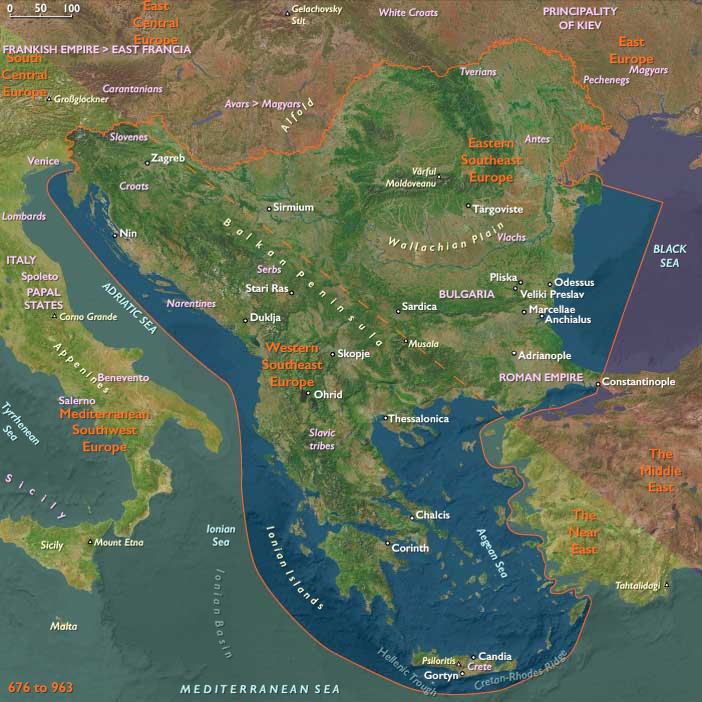
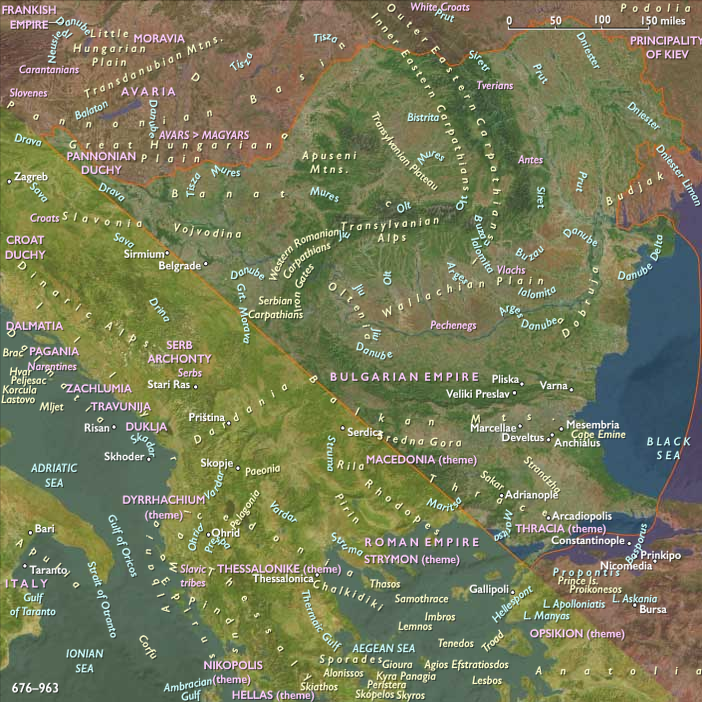
The Bulgarian Empire has by 815 expanded its territory south to include Macedonia, eastward to the Black Sea, and …
Locations
People
Groups
- Slavs, South
- Greeks, Medieval (Byzantines)
- Bulgarian Empire (First)
- Macedonia, East Roman Theme of
- Roman Empire, Eastern: Non-dynastic
Topics
Commodoties
Subjects
Regions
Subregions
Related Events
Filter results
Showing 10 events out of 54707 total
The poet Bai Juyi had returned to the Tang court in the winter of 814, where he holds the title of Assistant Secretary to the Prince's Tutor.
It s not a high-ranking position, but nevertheless one which he is soon to lose.
While serving as a minor palace official in 814, Bai had managed to get himself in official trouble.
He has made enemies at court and with certain individuals in other positions.
It is partly his written works that have lead him into trouble.
He has written two long memorials, translated by Arthur Waley as "On Stopping the War", regarding what he considered to be an overly lengthy campaign against a minor group of Tatars; and he has written a series of poems, in which he satirizes the actions of greedy officials and highlights the sufferings of the common folk.
At this time, one of the post-An Lushan warlords (jiedushi), Wu Yuanji in Henan, had seized control of Zhangyi Circuit (centered in Zhumadian), an act for which he seeks reconciliation with the imperial government, trying to get an imperial pardon as a necessary prerequisite.
Despite the intercession of influential friends, Wu is denied, thus officially putting him in the position of rebellion.
Still seeking a pardon, Wu turns to assassination, blaming the Prime Minister (another Wu, Wu Yuanheng) and other officials.
The imperial court generally begins by dawn, requiring the ministers to rise early in order to attend in a timely manner; and, on July 13, 815, before dawn, the Tang Prime Minister Wu Yuanheng is set to go to the palace for a meeting with Emperor Xianzong.
As he leaves his house, arrows are fired at his retinue.
His servants all flee, and the assassins seize Wu Yuanheng and his horse, then decapitate him, taking his head with them.
The assassins also attack Pei Du, another official who favors the campaign against the rebellious warlords, but are unable to kill him.
The people at the capital are shocked and there is turmoil, with officials refusing to leave their personal residences until after dawn.
In this context, Bai Juyi oversteps his minor position by memorializing the emperor.
As Assistant Secretary to the Prince's Tutor, Bai's memorial is a breach of protocol—he should have waited for those of censorial authority to take the lead before offering his own criticism.
This is not the only charge which his opponents use against him.
His mother had died, apparently caused by falling into a well while looking at some flowers, and two poems written by Bai Juyi—the titles of which Waley translates as "In Praise of Flowers" and "The New Well"—are used against him as a sign of lack of filial piety, one of the Confucian ideals.
The result is exile: …

…Bai Juyi is demoted to the rank of Sub-Prefect and banished from the court and the capital city to Jiujiang, at this time known as Xun Yang on the southern shores of the Yangtze River in northwest Jiangxi Province, China.
After three years he was sent as Governor of a remote place in Sichuan.
At the time, the main travel route from the capital is up the Yangtze River.
This trip allows Bai Juyi a few days to visit his friend Yuan Zhen, who is also in exile and with whom he explores the rock caves located at Yichang.
Bai Juyi isdelighted by the flowers and trees for which his new location is noted.
…Bai Juyi writes another popular long poem in 816, “The Lute Song.”
Bulgaria also faces religious problems, as the growing number of Christians disturbs Omurtag: the Khan begins anti-Christian persecutions, to which his eldest son Enravota also falls victim.
In addition, the Bulgarians have to restore their economy following the bloody conflicts of the first decade of the century, while their capital Pliska still lies in ruins.
…northwest to present-day Belgrade.
Al-Ma'mun, in attempting to end the division in Islam between the Shiites (who believe in the divinity of Ali ibn Abi Talib and his descendants) and the Sunnites (who believe in the divinity of the three caliphs preceding Ali), prompts Shiite radicals, the Alids, to rebellion.
In early 815, the Zaydi Alid revolt of Ibn Tabataba and Abu 'l-Saraya al-Sirri beaks out at Kufa and spreads quickly through southern Iraq.
Hasan proves unable to confront the Alids and the rebels at one point threaten Baghdad itself before the intervention of Harthama leads to the suppression of the revolt after the capable general captures and beheads Abu ‘l-Saraya.
The domination of the Caliphate by Fadl and the Khurasanis around him however arouses great opposition among the old-established Abbasid elites at Baghdad, and Hasan is forced to abandon the city, where various factional leaders share power.
Al-Hakam, the Umayyad emir of Córdoba, crushes a revolt in Toledo by Spanish Christians and Jews in in 815; this is a notable exception to the decades-long Pax Islamica.
The Anglo-Saxon Chronicle records that in 815 Egbert ravaged the whole of the territories of the remaining British kingdom, Dumnonia, known to the author of the Anglo-Saxon Chronicle as the West Welsh; their territory is about equivalent to what is now Cornwall.
Omurtag sends emissaries to Constantinople to negotiate the peace in the beginning of 815.
The signing ceremony is a solemn event and performed in the presence of numerous people.
The agreement envisages that the Emperor must vow according to the pagan Bulgarian customs and Omurtag's emissaries according to the Christian laws.
The Byzantine historians, outraged by the emperor's actions, recorded that the "most Christian" ruler had to pour out water on the ground from a cup, to personally turn round horse saddles, to touch triple bridle and to lift grass high above the ground.
Another historian added that Leo V had to even cut up dogs as witnesses to his vow.
The treaty of 815 between the Empire and Bulgaria determines the boundary between the two countries and provides a thirty-year peace.
Although the treaty is in Bulgaria's favor, it is a welcome respite for Constantinople, which has had to regroup its forces after successive defeats, and which faces another round of internal turmoil because of the revival of iconoclasm.
Harthama had remained in Iraq after helping al-Mamun to capture Baghdad, and had played a leading role in defeating the pro-Alid revolt of Abu 'l-Saraya al-Sirri in 815.
Soon after he had been appointed as governor of Arabia and Syria, but instead of taking up his post Harthama has come east with the intention of appraising al-Ma'mun, who has remained in Merv, of the real situation in Iraq, and especially the resentment caused by the government's domination by a group of Khurasanis around al-Ma'mun's vizier, al-Fadl ibn Sahl.
Al-Fadl and his supporters are however able to turn al-Ma'mun against Harthama, who is imprisoned and executed in June 816.
In response to the news of his execution, Harthama's son Hatim, the governor of Arminiya, leads a rebellion that is however cut short by his own death.
Al-Ma'mun gradually changes his policy.
When news of the Iraqi insurrection finally reaches al-Ma'mun, he abruptly decides to leave Merv for Baghdad.
The court party sets out from Merv for Baghdad.
Al-Ma'mun, having become caliph of the entire 'Abbasid empire, decides to continue to reside at Merv, assisted by the al-Fadl.
Determined to put an end to the division of the Islamic world between Sunnite and Shi'ite—between the adherents of the 'Abbasid caliphs, descendants of Muhammad's uncle al-'Abbas, and the defenders of 'Ali, the prophet's cousin and son-in-law, and his descendants—al-Ma'mun makes a decision that is startling to his contemporaries and injurious to his own position.
He designates as his heir not a member of his own family but instead 'Ali ar-Rida, eighth imam of the Twelver Shi'ites, who is a descendant of 'Ali.
In an attempt visibly to reconcile the two rival families, al-Ma'mun gives to 'Ali ar-Rida his daughter as a wife.
As a further symbol of reconciliation, he adopts the green flag in place of the traditional black flag of the 'Abbasid family.
Years: 815 - 815
Locations
People
Groups
- Slavs, South
- Greeks, Medieval (Byzantines)
- Bulgarian Empire (First)
- Macedonia, East Roman Theme of
- Roman Empire, Eastern: Non-dynastic