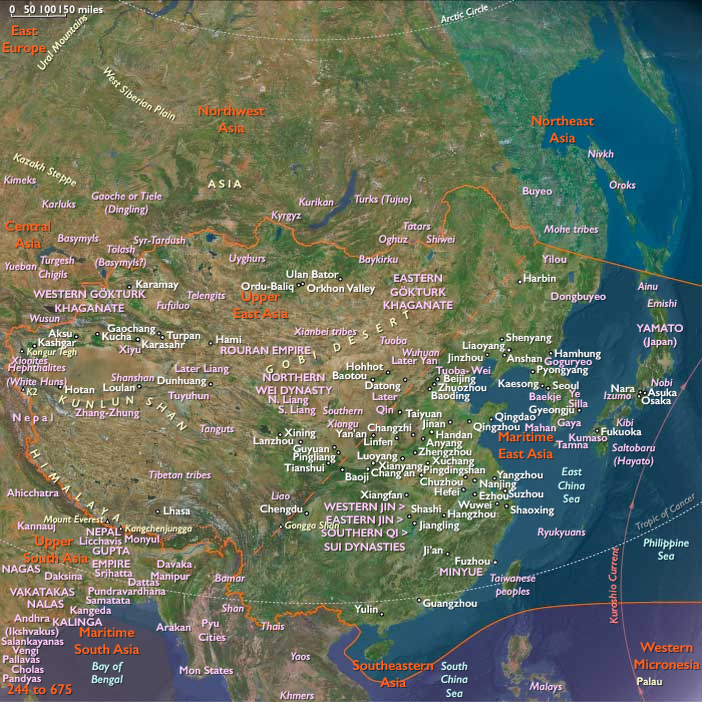
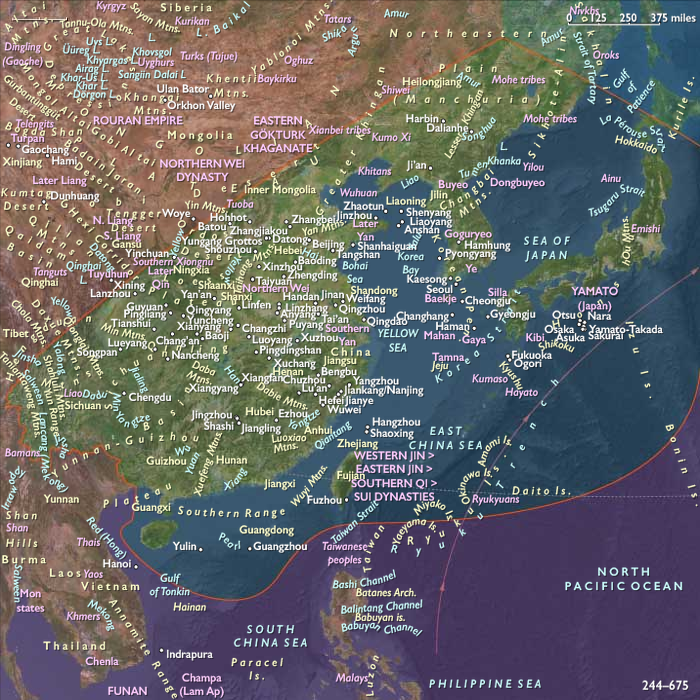
The Sui Dynasty of China between 598 …
Years: 592 - 603
The Sui Dynasty of China between 598 and 614 launches a series of wars against Goguryeo, located in the northern and central parts of the Korean Peninsula and the southern and central parts of inner and outer Manchuria.
Groups
- Korean people
- Chinese (Han) people
- Goguryeo (Koguryo), Kingdom of
- Sui Dynasty (Imperial Chinese dynasty)
Topics
Subjects
Regions
Subregions
Related Events
Filter results
Showing 10 events out of 57203 total
Hindus from southern India settle Palembang, in southern Sumatra, before 600.
The Chinese revolutionize cavalry warfare with the invention of the stirrup around 600.
The bubonic plague epidemic ends its fifty-two year run in Europe in 594, having killed a third of the population: a total of one hundred million in Asia, Europe and the Middle East.
The Earth's population, despite these losses, has risen in 600 to about two hundred and eight million people.
A military conflict in 602 between the Chinese Sui dynasty and Vietnamese Ly dynasty ends in a decisive Sui victory, the surrender of the Ly to the Sui, and the annexation of Van Xuan by the Sui.
The eastern Turk empire, closely linked to the empire of the Western Turks, begins to encounter grave difficulties caused partly by internal strife and partly by the aggressive Central Asian policies of northern China’s new Sui dynasty.
Oghuz Turks, Mediterranean Caucasoid in physical type, arrive on the Kazakh Uplands, a large peneplain formation extending throughout the central and eastern regions of present Kazakhstan, in 600.
After the Arab conquest, the Oghuz will expand across present Turkmenistan into the Middle East, and the Seljuq and Ottoman empires will develop.
Contemporary historians do not distinguish the Turkmen, who will appear as an ethnic group about CE 1000, from the Oghuz.
East Central Europe (592–603 CE): Avar Pressure, Slavic Territorial Solidification, and Early State Formation in Bohemia and Moravia
Between 592 and 603 CE, East Central Europe—encompassing Poland, Czechia, Slovakia, Hungary, and those portions of Germany and Austria lying east of 10°E and north of a line stretching from roughly 48.2°N at 10°E southeastward to the Austro-Slovenian border near 46.7°N, 15.4°E—experienced continued geopolitical evolution marked by the dominant presence of the Avar Khaganate, intensified Slavic settlement, and the early stages of state formation in the distinct West Slavic territories of Bohemia and Moravia. During this period, the Avars further strengthened their hold over the Carpathian Basin, increasing diplomatic and military pressure on neighboring territories, notably the emerging Slavic polities to their northwest and Bavarian duchy to the west.
Political and Military Developments
Avar Dominance and Expansion
-
The Avar Khaganate further consolidated its position in East Central Europe, exerting influence and pressure across territories ranging from Hungary and Slovakia southward into the northern Balkans.
-
Frequent Avar military campaigns and diplomatic pressures influenced regional stability, causing localized disruptions while prompting smaller neighboring powers, especially Bavarians and early Slavic communities, to develop stronger defensive measures.
Early Bohemian and Moravian Polities
-
In Bohemia, West Slavic communities increasingly unified under local leadership, establishing stronger, centralized tribal structures and fortifying settlements against potential Avar incursions. This period saw the roots of a distinct early Czech identity and leadership hierarchy forming in the region.
-
Similarly, in Moravia, emerging local polities consolidated under tribal chieftains, organizing effective defense and diplomatic responses to pressure from Avars to the southeast and interactions with Bavarians to the west.
Bavarian Diplomatic Role
-
Bavaria (Baiuvarii) continued to act as an influential political intermediary between Frankish, Slavic (especially Moravian), and Avar interests, carefully balancing regional alliances and trade partnerships.
Economic and Technological Developments
Expanded Trade Networks
-
Bohemia and Moravia played increasingly pivotal roles in regional trade networks, facilitating commercial interactions between Avar-controlled southern regions, Bavarian-controlled western territories, and Slavic groups to the north and east. Key commodities included agricultural products, textiles, iron goods, and luxury items from Byzantium.
Infrastructure Maintenance and Fortification
-
Local leadership in Bohemia and Moravia actively improved fortifications and settlements, reflecting growing political organization and providing protection against raids and external threats, particularly from the Avars.
Cultural and Artistic Developments
Distinct West Slavic Identities
-
Bohemian and Moravian Slavic communities further solidified their distinct cultural identities, evidenced by unique styles in pottery, jewelry, settlement patterns, and burial customs clearly differentiated archaeologically from other Slavic and neighboring cultures.
Avar Cultural Synthesis
-
The Avars continued to significantly influence regional culture through their distinctive artistic expressions, especially metallurgy and decorative arts, merging Central Asian steppe traditions with local European influences.
Settlement and Urban Development
Strengthened Bohemian and Moravian Settlements
-
Bohemia and Moravia experienced the growth of fortified settlements (hillforts) and stable villages, indicating increasing social organization and early signs of political centralization essential to future state formation.
Avar-Controlled Regional Centers
-
Important cities and strategic settlements, including Augusta Vindelicorum (Augsburg), Vindobona, and Aquincum, continued flourishing under Avar rule as vital administrative and trade hubs.
Social and Religious Developments
Bohemian and Moravian Social Hierarchies
-
In both Bohemia and Moravia, clear hierarchical structures emerged, featuring tribal chieftains, warrior aristocracies, and organized communal practices, establishing firm social foundations for future medieval duchies.
Avar Social and Political Stability
-
The Avars maintained highly organized social and military structures under the Khagan’s authority, further securing their regional dominance and stabilizing the extensive territories under their control.
Long-Term Consequences and Historical Significance
The era 592–603 CE was pivotal in shaping East Central Europe's early medieval landscape. Continued Avar dominance and intensified pressure catalyzed defensive and political developments among Slavic communities, particularly in Bohemia and Moravia, where early state structures began forming. Simultaneously, Bavaria's diplomatic and economic interactions with neighboring regions set essential patterns of commerce and alliance-building. These developments significantly influenced future medieval state formation and cultural identities, creating lasting frameworks that would define East Central Europe's historical trajectory.
Eastern Southeast Europe (592–603 CE): Adaptation and Strategic Resilience
Settlement and Migration Patterns
Persistent Migration and Adaptation
From 592 to 603 CE, Eastern Southeast Europe continued experiencing significant migratory movements, notably from Slavic and Avar groups. Settlements and urban communities adapted strategically to these demographic shifts, reinforcing defensive capacities and integrating new populations effectively.
Strengthened Urban Defenses
Urban centers such as Constantinople, Philippopolis, Adrianople, and Serdica maintained and enhanced robust fortifications. Strategic urban planning and infrastructure investments supported continued security and societal stability amidst ongoing external pressures.
Economic and Technological Developments
Economic Stability and Adaptive Trade
Regional economies demonstrated continued stability, with adaptive trading practices and consistent agricultural productivity sustaining economic resilience. Constantinople's central economic role remained pivotal, anchoring regional trade networks and resource allocation.
Military and Defensive Advances
Technological and infrastructural advancements emphasized military defense, including fortification upgrades, improved military logistics, and advanced strategic planning. These developments enhanced regional security, protecting economic and social continuity.
Cultural and Artistic Developments
Cultural Resilience and Continuity
Cultural activities remained vigorous, effectively integrating classical traditions and Christian symbolism. Artistic and communal projects reinforced cultural identity and societal cohesion, demonstrating resilience amid shifting circumstances.
Intellectual Persistence
Scholarly and educational institutions continued to preserve and disseminate classical and theological knowledge actively. Intellectual endeavors maintained vibrancy, effectively adapting to contemporary challenges and societal conditions.
Social and Religious Developments
Effective Governance
Administrative structures continued their efficient adaptation to regional challenges, emphasizing effective governance, civic oversight, and resource management. Robust provincial administration was crucial in maintaining societal stability and strategic responsiveness.
Christianity’s Increasing Societal Integration
Christianity further expanded its societal role, profoundly shaping regional social, cultural, and political dynamics. The continued growth of religious institutions significantly enhanced community support networks, fostering resilience and societal cohesion.
Long-Term Consequences and Historical Significance
The era from 592 to 603 CE was characterized by significant demographic adaptation, fortified urban resilience, sustained economic stability, and cultural continuity. These developments were instrumental in strengthening Eastern Southeast Europe's adaptive capacities, laying the groundwork for future historical stability and prosperity.

The Middle East: 592–603 CE
Cultural Shifts and Decline of Ancient Cities
Abandonment of Kish
The ancient city of Kish, continuously occupied for nearly four thousand years, is permanently abandoned during the late Sassanian period. This abandonment symbolizes broader shifts occurring in urban centers across the region, reflecting both internal pressures and external threats as the Sassanian Empire struggles to maintain control over its vast territories.
The Origins and Spread of Polo
The era sees the cultural prominence of polo, whose origins, though debated, are strongly associated with Persia. Originally a training exercise for elite cavalry units, polo emerges as a favored sport among the Iranian nobility. Historical records from the sixth century CE notably mention King Khosrau II Parviz and his courtiers engaging in polo matches, with women, including the queen and her ladies, also participating. The game’s name derives from the Persian word "pulu," referring to willow roots used for making polo balls, underscoring its deep cultural roots in Persian society.
This period thus marks both significant cultural continuity and profound urban transformation in the Middle East, capturing a moment of cultural vibrancy amid broader regional change.
Kish, which has been continuously occupied for four thousand years, is permanently abandoned under the Sasssanids.
Years: 592 - 603
Groups
- Korean people
- Chinese (Han) people
- Goguryeo (Koguryo), Kingdom of
- Sui Dynasty (Imperial Chinese dynasty)