
The creation of the State of Israel …
Years: 1948 - 1948
May
The creation of the State of Israel brings about the (first) Arab-Israeli war: early on May 15, units of the regular armies of Syria, Transjordan, Iraq, Lebanon, and Egypt cross the frontiers of Palestine.
Initially these forces consist of approximately eight thousand to ten thousand Egyptians, two thousand to four thousand Iraqis, four thousand to five thousand Transjordanians, three thousand to four thousand Syrians, one thousand to two thousand Lebanese, and smaller numbers of Saudi Arabian and Yemeni troops; about twenty-five thousand in all.
Goldie Myerson, a signatory of Israel's independence declaration and newly appointed minister to Moscow, had personally attempted to dissuade King Abdullah of Transjordan from joining the invasion of Israel decided on by other Arab states.
Israeli forces composed of the Haganah, such irregular units as the Irgun and the Stern Gang, and women's auxiliaries, number thirty-five thousand or more, armed with Czechoslovakian weapons sent at the behest of the Soviet Union.
Moshe Dayan commands the Jerusalem area; Yitzhak Rabin directs the defense of Jerusalem (and also fights the Egyptians in the Negev).
The invading Arab League forces occupy the areas in southern and eastern Palestine not apportioned to the Jews, then capture the small Jewish quarter of the Old City of Jerusalem.
The Israelis, meanwhile, win control of the main road to Jerusalem through the Yehuda Mountains (Judaean Hills) and successfully beat off Arab attacks.
The Arab League has fielded only a few well-trained units.
In addition, some Arab logistical lines are long, making resupply and communication difficult.
The most formidable Arab force is Transjordan's Arab Legion, commanded by Glubb Pasha, but Abdullah has secret relations with the Zionists and strongly opposes a Palestinian state led by his enemy al-Husseini.
Other states, such as Egypt and Iraq, also have different objectives, and this internal strife, disorganization, and military ineptitude prevents the Arabs from mounting a coordinated attack.
Abdullah's primary purpose, which he has spelled out in secret discussions with Jewish envoys, is to extend his rule to include the area allotted to the Palestinian Arabs under the United Nations partition resolution of November 1947.
Accordingly, he engages his forces in the area of Palestine popularly known as the West Bank and expels Jewish forces from East Jerusalem (the Old City).
Initially these forces consist of approximately eight thousand to ten thousand Egyptians, two thousand to four thousand Iraqis, four thousand to five thousand Transjordanians, three thousand to four thousand Syrians, one thousand to two thousand Lebanese, and smaller numbers of Saudi Arabian and Yemeni troops; about twenty-five thousand in all.
Goldie Myerson, a signatory of Israel's independence declaration and newly appointed minister to Moscow, had personally attempted to dissuade King Abdullah of Transjordan from joining the invasion of Israel decided on by other Arab states.
Israeli forces composed of the Haganah, such irregular units as the Irgun and the Stern Gang, and women's auxiliaries, number thirty-five thousand or more, armed with Czechoslovakian weapons sent at the behest of the Soviet Union.
Moshe Dayan commands the Jerusalem area; Yitzhak Rabin directs the defense of Jerusalem (and also fights the Egyptians in the Negev).
The invading Arab League forces occupy the areas in southern and eastern Palestine not apportioned to the Jews, then capture the small Jewish quarter of the Old City of Jerusalem.
The Israelis, meanwhile, win control of the main road to Jerusalem through the Yehuda Mountains (Judaean Hills) and successfully beat off Arab attacks.
The Arab League has fielded only a few well-trained units.
In addition, some Arab logistical lines are long, making resupply and communication difficult.
The most formidable Arab force is Transjordan's Arab Legion, commanded by Glubb Pasha, but Abdullah has secret relations with the Zionists and strongly opposes a Palestinian state led by his enemy al-Husseini.
Other states, such as Egypt and Iraq, also have different objectives, and this internal strife, disorganization, and military ineptitude prevents the Arabs from mounting a coordinated attack.
Abdullah's primary purpose, which he has spelled out in secret discussions with Jewish envoys, is to extend his rule to include the area allotted to the Palestinian Arabs under the United Nations partition resolution of November 1947.
Accordingly, he engages his forces in the area of Palestine popularly known as the West Bank and expels Jewish forces from East Jerusalem (the Old City).
Locations
People
- Abdullah I of Jordan
- Amin el- Husseini
- Chaim Weizmann
- David Ben-Gurion
- Golda Meir
- John Bagot Glubb
- Moshe Sharett
- Shimon Peres
Groups
- Arab people
- Jews
- Arab nationalism
- Zionism
- ZO (Zionist Organization)
- Yemen, Mutawakkilite Kingdom of (North Yemen)
- Haganah, the (Hebrew: "The Defense")
- Egypt, Kingdom of (British Protectorate)
- Union of Soviet Socialist Republics (USSR), or Soviet Union
- Iraq, Hashemite Kingdom of
- Palestine, British Mandate of
- Jewish Agency for Palestine
- Irgun (Irgun Tsvai Leumi; Hebrew: "National Military Organization", or Etzel)
- Saudi Arabia, Kingdom of
- Lehi (Lohamei Herut Israel, "Fighters for the Freedom of Israel", aka the Stern Gang)
- Lebanon, Republic of
- Arab League, or League of Arab States
- Czechoslovakia (restored)
- Transjordan, Kingdom of
- Syria, or Syrian Arab Republic
- Palestinians
- Arab Liberation Army
- Holy War, Army of the, or Holy War Army (Jaysh al-Jihad al-Muqaddas)
- Israel
Topics
Commodoties
Subjects
Regions
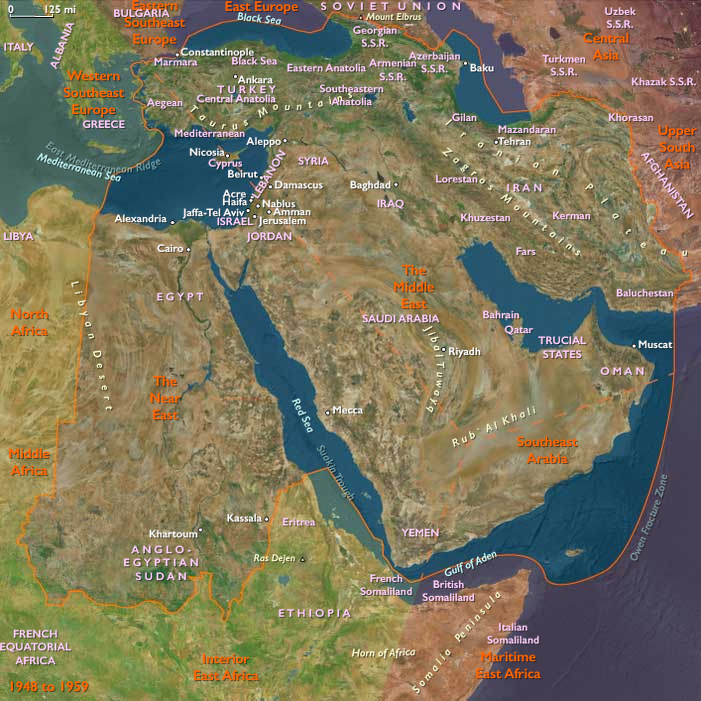
Subregions
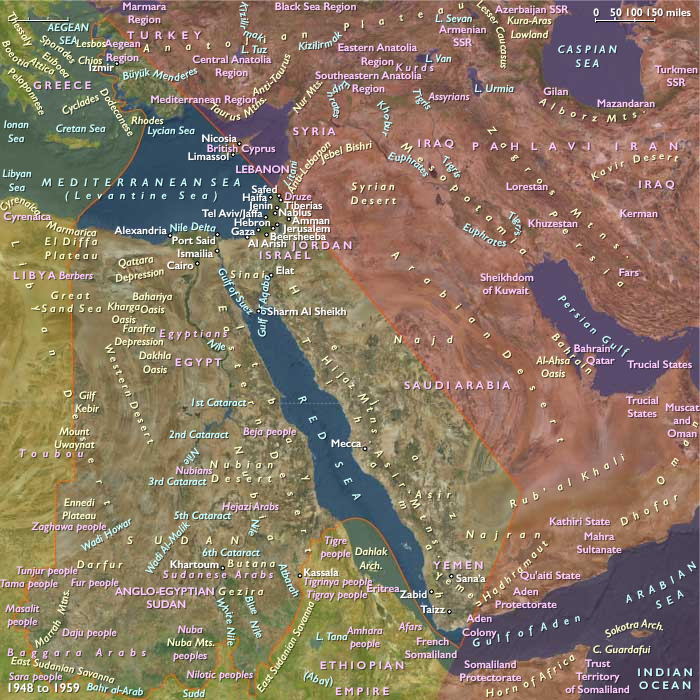
Related Events
Showing 10 events out of 4916 total
Years: 1948 - 1948
May
Locations
People
- Abdullah I of Jordan
- Amin el- Husseini
- Chaim Weizmann
- David Ben-Gurion
- Golda Meir
- John Bagot Glubb
- Moshe Sharett
- Shimon Peres
Groups
- Arab people
- Jews
- Arab nationalism
- Zionism
- ZO (Zionist Organization)
- Yemen, Mutawakkilite Kingdom of (North Yemen)
- Haganah, the (Hebrew: "The Defense")
- Egypt, Kingdom of (British Protectorate)
- Union of Soviet Socialist Republics (USSR), or Soviet Union
- Iraq, Hashemite Kingdom of
- Palestine, British Mandate of
- Jewish Agency for Palestine
- Irgun (Irgun Tsvai Leumi; Hebrew: "National Military Organization", or Etzel)
- Saudi Arabia, Kingdom of
- Lehi (Lohamei Herut Israel, "Fighters for the Freedom of Israel", aka the Stern Gang)
- Lebanon, Republic of
- Arab League, or League of Arab States
- Czechoslovakia (restored)
- Transjordan, Kingdom of
- Syria, or Syrian Arab Republic
- Palestinians
- Arab Liberation Army
- Holy War, Army of the, or Holy War Army (Jaysh al-Jihad al-Muqaddas)
- Israel
Topics
Commodoties
Subjects
Regions
Subregions