2. Breton Settlements …
Years: 578 - 578
2. Breton Settlements and Raids
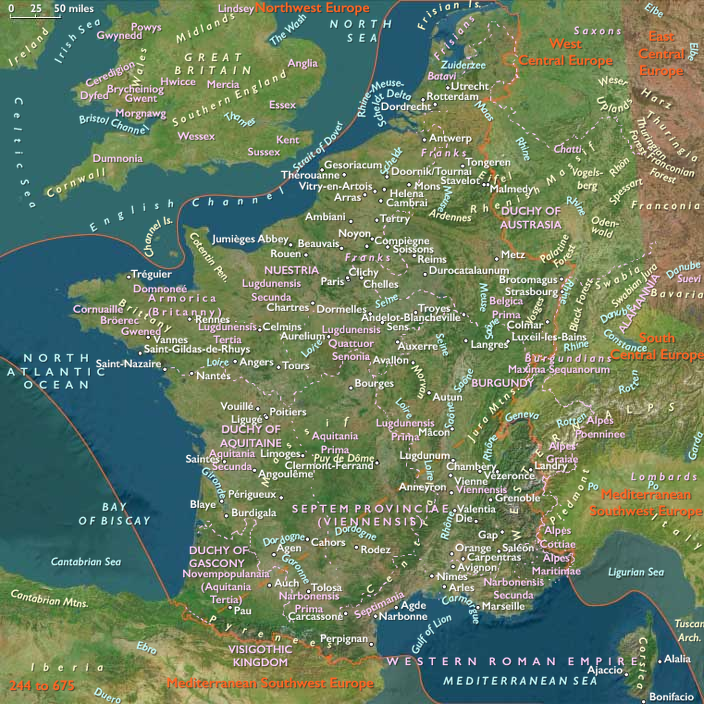
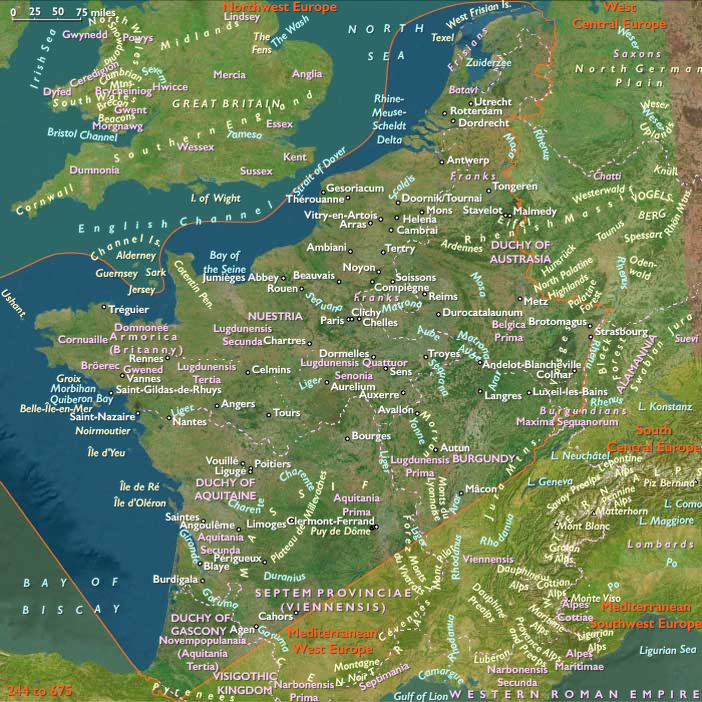
- Since the fifth century, Romano-British migrants fleeing Anglo-Saxon invasions have settled in western Brittany (now known as Bretagne), where they establish independent Breton-speaking communities.
- These settlements, heavily populated and culturally distinct, resist Frankish integration and retain strong ties to Britain.
- The Bretons frequently launch raids into Frankish-controlled territories, challenging Frankish rule along the eastern frontier.
3. The Ongoing Frankish-Breton Conflict
- The Franks struggle to maintain full control, as Breton resistance remains strong in the western part of the peninsula.
- Neustrian kings, such as Chilperic I and his successors, periodically attempt to subdue the Bretons, but with limited success.
- The conflict continues for centuries, shaping the political and cultural divide between Frankish-controlled eastern Brittany and independent Breton western settlements.
Conclusion: A Divided Peninsula
Despite Frankish control of the eastern region, Brittany remains a divided land, with the Bretons in the west maintaining their independence and launching raids against Frankish territories. This ongoing struggle defines the relationship between the Franks and Bretons for centuries, contributing to the eventual rise of the independent Duchy of Brittany in the medieval period.
Locations
Groups
- Franks
- Armorica
- Goths (East Germanic tribe)
- Breton people
- Visigothic Kingdom of Spain
- Soissons (eventually Neustria), Frankish Kingdom of
- Paris, Frankish Kingdom of
- Orléans (eventually Burgundy), Frankish Kingdom of
- Reims and Metz (eventually Austrasia), Frankish Kingdom of
- Basque people
Topics
Commodoties
Subjects
Regions
Subregions
Related Events
Filter results
Showing 10 events out of 50 total
Birth of Charles III, Duke of Bourbon, and Dynastic Consolidation (1490)
Charles of Bourbon, born at Montpensier as the second son of Gilbert, Count of Montpensier, and Clara Gonzaga(daughter of Federico I Gonzaga, Marquess of Mantua, and Margaret of Bavaria), emerges as a pivotal figure in Bourbon dynastic history. Following the death of his father, Gilbert, in 1496, Charles inherits a significant dynastic responsibility. His mother, Clara Gonzaga, provides him an illustrious lineage linking French nobility to the influential Italian House of Gonzaga.
In 1501, upon the death of his elder brother Louis, Charles becomes heir to the Montpensier estates. His dynastic importance heightens dramatically due to the lack of male heirs in the senior Bourbon line following the death of Peter II, Duke of Bourbon, whose daughter, Suzanne, represents the last of the senior Bourbon lineage.
To definitively resolve succession questions regarding the extensive Bourbon estates, a strategic marriage is arranged between Charles and Suzanne de Bourbon, daughter of Peter II and his wife Anne of France. Their union, solemnized in a dynastic match, ensures the consolidation of Bourbon territories and definitively settles questions regarding rightful inheritance and continuity of the Bourbon lineage.
Marriage and Dynastic Significance (1505):
On May 10, 1505, Charles marries Suzanne, thus uniting the "heir male" line, represented by Charles, with the "heir general" line, embodied by Suzanne. With this marriage, Charles becomes the undisputed Duke of Bourbon, cementing his status and effectively ensuring the continuity and unity of Bourbon lands, especially in Auvergne.
Moreover, this union carries profound political significance beyond Bourbon estates. As head of the House of Bourbon—now recognized as the senior-most cadet branch of the royal House of Valois—Charles and his descendants occupy a crucial position in French royal succession. The marriage solidifies the House of Bourbon's future claim to the French throne, positioning the dynasty as direct successors should the Valois male lineage fail—a scenario eventually realized in 1589 when the Bourbon dynasty ascends the throne.
Consequences and Legacy:
The marriage of Charles III and Suzanne stabilizes Bourbon territories, laying the groundwork for the Bourbon family's ascendancy to the French throne at the end of the 16th century. Charles's elevation thus shapes the political trajectory of Atlantic West Europe, underscoring the interplay between marriage alliances, dynastic inheritance, and political power during the late medieval and early modern periods.

Charles III, Duke of Bourbon: Betrayal and Shifting Allegiances (1522)
In 1522, Charles III, Duke of Bourbon, Constable of France, becomes increasingly alienated from King Francis I, setting in motion one of the most dramatic betrayals of the early modern era. The proud duke, already renowned as a military commander—especially for his role commanding the vanguard at the victorious Battle of Marignano (1515)—had initially been rewarded by Francis with both the office of Constable and the prestigious Governorship of Milan. Yet Bourbon's increasing power, wealth, and independence soon made Francis uneasy, resulting in Charles’s recall from Milan, Francis’s refusal to repay his debts, and the king's decision to place the command of the vanguard in subsequent campaigns (notably the recent war in the Netherlands) in the hands of Charles IV of Alençon, the king's brother-in-law, a clear slight against Bourbon’s honor.
The breaking point occurs in 1521 with the death of Bourbon’s wife, Suzanne, Duchess of Bourbon, whose vast estates form the backbone of his wealth and status. Suzanne, who had no surviving children, had designated Charles as her sole heir. However, Louise of Savoy, mother of Francis and sister of Suzanne, quickly lays claim to these estates, citing her closer blood relation. Louise seeks to resolve this inheritance dispute by marrying Charles herself, but the duke rejects her offer, citing their significant age difference—Louise is fourteen years his senior—and his personal disdain for the proposal.
Angered by Charles's rejection and motivated by financial necessity for his ongoing campaigns in the Italian Wars, Francis supports his mother’s legal claims and aggressively moves to seize the disputed lands. Even before a formal ruling in the lawsuit, the crown confiscates part of Bourbon’s property, further enraging the duke and driving him towards treasonous actions.
Feeling betrayed, isolated, and humiliated at the French court, Bourbon secretly begins negotiations with Emperor Charles V, plotting to shift his considerable military talents and influence to the Imperial cause against his own sovereign.
Long-term Consequences and Significance
Bourbon’s alienation and subsequent defection radically alter the balance of power in the ongoing conflicts between France and the Habsburg Empire. By turning one of France’s leading military commanders into an Imperial ally, Charles V gains an invaluable strategic advantage. Bourbon’s defection deepens the crisis facing Francis I and exposes critical vulnerabilities in the French monarchy’s management of powerful nobles, setting the stage for a series of military and political disasters, including the catastrophic French defeat at Pavia (1525) and the resulting capture of Francis himself. This rupture between Francis and Bourbon exemplifies the volatile interplay between personal rivalries, dynastic politics, and international warfare in early sixteenth-century Europe.
Lautrec's defeat at Bicocca has brought England openly into the conflict.
The English ambassador in late May 1522 had presented Francis with an ultimatum enumerating accusations against France, notably that of supporting the Duke of Albany in Scotland, all of which were denied by the king.
Duke Charles II of Bourbon, Constable of France, seeing no hope of prevailing in his fight to keep King Francis from confiscating his late wife’s estates, makes a secret agreement to betray his King and offer his services to the Holy Roman Emperor Charles V. The Emperor, the Constable, and King Henry VIII of England devise a grand plan to partition France.
Henry VIII and Charles on June 16, 1522, sign the Treaty of Windsor.
The treaty outlines a joint English-Imperial attack against France, with each party providing at least forty thousand men.
The plan to attack and partition France will fail, but the French will neither forgive Charles or fully trust him again.
Charles agrees to compensate England for the pensions that will be lost because of conflict with France and to pay the past debts that will be forfeit; to seal the alliance, he also agrees to marry Henry's only daughter, Mary.
Francis, forced to abandon Lombardy after the French defeat at the Battle of Bicocca in 1522 and determined to regain possession of the territory, had ordered an invasion of the region in late 1523, with an army of eighteen thousand men under the command of Guillaume Gouffier, Seigneur de Bonnivet.
The younger brother of Artus Gouffier, seigneur de Boisy, tutor of Francis I of France, Bonnivet had been brought up with Francis, and after the young king's accession had became one of the most powerful of the royal favorites.
In 1515 he was made admiral of France.
In the imperial election of 1519 he superintended the candidature of Francis, and spent vast sums of money in his efforts to secure votes, but without success.
An implacable enemy of the Constable de Bourbon, he has contributed to the downfall of the latter.
In command of the army of Navarre in 1521, he had occupied Fuenterrabia and was probably responsible for the renewal of hostilities resulting from its not being restored.
Bonnivet had succeeded Odet de Foix, Vicomte de Lautrec, in 1523, as commander of the army of Italy.
The French army advances through the Piedmont to Novara, where it is joined by a similarly sized force of Swiss mercenaries.
Prospero Colonna, whose health is declining, has only nine thousand men to oppose the French advance, and finally decides to retreat to Milan.
Bonnivet, however, overestimates the size of the Spanish-Imperial army and moves into winter quarters rather than attacking the city.
This allows the commanders of Emperor Charles to summon fifteen thousand landsknechts and a large Spanish force under the command of Charles of Bourbon.
By December 28, when Charles de Lannoy replaces Colonna, Bonnivet has begun his withdrawal.
A member of the noble de Lannoy family, Charles was born the younger son of Jean de Lannoy, Lord of Mingoval, himself nephew of Jean III de Lannoy.
His mother was Philipotte de Lalaing.
He had taken service with the Emperor Maximilian I and won distinction for bravery and leadership, being appointed member to the council of Charles of Burgundy; later Emperor Charles V and his Caballerizo mayor in 1515.
Appointed knight of the Order of the Golden Fleece in 1516, he had become governor of Tournai in 1521, had been made viceroi of Naples in 1522, and is made commander in chief of Imperial armies in Italy upon the death of Prospero Colonna at the end of 1523.
The forces of Lannoy and of Gouffier clash near the Sesia River, on April 30, when the Spanish-Imperial troops intercept the French.
Bonnivet's forces (where many of the Swiss mercenaries abandon the French army) suffer a decisive defeat by Lannoy's forces.
Pierre Terrail, Lord of Bayard, after allaying a revolt at Genoa, and striving with the greatest assiduity to check a pestilence in Dauphiné, Bayard had been sent into Italy with Admiral Bonnivet, who, being defeated at Robecco and wounded in a combat during his retreat, implores Bayard to assume command and save the army.
He repulsed the foremost pursuers, but in guarding the rear at the passage of the river Sesia between the towns of Romagnano Sesia and Gattinara, is mortally wounded by an arquebus ball, another demonstration of the power of the Spanish arquebusiers against more traditional troops.
He dies in the midst of the enemy, attended by Pescara, the Spanish commander, and by his old comrade, Charles, duc de Bourbon, who is now fighting on the opposite side.
Charles is reported to have said “Ah! Monsieur de Bayard... I am very sad to see you in this state; you who were such a virtuous knight!”
Bayard answered, “Sir, there is no need to pity me. I die as a man of honor ought, doing my duty; but I pity you, because you are fighting against your king, your country, and your oath.”
His body is restored to his friends and will be interred at Saint-Martin-d'Hères.
Finally, the French army retreats into the Alps in disarray.
Charles de Lannoy launches an invasion of Provence, commanded by Don Fernando d'Avalos and Charles de Bourbon, crossing the Alps in early July with nearly eleven thousand men.
The Spanish-Imperial forces capture and sack most of the smaller towns of Provence, and finally Charles de Bourbon enters the provincial capital of Aix-en-Provence on August 9, taking the title of Count of Provence.
Fernando d'Avalos and Charles de Bourbon had by mid-August, besieged Marseille, the only stronghold in Provence that remains in French hands.
Their assaults upon the city fail, and when the French army commanded by Francis I himself arrives at Avignon at the end of September, they are forced to retreat back to Italy.
King Francis crosses the Alps in mid-October and advances on Milan at the head of an army numbering more than forty thousand men.
Bourbon and d'Avalos, their troops not yet recovered from the campaign in Provence, are in no position to offer serious resistance.
The French army moves in several columns, brushing aside Imperial attempts to hold its advance, but fails to bring the main body of Imperial troops to battle.
Nevertheless, Charles de Lannoy, who has concentrated some sixteen thousand men to resist the thirty-three thousand French troops closing on Milan, decides that the city cannot be defended and withdraws to Lodi on October 26.
Francis, having entered Milan and installed Louis II de la Trémoille as the governor at the urging of Bonnivet and against the advice of his other senior commanders, who favor a more vigorous pursuit of the retreating Lannoy) advances on Pavia, where Antonio de Leyva remains with a sizable Imperial garrison.
De Levya, belonging to a family from Navarre, had made his military debut in the Alpujarras in 1502 during the struggle against the revolting Mudéjares from Granada and later served in Italy under the Gran Capitán from 1503 to 1504.
He plays a prominent part in the Italian Wars and had been wounded at the battle of Ravenna in 1512.
Under the Marquis of Pescara, he had fought near Milan and in the unlucky campaign of Provence in 1524.
The main mass of French troops arrives at Pavia in the last days of October 1524.
Years: 578 - 578
Locations
Groups
- Franks
- Armorica
- Goths (East Germanic tribe)
- Breton people
- Visigothic Kingdom of Spain
- Soissons (eventually Neustria), Frankish Kingdom of
- Paris, Frankish Kingdom of
- Orléans (eventually Burgundy), Frankish Kingdom of
- Reims and Metz (eventually Austrasia), Frankish Kingdom of
- Basque people