
The Political Structure of Brittany and Its …
Years: 635 - 635
The Political Structure of Brittany and Its Relationship with the Franks (6th–7th Century CE)
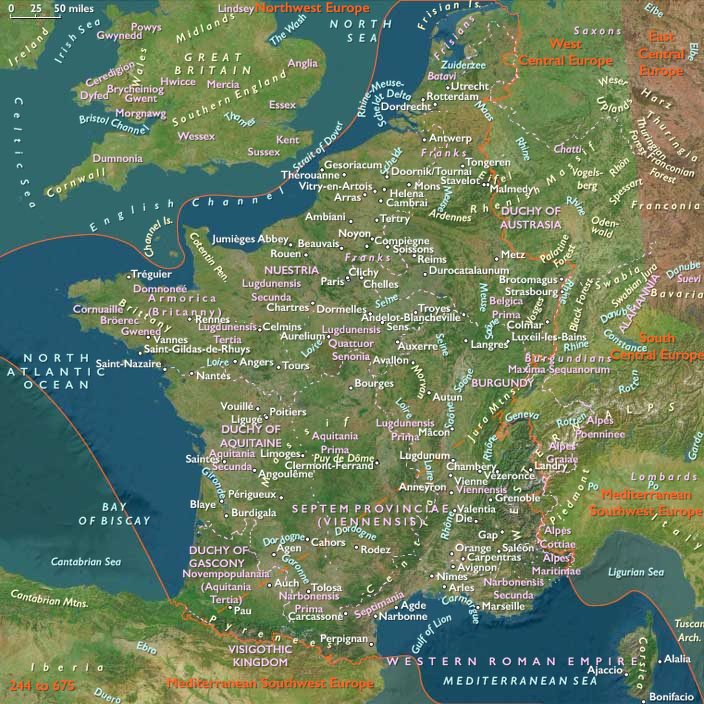
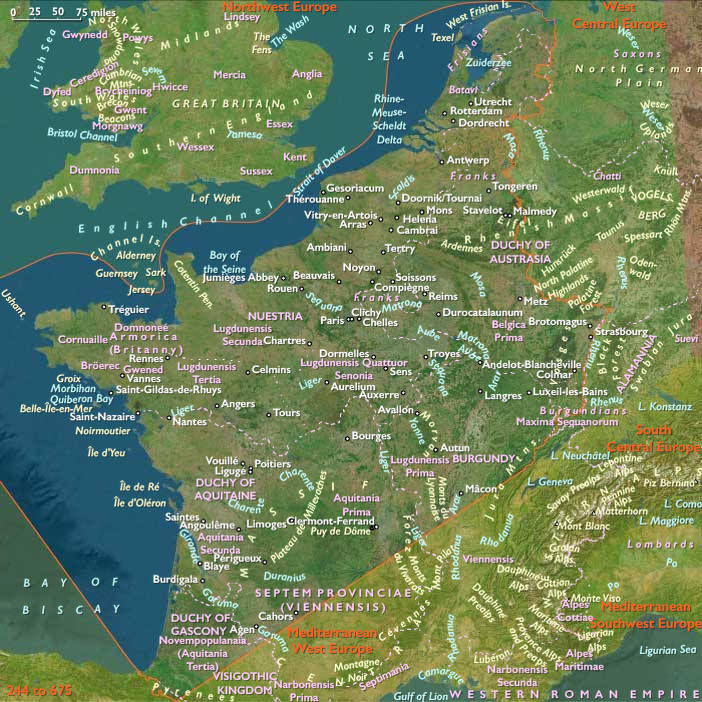
Throughout the sixth and seventh centuries, the Bretons were divided into several minor kingdoms (regna), of which the best known—according to Gregory of Tours—were:
- Domnonée (Domnonia) – Likely the chief kingdom, originating from Dumnonian migrants from Britain.
- Cornouaille – Centered in western Brittany, corresponding to modern Cornouaille.
- Gwened (Vannes/Venetis) – A key coastal power, often in conflict with the Franks.
While initially acknowledging Frankish overlordship under Clovis I and Childebert I, the Bretons made multiple attempts to resist Frankish rule, particularly during the reign of Chilperic I, who subdued Waroch II and reasserted Frankish dominance over eastern Brittany.
By the seventh century, under Guntram and Dagobert I, Brittany remained a Frankish tributary-vassal state, though it retained de facto autonomy under its local kings.
1. Domnonée’s Rise as the Chief Breton Kingdom
- By the early seventh century, Domnonée appears to have consolidated power over neighboring Breton territories, including Broweroch.
- The rulers of Domnonée likely continued as High Kings of the Bretons, giving them a dominant political status in the region.
- Domnonian kings are now listed as “Kings of the Bretons”, reinforcing their supremacy over the other minor kingdoms.
2. King Judicael: The High King of the Bretons (c. 610–640 CE)
- According to the Chronicle of Fredegar, the reigning King of the Bretons at this time was Judicael, son of Hoel III (580–612 CE).
- It is highly probable that he was the same Judicael known from Breton tradition, who ruled Domnonée and expanded his authority over Brittany.
- This would mean that Domnonée had effectively absorbed Broweroch, and Judicael had become the High King of Brittany.
3. Judicael’s Dealings with Dagobert I and Eligius
- Judicael’s increased power likely explains why he was involved in diplomatic interactions with King Dagobert I and Saint Eligius, a Frankish court official.
- His meeting with Dagobert at Clichy (635–636 CE) suggests that he was recognized as the principal ruler of the Bretons, pledging nominal submission to the Frankish crown while retaining internal autonomy.
4. The Lasting Impact of Domnonian Supremacy
- Domnonée’s dominance over Brittany during this period set a precedent for later Breton rule, where the title “King of the Bretons” would continue to be used.
- Though Brittany remained a tributary to the Franks, it resisted full integration, maintaining a distinct identity and political independence.
- The struggle between Breton autonomy and Frankish overlordship would continue for centuries, shaping the future of medieval Brittany.
Conclusion: The Unification of Brittany Under Domnonée
The evidence suggests that by the seventh century, Domnonée had effectively become the chief Breton state, with Judicael serving as High King of the Bretons. His dealings with Dagobert I and Saint Eligius reflect Brittany’s continued vassalage to the Franks, but also its strong regional identity and resistance to direct Frankish control. This period marks an important phase of consolidation for the Breton kingdoms, setting the stage for their ongoing struggle for independence in the medieval era.
Locations
People
Groups
- Franks
- Breton people
- Domnonée, Breton kingdom of
- Dumnonia, Brythonic kingdom of
- Neustria and Burgundy, Frankish Kingdom of
Topics
Subjects
Regions
Subregions
Related Events
Showing 10 events out of 56659 total
Years: 635 - 635
Locations
People
Groups
- Franks
- Breton people
- Domnonée, Breton kingdom of
- Dumnonia, Brythonic kingdom of
- Neustria and Burgundy, Frankish Kingdom of
Topics
Subjects
Regions
Subregions