
Filters:
South Africa, still in the grip of …
Years: 18189BCE - 16461BCE
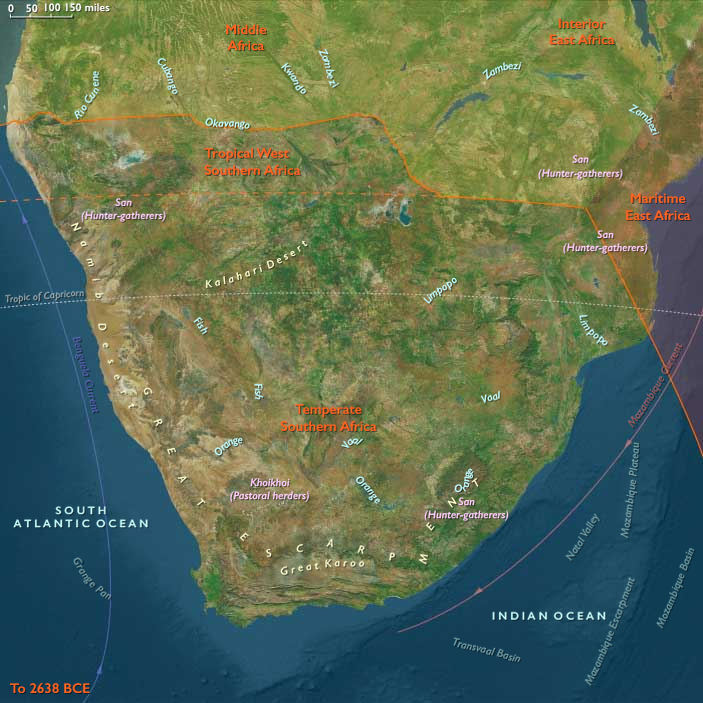
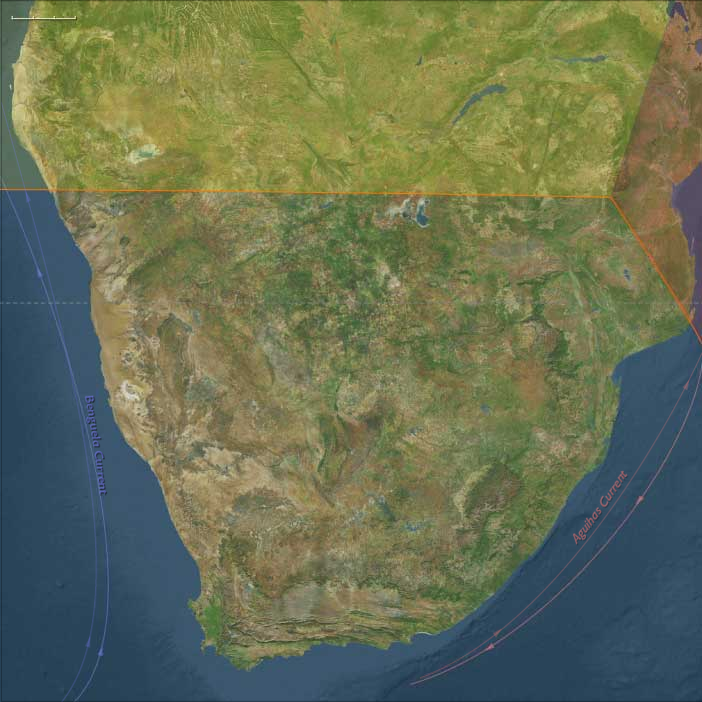
South Africa, still in the grip of the world's last Ice Age roughly twenty thousand years before the present, is occupied by people now known as San.
Remnants of San communities still survive today in the Kalahari Desert.
The San, who develop their society over thousands of years in isolation, speak a language that includes unique "click" consonants, are smaller statured, and have lighter skin pigmentation than the Bantu speakers who will later move into southern Africa.
San obtain a livelihood from often difficult environments by gathering edible plants, berries, and shellfish; by hunting game; and by fishing.
Gathering is primarily the task of women, who provide approximately eighty percent of the food-
stuffs consumed by the hunter-gatherer communities. Men hunt, make tools and weapons from wood and stone, produce clothing from animal hides, and fashion a remarkable array of musical instruments.
San also create vast numbers of rock paintings—South Africa contains the bulk of the world's
prehistoric art still extant—which express an extraordinary aesthetic sensibility and document San hunting techniques and religious beliefs.
The rock paintings also demonstrate that considerable interaction took place among hunter-gatherer communities throughout southern Africa.
The primary social unit among the San is the nuclear family.
Families join together to form hunter-gatherer bands of about twenty to fifty people. Men and women have equal status in these groups and there is no development of a hereditary chiefdom, although the male head of the main family usually takes a leading role in decision making.
Such bands move about the countryside seeking foodstuffs, sometimes remaining for long periods in particularly productive environments, sometimes splitting apart and joining other groups when food is scarce.
Because they make such limited demands on their environment, San manage to provide a living for themselves for thousands of years.
Population numbers remain small, however, and settlement is generally sparse.
Remnants of San communities still survive today in the Kalahari Desert.
The San, who develop their society over thousands of years in isolation, speak a language that includes unique "click" consonants, are smaller statured, and have lighter skin pigmentation than the Bantu speakers who will later move into southern Africa.
San obtain a livelihood from often difficult environments by gathering edible plants, berries, and shellfish; by hunting game; and by fishing.
Gathering is primarily the task of women, who provide approximately eighty percent of the food-
stuffs consumed by the hunter-gatherer communities. Men hunt, make tools and weapons from wood and stone, produce clothing from animal hides, and fashion a remarkable array of musical instruments.
San also create vast numbers of rock paintings—South Africa contains the bulk of the world's
prehistoric art still extant—which express an extraordinary aesthetic sensibility and document San hunting techniques and religious beliefs.
The rock paintings also demonstrate that considerable interaction took place among hunter-gatherer communities throughout southern Africa.
The primary social unit among the San is the nuclear family.
Families join together to form hunter-gatherer bands of about twenty to fifty people. Men and women have equal status in these groups and there is no development of a hereditary chiefdom, although the male head of the main family usually takes a leading role in decision making.
Such bands move about the countryside seeking foodstuffs, sometimes remaining for long periods in particularly productive environments, sometimes splitting apart and joining other groups when food is scarce.
Because they make such limited demands on their environment, San manage to provide a living for themselves for thousands of years.
Population numbers remain small, however, and settlement is generally sparse.
Groups
Commodoties
Subjects
Regions
Subregions
Years: 18189BCE - 16461BCE
Groups
Commodoties
Subjects
Regions
Subregions