
The ruthlessness of Iskandar Muda’s regime …
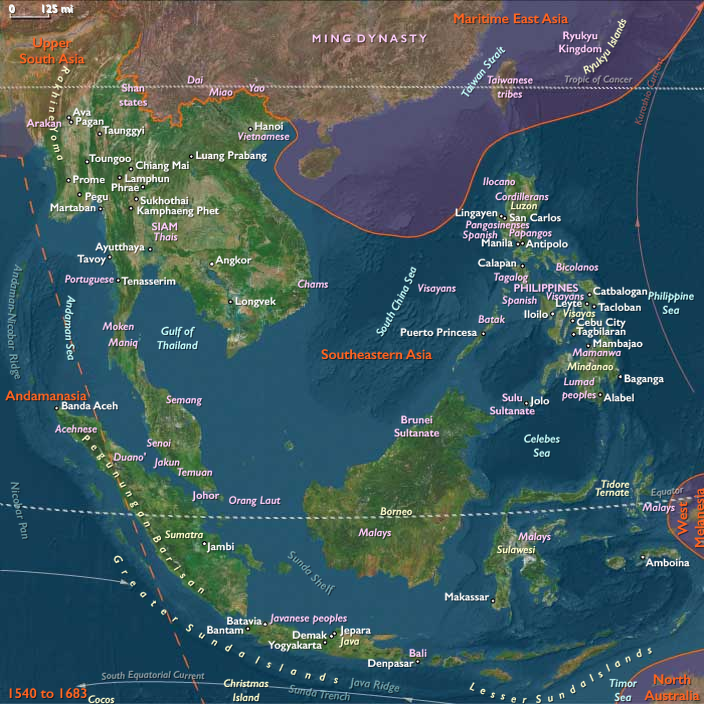
Years: 1540 - 1683
The ruthlessness of Iskandar Muda’s regime earns him many enemies and nearly ignites civil war.
Despite its economic prosperity, Aceh’s gains under his rule fail to bring lasting political or structural transformation. Instead, the orang kaya (merchant elite) reassert their influence, seeking ways to curtail royal power.
By the late seventeenth century, they successfully install a succession of female rulers, likely viewing them as either more moderate or easier to manipulate. However, by the eighteenth and nineteenth centuries, both the orang kaya and the royal court see their power wane, as hereditary district chiefs (uleebalang) and influential Muslim leaders rise in prominence. As a result, Aceh loses its imperial authority and much of its political cohesion.
Yet, unlike most of its regional counterparts, Aceh remains an important local power. Well into the nineteenth century, it continues to be a major economic force, producing over half of the world’s pepper supply as late as 1820.
Aceh also proves politically shrewd—it joins Dutch forces in 1641 in an attack on Portuguese Malacca, but in the following decades, it stands apart from other major states of the early modern archipelago. While others become entangled with the Dutch East India Company (VOC), Aceh alone among them manages to retain its independence until the late nineteenth century.
Locations
People
Groups
- Javanese people
- Acehnese people
- Dutch people
- Portuguese people
- Tidore, Sultanate of
- Aceh, or Atjeh, Sultanate
- Ternate, Sultanate of
- Portugal, Avizan (Joannine) Kingdom of
- Makassar people
- Portuguese Malacca
- Spaniards (Latins)
- Spain, Habsburg Kingdom of
- Banten Sultanate
- Mataram, Sultanate of
- Netherlands, United Provinces of the (Dutch Republic)
- Dutch East India Company in Indonesia
- Dutch East India Company (Vereenigde Oostindische Compagnie or VOC in Dutch, literally "United East Indies Company")
Topics
Commodoties
Subjects
Regions
Subregions
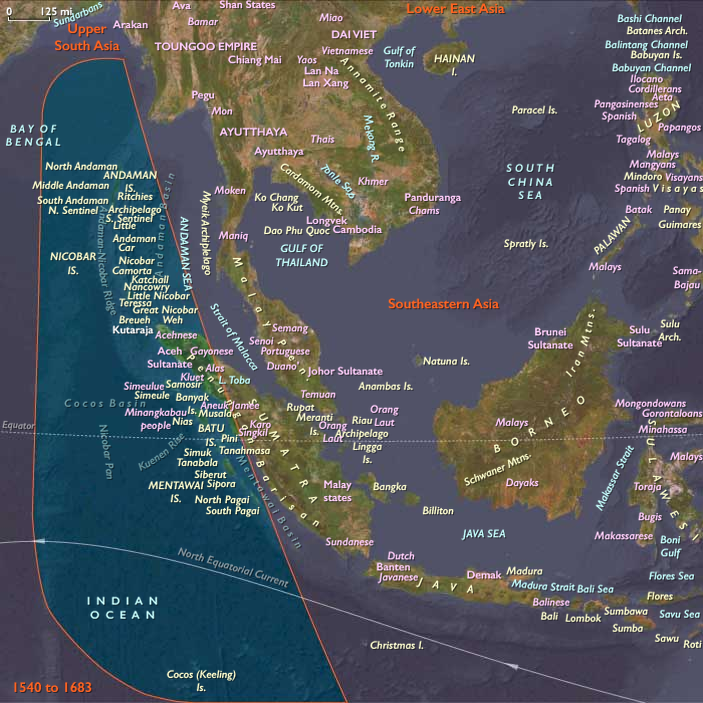
Years: 1540 - 1683
Locations
People
Groups
- Javanese people
- Acehnese people
- Dutch people
- Portuguese people
- Tidore, Sultanate of
- Aceh, or Atjeh, Sultanate
- Ternate, Sultanate of
- Portugal, Avizan (Joannine) Kingdom of
- Makassar people
- Portuguese Malacca
- Spaniards (Latins)
- Spain, Habsburg Kingdom of
- Banten Sultanate
- Mataram, Sultanate of
- Netherlands, United Provinces of the (Dutch Republic)
- Dutch East India Company in Indonesia
- Dutch East India Company (Vereenigde Oostindische Compagnie or VOC in Dutch, literally "United East Indies Company")
Topics
Commodoties
Subjects
Regions
Subregions