
The Bavarians had emerged in a region …
Years: 555 - 555
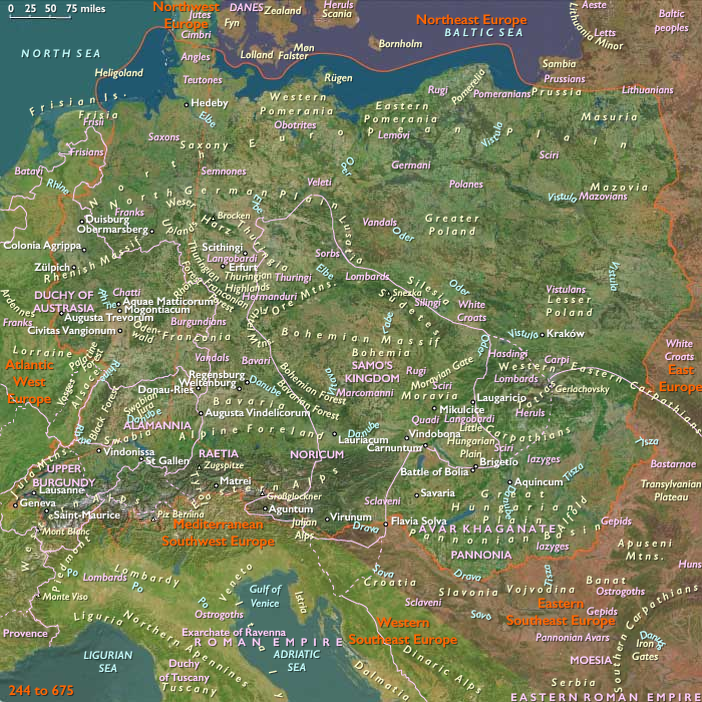
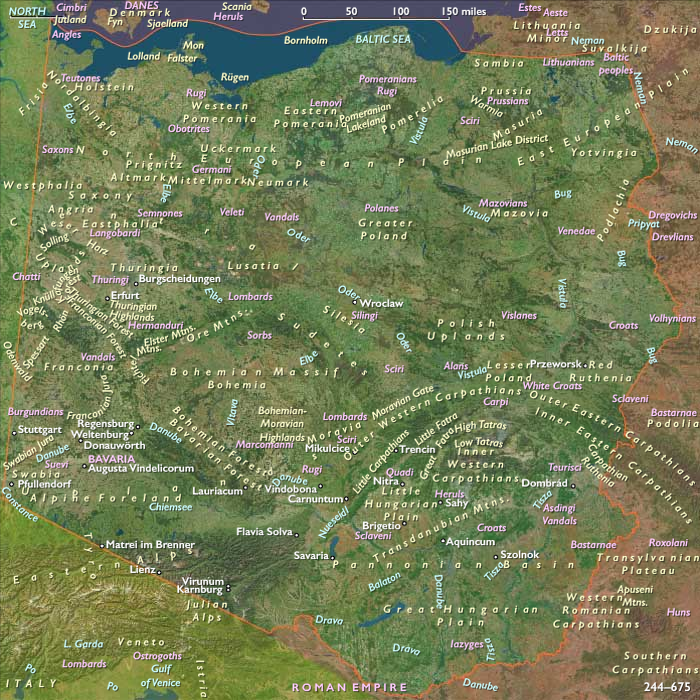
The Bavarians had emerged in a region north of the Alps originally inhabited by the Celts, which had been part of the Roman provinces of Raetia and Noricum.
The Bavarians speak Old High German but, unlike other Germanic groups, probably did not migrate from elsewhere.
Rather, they seem to have coalesced out of other groups left behind by Roman withdrawal late in the fifth century.
These peoples may have included the Celtic Boii, some remaining Romans, Marcomanni, Allemanni, Quadi, Thuringians, Goths, Scirians, Rugians, Heruli.
The name "Bavarian" ("Baiuvarii") means "Men of Baia" which may indicate Bohemia, the homeland of the Celtic Boii and later of the Marcomanni.
They first appear in written sources around 520.
By the sixth century, there is evidence of the foundation of a Bavarian stem duchy whose leadership is related to the ruling Frankish (and possibly Alemannic/Swabian) houses.
The dukes of Bavaria choose the site of a first century CE Roman camp (later called Regensburg) as their seat; it will remain the capital of Bavaria from about 530 to the first half of the thirteenth century.
From about 554, the house of Agilolfing rules the Duchy of Bavaria, subordinate to the Franks.
Three early dukes are named in Frankish sources: Garibald I may have been appointed to the office by the Merovingian kings and married the Lombard princess Walderada when the church forbade her to King Chlothar I in 555.
Locations
People
Groups
- Franks
- Lombards (West Germanic tribe)
- Bavarians (West Germanic tribe)
- Orléans (eventually Burgundy), Frankish Kingdom of
- Paris, Frankish Kingdom of
- Reims, Frankish Kingdom of
- Bavaria, Agilolfing Duchy of
Topics
Subjects
Regions
Subregions
Related Events
Showing 10 events out of 57575 total
Years: 555 - 555
Locations
People
Groups
- Franks
- Lombards (West Germanic tribe)
- Bavarians (West Germanic tribe)
- Orléans (eventually Burgundy), Frankish Kingdom of
- Paris, Frankish Kingdom of
- Reims, Frankish Kingdom of
- Bavaria, Agilolfing Duchy of
Topics
Subjects
Regions
Subregions