
The Batavi, a sub-tribe of the Germanic …
Years: 69 - 69
July
The Batavi, a sub-tribe of the Germanic Chatti tribal group who had rendered valuable aid under the early emperors, had been well treated in order to attach them to the cause of Rome.
They are exempt from tribute, but are obliged to supply a large number of men for the army.
Gaius Julius Civilis, a hereditary prince of the Batavi, the prefect of a Batavi cohort, and a veteran of twenty-five years' service, had distinguished himself by service in Britain, where he and the eight Batavi cohorts had played a crucial role in both the Roman invasion in 43 CE and the subsequent subjugation of southern Britain.
Before and during the disturbances that followed the death of Nero, Civilis had been twice imprisoned on a charge of rebellion, and narrowly escaped execution.
Civilis in early 69 had been released by Vitellius, when the latter, having launched his mutiny against Otho, was in urgent need of the Batavi's military support.
The Batavi regiments, having duly helped Vitellius overthrow Otho at the Battle of Bedriacum, were then ordered to return home, but at this point came the mutiny of Vespasian, commander of forces in Syria.
Vitellius' general in Germania Inferior, ordered to raise more troops, squanders the goodwill of the Batavi by attempting to conscript more Batavi than the maximum stipulated in their treaty.
The brutality and corruption of the Roman recruiting centurions bring already deep discontent in the Batavi homeland to the boil.
Civilis, commanding the Batavian auxiliary troops allocated in the summer of 69 to the Rhine legions, takes up arms under the pretense of siding with Vespasian and induces the inhabitants of his native country to rebel.
The Batavi are immediately joined by several neighboring German tribes, the most important of whom are the Frisii.
Vespasian, who is fighting Vitellius for the imperial throne, salutes the rebellion that keeps his enemy from calling the Rhine legions to Italy.
The Batavi are promised independence and Civilis is on his way to becoming king, but, for unknown reasons, this is not enough for the Batavi.
Civilis chooses to pursue vengeance and swears to destroy the two Roman legions.
The timing is well chosen: with the civil war of the Year of the Four Emperors at its peak, it will take some time before Rome can produce an effective counterattack.
Moreover, the eight Batavian auxiliary units of Vitellius' army are on their way home and can be easily persuaded to join the rebellion for an independent Batavia.
This is an important reinforcement.
Apart from being veteran troops, their numbers are greater than the combined Roman troops stationed in Moguntiacum (Mainz) and …
Locations
People
Groups
- Lingones (Celtic tribe)
- Frisii (East Germanic tribe)
- Chatti (Germanic tribe)
- Batavi (Germanic tribe)
- Bructeri (Germanic tribe)
- Roman Empire (Rome): Julio-Claudian dynasty
Topics
- Classical antiquity
- Pre-Roman Iron Age of Northern Europe
- Roman Age Optimum
- Pax Romana
- Year of the Four Emperors, or Roman Civil War of 68-69
- Batavi, Revolt of the
Commodoties
Subjects
Regions
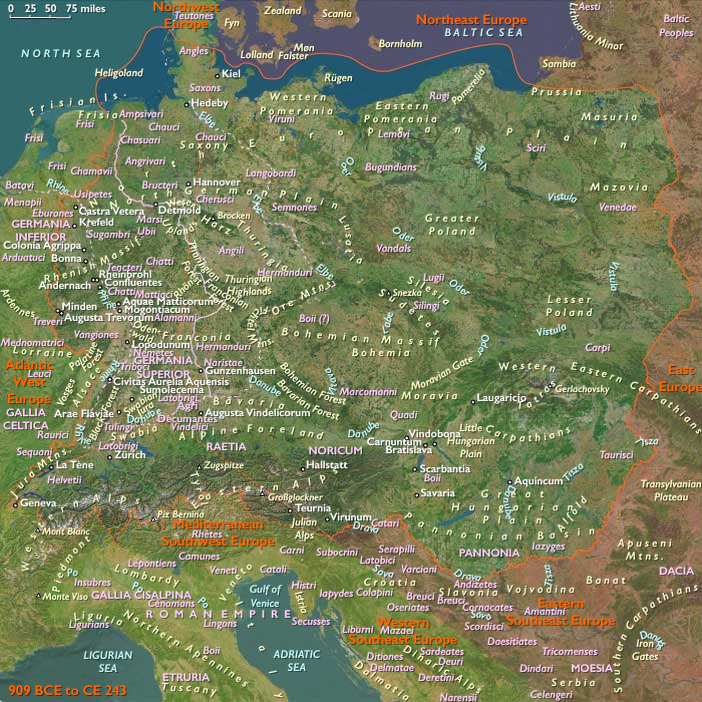
Subregions
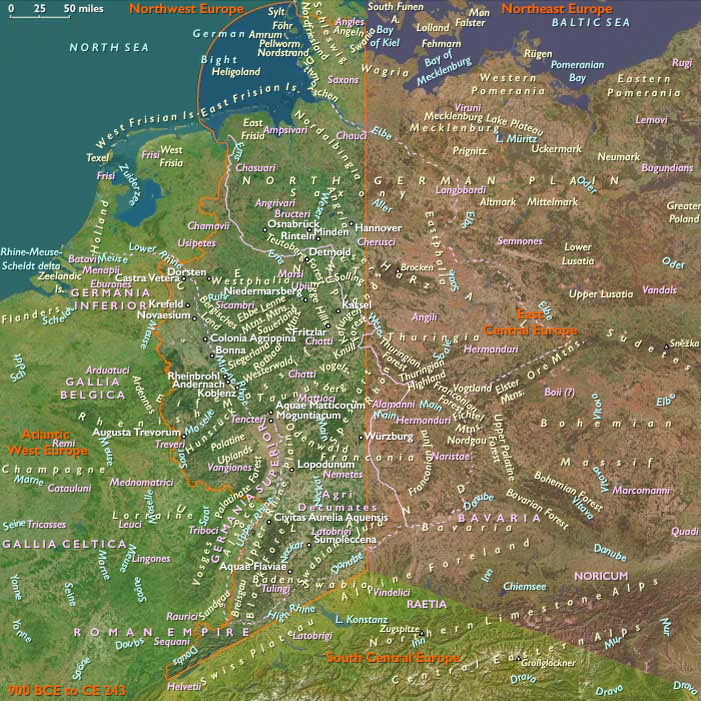
Years: 69 - 69
July
Locations
People
Groups
- Lingones (Celtic tribe)
- Frisii (East Germanic tribe)
- Chatti (Germanic tribe)
- Batavi (Germanic tribe)
- Bructeri (Germanic tribe)
- Roman Empire (Rome): Julio-Claudian dynasty
Topics
- Classical antiquity
- Pre-Roman Iron Age of Northern Europe
- Roman Age Optimum
- Pax Romana
- Year of the Four Emperors, or Roman Civil War of 68-69
- Batavi, Revolt of the
Commodoties
Subjects
Regions
Subregions