
The Bahmani dynasty believes that they descend …
Years: 1518 - 1518
The Bahmani dynasty believes that they descend from Bahman, a legendary king of Iran.
The Bahamani Sultans are patrons of the Persian language, culture and literature, and some members of the dynasty had become well-versed in that language and composed its literature in that language.
The most important personality of the Bidar period of the Bahmani sultanate was Mahmud Gawan, who served several sultans as prime minister and general from 1461 to 1481.
He had reconquered Goa, which had been captured by the rulers of Vijayanagar, thereby extending the sultanate from coast to coast.
Gawan also introduced remarkable administrative reforms and controlled many districts directly, thus very much improving the state’s finances, but his competent organization ended with his execution, ordered by the sultan as the result of a court intrigue.
After realizing his mistake, the sultan drank himself to death within the year, thus marking the beginning of the end of the Bahmani sultanate.
After Gawan’s death the various factions at the sultan’s court had begun a struggle for power that ends only with the dynasty itself: indigenous Muslim courtiers and generals are ranged against the ‘aliens’—Arabs, Turks and Persians.
The last sultan, Mahmud Shah, no longer has any authority and has presides over the dissolution of his realm as Sri Krishnadevaraya of Vijayanagar defeats the last remnant of Bahmani power.
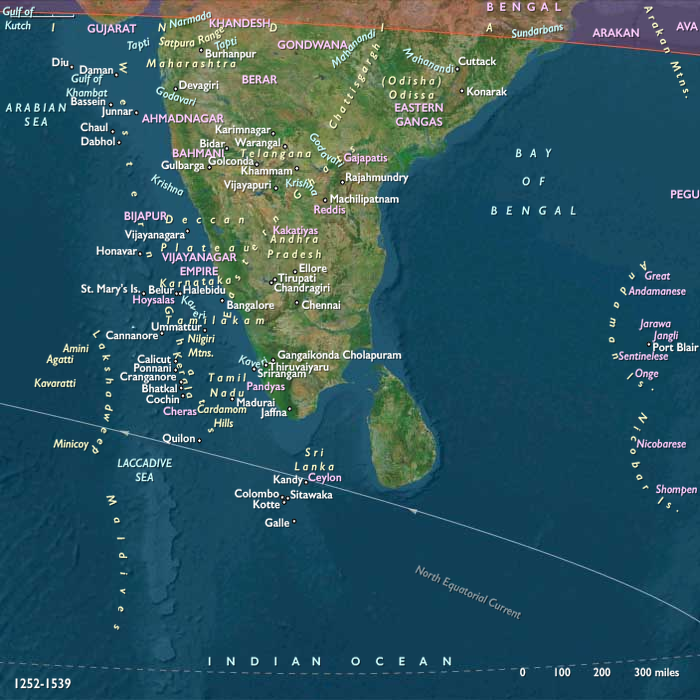
The governors of the four most important provinces had declared their independence from the Bahmani ruler one after another: Bijapur (1489), Ahmadnagar (1490), Berar (1490), Bidar (1492) and Golconda (1512).
Although the Bahmani sultans will live on in Bidar until 1527, they are mere puppets in the hands of the real rulers of Bidar, the Barid Shahis, who use them so as to put pressure on the other usurpers of Bahmani rule.
The Bidar Sultanate was founded in 1492 by Qasim Barid, a Turkmen from Georgia who had joined the service of the Bahmani sultan Muhammad Shah III.
Beginning his career as a sar-naubat, he later became the mir-jumla (prime minister) of the Bahmani sultanate and during the reign of Mahmud Shah became the de facto ruler.
After his death in 1504, his son Amir Barid became the prime minister and controlled the administration of the Bahmani sultanate.
Locations
People
Groups
- Hinduism
- Arab people
- Persian people
- Indian people
- Turkmen people
- Orissa, Kingdom of
- Bidar Sultanate
- Deccan Sultanates
- Adil Shahi dynasty (Bijapur, Sultanate of)
- Berar Sultanate
- Ahmadnagar Sultanate
- Vijayanagara, (Tuluva) Kingdom of
- Qutb Shahi dynasty of Golconda
Topics
Commodoties
Subjects
Regions

Subregions
Years: 1518 - 1518
Locations
People
Groups
- Hinduism
- Arab people
- Persian people
- Indian people
- Turkmen people
- Orissa, Kingdom of
- Bidar Sultanate
- Deccan Sultanates
- Adil Shahi dynasty (Bijapur, Sultanate of)
- Berar Sultanate
- Ahmadnagar Sultanate
- Vijayanagara, (Tuluva) Kingdom of
- Qutb Shahi dynasty of Golconda
Topics
Commodoties
Subjects
Regions
Subregions