The Bagratids, in an effort to unify …
Years: 961 - 961
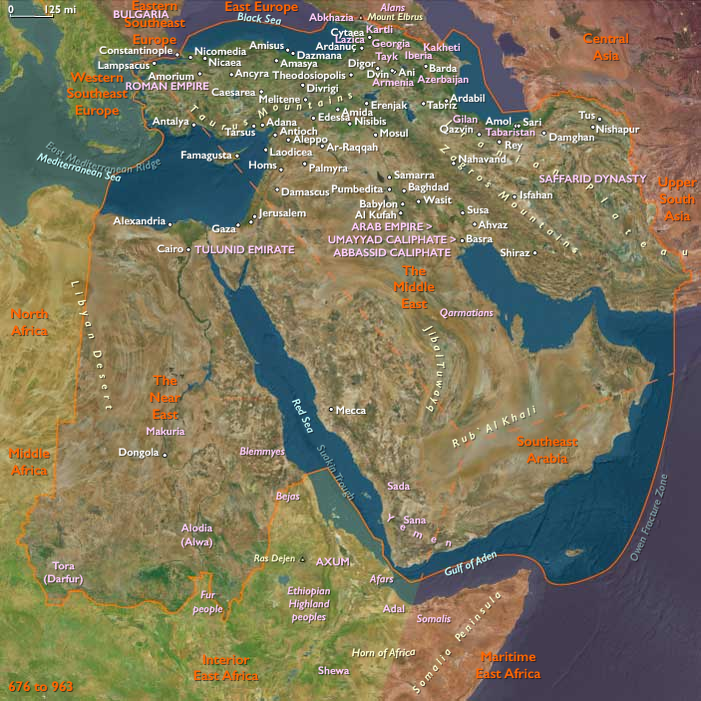
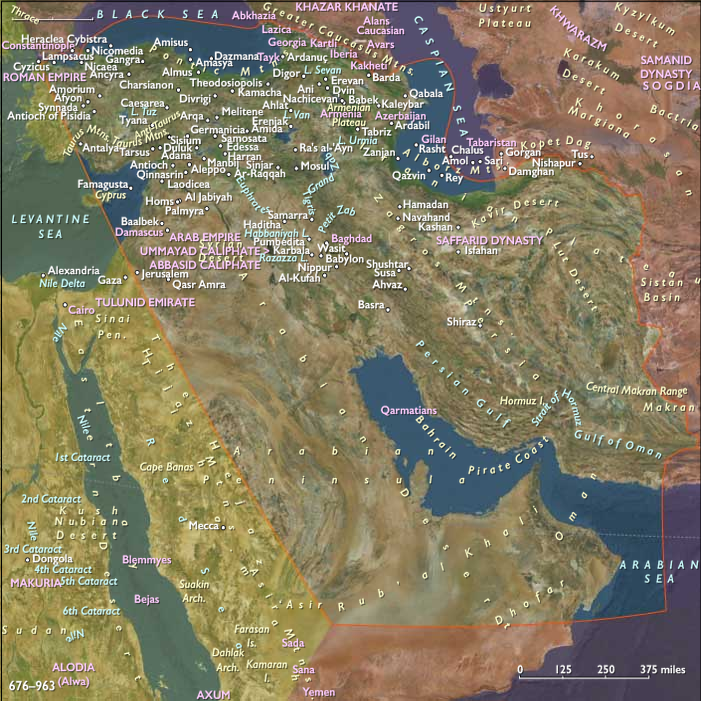
The Bagratids, in an effort to unify the Armenian nation under one flag, have subjugated other Armenian noble families through conquests and fragile marriage alliances.
Eventually, some noble families such as the Artsrunis and the Siunis had broken off from the central Bagratid authority.
Ashot III the Merciful transfers the Bagratid capital to the city of Ani (now famous for its ruins).
The Bagratuni dynasty retains power by playing off the competition between the Greek Christians and the Muslim Arabs.
Locations
People
Groups
- Arab people
- Armenian people
- Christians, Armenian Apostolic Orthodox
- Christianity, Chalcedonian
- Greeks, Medieval (Byzantines)
- Islam
- Muslims, Sunni
- Armenia, Bagratid
- Armenia, Bagratid
- Armenia, Zakarid
Topics
Commodoties
Subjects
Regions
Subregions
Related Events
Filter results
Showing 10 events out of 52819 total
Li Yu succeeds his father Li Jing, also a poet, to the throne of the Southern T'ang kingdom in 961 at the age of twenty-four.
The death of 'Abd al-Malik’s father and predecessor, Nuh, in 954, had potentially spelled disaster for the Samanid state, since the rebel Abu 'Ali Chaghani had been in a good position to make good on his claims to Khurasan; he had the support of both the Buyids and the Caliph.
He died before he could press his claims, however, sparing 'Abd al-Malik from having to deal with him.
Unfortunately, the Samanid state has become increasingly internally unstable during Abd al-Malik's reign.
The governor of Khurasan, Bakr ibn Malik al-Farghani, had been murdered by the amir's Turkish guard.
He was replaced for some time by Muhammad ibn Ibrahim Simjuri, and Abu Ja'far 'Utbi was made vizier.
However, the Turkish contingent of the military has been rapidly gaining more and more power.
The Turkish leader Alptigin manages to gain the governorship of Khurasan for himself, and has Muhammad ibn Abu 'Ali Muhammad Bal'ami, son of Emir Nasr's vizier, promoted to that post.
The new vizier, however, falls under the influence of the Turks, further cementing their grip on power within the state.
'Abd al-Malik has been unable to stop the expansion of the Turks' powers, resulting in the Turks being effectively in control by the time he dies in 961.
The Turkic military establishment splits over who should succeed 'Abd al-Malik.
Alp Tigin, the leader of the Samanid Turks and the governor of Khurasan, attempts to appoint his son as amir, while Fa'iq, who has known 'Abd al-Malik's brother, Mansur, since his childhood, presses for the latter's coronation.
Mansur and Fa'iq are eventually victorious; Alp Tigin flees to Ghazna, which becomes a separate domain where the Ghaznavid Empire will eventually form.
Emperor Romanos appoints Nikephoros Phokas commander of a wartime expedition to liberate Crete, under Arab control since 826 at great cost to Aegean populations and international commerce.
This enterprise mobilizes the entire imperial fleet and close to twenty-four thousand troops.
Nikephoros on March 7, 961, gains the island with the capture of Chandax, now Iráklion.
He breaks all Arab resistance in a general massacre, the inhumanity of which reveals his fierce nature: some two hundred thousand are killed and as many enslaved, according to the Mamluk chronicler al-Nuwairi.
Aided by the monks, among whom is Athanasius, his spiritual director and founder of the Greek Orthodox monastery on Mt.
Athos, Nikephoros achieves the reconsolidation of Christianity.
He then returns to Constantinople with 'Abd al-'Aziz, the last amir of Crete, as his captive.
This exploit, sung by the poet Theodosius the Deacon, realizes the imperial dream (after dozens of attempts had failed to liberate Crete) of Constantinople’s mastery of the eastern Mediterranean.
Abd ar-Rahman is very tolerant of non-Muslims, and Jews and Christians both are treated fairly.
European nations send emissaries such as those from Otto I of Germany, and the emperor in Constantinople.
He is a patron of arts, especially architecture.
A third of his revenue suffices for the ordinary expenses of government, a third is hoarded, and a third is spent on buildings.
He has renovated and added to the Mosque–Cathedral of Córdoba.
After declaring the caliphate, he had had a massive palace complex, known as the Medina Azahara, built some five kilometers north of Córdoba.
Modeled after the old Umayyad palace in Damascus, the Medina Azahara serves as a symbolic tie between the new caliph and his ancestors.
It is said that Cordoba contained three thousand mosques and one hundred thousand shops and homes during his reign, during which Córdoba has become the most important intellectual center of Western Europe.
He has expanded the city's library, which will be further enriched by his successors.
I have now reigned above fifty years in victory or peace; beloved by my subjects, dreaded by my enemies, and respected by my allies.
Riches and honors, power and pleasure, have waited on my call, nor does any earthly blessing appear to have been wanting to my felicity.
In this situation, I have diligently numbered the days of pure and genuine happiness which have fallen to my lot: they amount to Fourteen: - O man! place not thy confidence in this present world!
He has also reinforced the Iberian fleet, which has become the most powerful in Mediterranean Europe.
Iberian raiders move up to Galicia, Asturias, and North Africa.
The colonizers of Fraxinetum had come from al-Andalus as well.
Due to his consolidation of power, Muslim Iberia becomes a power for a few centuries.
It also brings prosperity, and with this he has created mints where pure gold and silver coins are created.
Abd-ar-Rahman has spent the rest of his years in his new palace outside Córdoba.
He is accused of having sunk in his later years into the self-indulgent habits of the harem.
He is known to have openly kept a male as well as a female harem.
This likely influenced the polemical story of his falling in love with a thirteen-year-old boy (later enshrined as a Christian martyr and canonized as Saint Pelagius of Córdoba) who refused the Caliph's advances.
The love story may have been a construct on top of an original tale, however, in which he ordered the boy-slave to convert to Islam.
Either way, enraged, he had the boy tortured and dismembered, thus serving as Christian polemic demonizing Muslims.
He dies in October 961 and is succeeded by his son al-Hakam II.

Otto, begged by Pope John to come to his aid, leads a second expedition into Italy in 961, aiming at his coronation as Holy Roman Emperor.
Berengar's troops desert him and Otto, by Christmas 961, has taken Pavia by default and declared Berengar deposed.
Gamle Eiriksson, Sigurd Sleva and Harald Greycloak, three of the sons of Eric Bloodaxe (Eirikssønnene) land unnoticed on Hordaland in 961 and surprise the king at Fitjar.
The battle is won by the forces of King Haakon, but he is wounded and eventually dies.
According to Snorri Sturluson, the king had wanted the Norwegians to accept the sons of Eric Bloodaxe to succeed him as king and thus end the war.
The Battle of Fitjar at Stord is the last battle in the war between the sons of Eric Bloodaxe and their uncle King Haakon the Good for power over Norway.
It also forms part of a contest between Norway and Denmark for control the area of Oslofjord.
After Haakon's death, Harald Greycloak and his brothers become kings of Norway, but they have little authority outside Western Norway.
In 961, their uncle King Harald Bluetooth of Denmark travels to Norway and declared Harald Greycloak, the third son of Eric Bloodaxe and the most powerful of the brothers by right of being the eldest surviving son, to be his vassal king in Norway.
The succession issue is finally settled as Harold ascends the throne as Harald II of Norway.
However, the Norwegians have been severely tormented by years of war.
Nikephoros, upon returning to Constantinople from his successful expedition against the Emirate of Crete, had been denied the usual honor of a triumph, permitted only a mere ovation in the Hippodrome.
He soon returns to the east with a large and well-equipped army, attacking the Arabs of Cilicia and Syria at the beginning of 962, capturing more than sixty fortresses.
The imperial army takes possession of three hundred and ninety thousand silver dinars, two thousand camels, and fourteen hundred mules during the capture of Aleppo in December 962,
Nikephoros’s aim has not been to conquer the emirate, but to terminate its role as a regional power—the city of Aleppo is thoroughly sacked and its forces destroyed, but its territories are not annexed.
Two military families—the Simjurids and Ghaznavids—have arisen from the Turkic slave-guards of the Samanids; they will ultimately prove disastrous to the Samanids.
The Simjurids had received an appanage in the Kohistan region of eastern Khorasan (northern Afghanistan).
Samanid generals Alp Tigin and Abu al-Hasan Simjuri had competed for the governorship of Khorasan and control of the Samanid empire by placing on the throne emirs they could dominate after the death of 'Abd al-Malik I in 961 CE, creating a succession crisis between 'Abd al-Malik I's brothers.
Abu had al-Hasan died in 961, but a new rival, Fa'iq, arose, and eventually Mansur I had been elected by the court ministers.
Alp Tigin, having backed the wrong candidate, had prudently retired from Khorasan to Ghazni, where he has dispossessed a local ruling family, thus starting the Ghaznavid dynasty in 962 CE.
Coins of the era, however show that he still nominally acknowledges the Samanid authority.
Otto’s 955 victory over the Magyars has brought the Slavs of Bohemia and Moravia and those of the Elbe and Oder basin into the sphere of empire, which the Germans declare themselves to be after swallowing the Kingdom of Italy—Pope, Papal States and all—in 961.
Otto now hopes to extend his influence east into Poland and Kievan Russia.
The forces of John XII had been defeated in the war against Pandolfo Testa di Ferro of Capua, and at the same time many strongholds in the Papal States are occupied by Berengar of Ivrea, effectively if not completely legally King of Italy, and his son Adalbert.
In this dilemma, the pope has recourse to Otto, who reappears in Italy at the head of a powerful army, as he had in the previous decade, now ostensibly as a papal champion.
Berengar, however, does not risk an encounter, but retired to his fortified castles.
Thus, without conclusive military encounters, on January 31, 962, Otto reaches Rome.
He takes an oath to recognize John as pope and ruler of Rome; to issue no decrees without the pope's consent; and, in case he should deliver the command in Italy to any one else, to exact from such person an oath to defend to the utmost of his ability the pope and the Patrimony of Peter.
The pope for his part swears to keep faith with Otto and to conclude no alliance with Berengar and Adalbert.
Consequently, Otto is solemnly crowned Holy Roman Emperor by the pope on February 2.
At a Roman synod ten days later, John, at Otto's desire, founds the Archbishopric of Magdeburg and the Bishopric of Merseburg, bestows the pallium on the Archbishop of Salzburg and Archbishop of Trier, and confirms the appointment of Rother as Bishop of Verona.
The next day, the emperor issues a decree, the famous Diploma Ottonianum, in which he confirms the Roman Church in its possessions, particularly those granted by the Donation of Pepin and by Charlemagne, and provides at the same time that in future the popes should be elected in canonical form, though their consecration is to take place only after the necessary pledges had been given to the emperor or his ambassadors.
In essence, the Emperor is to be the guarantor of papal independence, but to retain the right to confirm papal elections.
Historians debate, in terms of power and prestige, whether the Diploma Ottonianum was a prestigious advantage for the papacy or a political triumph for the emperor.
The emperor marches out of Rome with his army on February 14 to resume the war against Berengar and Adalbert.
From now on, the affairs of the German kingdom will be intertwined with those of Italy and the Papacy.
Otto's coronation as Emperor makes the German kings successors to the Empire of Charlemagne, which through translatio imperii, also makes them successors to Ancient Rome.
Years: 961 - 961
Locations
People
Groups
- Arab people
- Armenian people
- Christians, Armenian Apostolic Orthodox
- Christianity, Chalcedonian
- Greeks, Medieval (Byzantines)
- Islam
- Muslims, Sunni
- Armenia, Bagratid
- Armenia, Bagratid
- Armenia, Zakarid