
The Australian wine industry, based on vines …
Years: 1889 - 1889
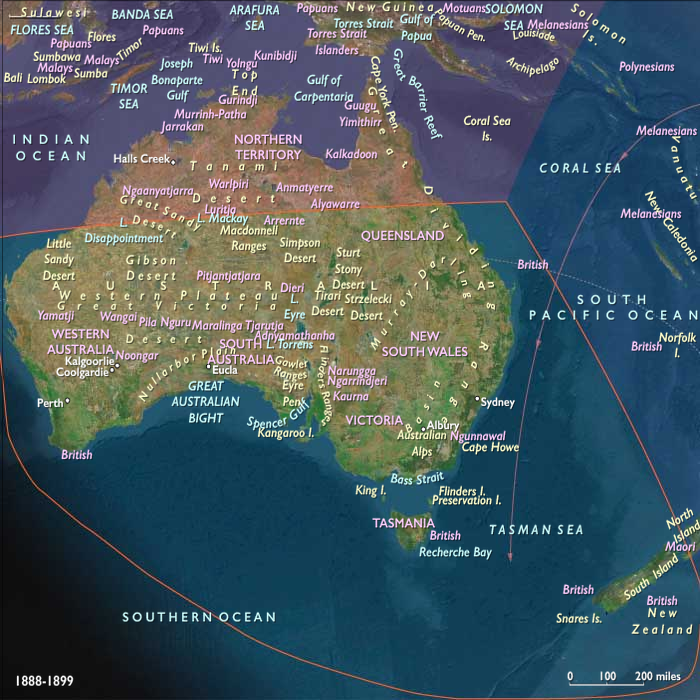
The Australian wine industry, based on vines first planted by English settlers, grows rapidly in the second half of the nineteenth century.
Vine cuttings from the Cape of Good Hope had been brought to the penal colony of New South Wales by Governor Phillip on the First Fleet (1788).
An attempt at wine making from these first vines had failed, but with perseverance, other settlers had managed to successfully cultivate vines for winemaking, and Australian made wine was available for sale domestically by the 1820s.
Gregory Blaxland had become the first person to export Australian wine in 1822, and the first winemaker to win an overseas award.
Vineyards had been established in the Hunter Valley in 1830.
James Busby had returned from France and Spain in 1833 with a serious selection of grape varieties, including most classic French grapes and a good selection of grapes for fortified wine production.
Wine from the Adelaide Hills had been sent to Queen Victoria in 1844, but there is no evidence that she placed an order as a result.
The production and quality of Australian wine had been much improved by the arrival of free settlers from various parts of Europe, who have used their skills and knowledge to establish some of Australia's premier wine regions.
For example, emigrants from Prussia in the mid 1850s were important in establishing South Australia's Barossa Valley as a winemaking region.
Early Australian winemakers had faced many difficulties, particularly due to the unfamiliar Australian climate.
However, they eventually achieve considerable success.
"At the 1873 Vienna Exhibition the French judges, tasting blind, praised some wines from Victoria, but withdrew in protest when the provenance of the wine was revealed, on the grounds that wines of that quality must clearly be French." (Phillips, Roderick (2000). A short history of wine. London: Allen Lane. p.265.)
Australian wines continue to win high honors in French competitions.
A Victorian Syrah (also called Shiraz) competing in the 1878 Paris Exhibition had been likened to Château Margaux and "its taste completed its trinity of perfection." (Phlllips. p. 265.)
One Australian wine had won a gold medal "first class" at the 1882 Bordeaux International Exhibition and another wins a gold medal "against the world" at the 1889 Paris International Exhibition.
This is all before the destructive effects on the industry of the phylloxera epidemic, which will eventually find its way to Australia.
Locations
Groups
Topics
Commodoties
Subjects
Regions

Subregions
Years: 1889 - 1889
Locations
Groups
Topics
Commodoties
Subjects
Regions
Subregions