The Assyrians have adopted attire similar to …
Years: 837BCE - 826BCE
The Assyrians have adopted attire similar to the Babylonian costume but more elaborate, including tasseled robes embroidered with small, repeated patterns or rosettes.
Men wear their hair shoulder length and curl both their hair and beards; they also wear fez-like hats, decorated to indicate rank.
Women's attire is similar, being differentiated by headbands made of wool or of stonework and gold.
Locations
Groups
- Mesopotamia
- Aramaeans
- Babylon, Kingdom of
- Assyria, (New) Kingdom of (Neo-Assyrian Empire)
- Assyrian people
Topics
- Younger Subboreal Period
- Iron Age, Near and Middle East
- Assyrian Wars of c. 909-c. 746 BCE
- Iron Age Cold Epoch
Commodoties
Subjects
Regions
Subregions
Related Events
Filter results
Showing 10 events out of 66571 total
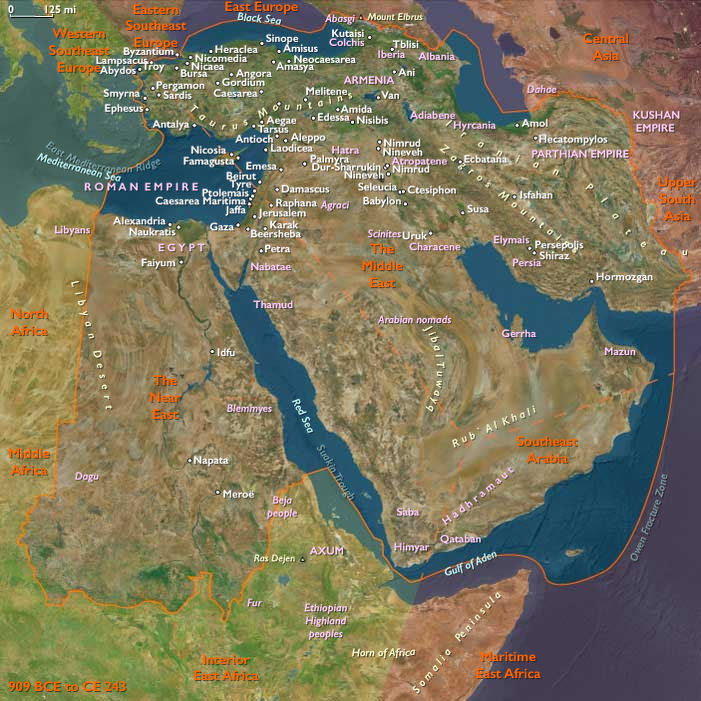
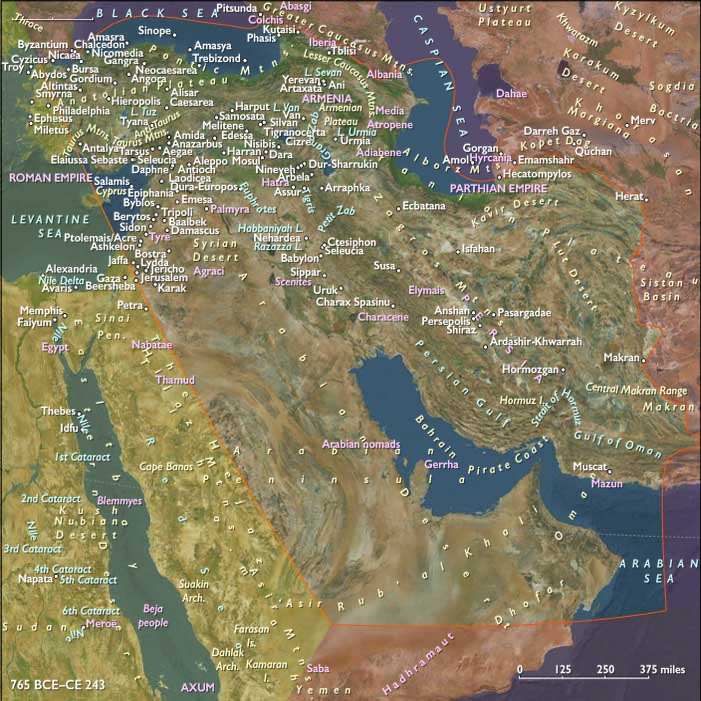
The Middle East, 837 to 826 BCE: Internal Strife and Cultural Refinement
During the era 837 to 826 BCE, the Assyrian Empire faces internal challenges that disrupt its previously expansive momentum under Shalmaneser III. Despite internal conflicts, the period also sees significant cultural developments, notably in Assyrian dress and ceremonial customs.
Assyrian Internal Strife
In the later years of Shalmaneser III’s reign, internal tensions significantly weaken the empire. Around 828–826 BCE, Shalmaneser faces a prolonged civil war due to a rebellion initiated by his son, Ashur-danin-pal. The intense two-year conflict severely taxes Assyrian resources and military capabilities, resulting in the temporary loss of several conquered territories. Although Shalmaneser eventually suppresses the rebellion, the strife causes lasting damage to Assyrian prestige and stability, interrupting its previously steady expansion.
Cultural and Artistic Development
During this turbulent era, Assyrian society undergoes notable refinement, especially in attire and royal ceremonial customs. Assyrian fashion, heavily influenced by Babylonian styles, becomes increasingly elaborate and sophisticated. Both men and women adopt intricate robes embroidered with small repeated patterns or rosettes, showcasing the empire's wealth and artisanal skill.
Men typically wear shoulder-length hair, meticulously curled, along with well-groomed beards. Their attire often includes distinctive, decorated fez-like hats, whose embellishments denote rank and status. Similarly, women enhance their outfits with ornate woolen headbands or elaborate headpieces made of stonework and gold, emphasizing both social standing and cultural refinement.
Political and Social Implications
The period of internal strife under Shalmaneser III underscores the inherent vulnerabilities of the Assyrian Empire, highlighting the challenges of governance and succession in an expanding imperial system. At the same time, the evolution in Assyrian dress and ceremonial customs signifies a continued focus on cultural and social cohesion despite political instability. This blend of internal disruption and cultural advancement illustrates the complex dynamics that define this transformative period in Middle Eastern history.
Internal strife troubles Shalmaneser's reign, and many of his conquests are lost.
Shalmaneser wages a two-year civil war around 828-826 to quash a rebellion by his son Ashurdaninpal.
The Near East (837–826 BCE): Aramaean Incursions and Egyptian Fragmentation
Aramaean Aggression and Israelite Decline
Around 835 BCE, the northern kingdom of Israel experiences devastating conflict as Hazael, the Aramaean king of Damascus, launches an invasion. This critical event is vividly recorded on the Tel Dan Stele, a basalt monument discovered at Tel Dan in northern Israel. The Aramaic inscription recounts Hazael's military victory, explicitly claiming responsibility for the deaths of Jehoram, son of Ahab, king of Israel, and Ahaziah, son of Jehoram, king of Judah. The stele further boasts of turning their towns into ruins and their lands into desolation, underscoring the vulnerability of the Israelite and Judean states during this era.
The kingdom of Israel, already weakened by internal dynastic upheavals and Jehu’s violent purge, struggles to resist external threats. Jehu, who remains king during this tumultuous period, witnesses extreme fluctuations in the kingdom’s stability, ultimately culminating in a catastrophic defeat by Hazael around 815 BCE. This crushing military loss effectively destroys Israel’s army and severely diminishes its political and military influence in the region.
Egypt’s Political Fragmentation
In Egypt, the period witnesses further political fragmentation. Pedubast I, declaring himself pharaoh around 835 BCE (or possibly 824 BCE), establishes the Twenty-third Dynasty. A ruler of Libyan ancestry, Pedubast initially controls Thebes and Upper Egypt while coexisting relatively peacefully with Shoshenq III, who continues to rule Lower Egypt from Memphis and the Delta region under the Twenty-second Dynasty. This division reflects Egypt’s ongoing political fragmentation during the Third Intermediate Period, characterized by regional power struggles and dynastic rivalries rather than outright warfare.
Pedubast's rule is notable for its length and relative stability, lasting approximately twenty-five years. His coexistence with Shoshenq III suggests a pragmatic relationship, highlighting how Egypt’s internal divisions, although politically significant, did not always result in direct conflict.
Summary of the Era
The years 837–826 BCE in the Near East are marked by significant regional instability, particularly through the aggressive expansion of the Aramaean kingdom under Hazael, which profoundly impacts Israel’s strength and territorial integrity. Simultaneously, Egypt faces continued internal divisions as rival dynasties coexist, reflecting broader patterns of fragmentation and localized governance. Together, these developments underscore a period of profound transition and vulnerability, shaping the Near Eastern political landscape for decades to come.

An invasion of the northern kingdom of Israel by an Aramaen king—almost certainly Hazael, king of Damascus—around 835 BCE is related in detail on a fragment of a black basalt monument, found broken and later reused in a later stratum as a building stone at the biblical site of Tel Dan in northern Israel.
Containinh an Aramaic inscription, the language of the Aramaic kings of Syria, it reads, in part [I killed Jeho]ram son of [Ahab] king of Israel, and [I] killed [Ahaz]iahu son of [Jehoram kin]g of the House of David. And I set [their towns into ruins and turned] their land into [desolation].
Jehu's long reign is a period of extreme oscillations in the north, capped by the catastrophic defeat of Israel and the destruction of its army by Hazael of Aram-Damascus in about 815 BCE.
Jehu's son and coregent Jehoahaz succeeds him.
Pedubast I declares himself king of Egypt, founding the Twenty-third Dynasty in either 835 or 824 BCE.
This local Pharaoh, who is recorded as being of Libyan ancestry, will rule Egypt for twenty-five years according to the redaction of Manetho done by Eusebius.
He first became king at Thebes in Year Eight of Shoshenq III and his highest dated Year is his Twenty-third Year according to Nile Level Text No. 29.
This year is equivalent to Year Thirty-One of Shoshenq III of the Tanis based Twenty-second Dynasty of Egypt; however, since Shoshenq II only controlled Lower Egypt in Memphis and the Delta region, Pedubast and Shoshenq III were not political rivals and may even have established a relationship.
The Middle East, 825 to 814 BCE: The Reconsolidation Under Shamsi-Adad V
The era 825 to 814 BCE marks a significant phase of reconsolidation and expansion for the Assyrian Empire under the rule of Shamsi-Adad V, who ascends the throne in 824 BCE following a turbulent period of civil unrest. Shamsi-Adad V embarks on determined efforts to restore stability, unity, and imperial prestige that had been severely compromised during the preceding civil war between his father, Shalmaneser III, and his rebellious brother, Ashur-danin-pal.
Shamsi-Adad V proves to be a vigorous leader who strategically directs Assyrian resources towards reasserting imperial authority over previously contested territories. A pivotal achievement during this era is the successful integration of Chaldea into the Assyrian Empire, a region strategically situated at the southernmost part of Mesopotamia. This conquest not only solidifies Assyria’s dominance in the region but also significantly enhances its economic prosperity and geopolitical influence.
The integration of Chaldea underscores Assyria's revitalized military prowess and Shamsi-Adad V’s adeptness at overcoming internal political turmoil to pursue expansionist policies effectively. His decisive actions in Chaldea demonstrate the empire’s robust capability for recovery and adaptation, ensuring that Assyria remains a formidable force within the Middle East.
Culturally, Assyria during this period continues to be characterized by the elaborate attire and ceremonial traditions that had developed during earlier reigns. The fashion remains highly sophisticated, reflecting influences from neighboring Babylonian customs, with intricate embroidered garments and detailed grooming practices signifying social and political status.
Thus, the era from 825 to 814 BCE under Shamsi-Adad V represents an important chapter of restoration and renewed expansion for the Assyrian Empire. It is a testament to the empire's resilience, its enduring capacity for recovery, and its sustained ability to exert significant regional influence, shaping the historical trajectory of the Middle East.
Shamsi-Adad V, who rules Assyria from 824 BCE, adds Chaldea to his empire.
The Near East (825–814 BCE): Egyptian Division and Israelite Struggles
Egyptian Fragmentation Deepens
Between 825 and 814 BCE, Egypt's political fragmentation intensifies, particularly after the reign of Osorkon II. By approximately 818 BCE, control of Egypt is effectively divided, with Shoshenq III of the Twenty-second Dynasty ruling over Lower Egypt from Memphis and the Delta region, while Upper and Middle Egypt are governed by Takelot II and his son Osorkon, later known as Osorkon III. Following the death of Takelot II, rivalry erupts between his sons Osorkon and Shoshenq III, plunging Thebes into a civil conflict.
Adding to the political complexity, Pedubast I, a ruler of Libyan ancestry, had earlier declared himself Pharaoh, founding the Twenty-third Dynasty and reigning primarily over Thebes and Upper Egypt. His rule, lasting approximately twenty-five years, represents a further layer of political division. The competition between Pedubast I and the existing line of Takelot II/Osorkon III characterizes this turbulent era, underscoring the extent of Egypt's fragmentation during the Third Intermediate Period.
Jehoahaz and Israel’s Continuing Decline
In the northern kingdom of Israel, the death of King Jehu in 815 BCE marks the beginning of sole rulership for his son Jehoahaz. His reign unfolds against the backdrop of Israel’s diminished military and political power following catastrophic defeats by the Aramaean kingdom of Damascus under Hazael. Israel continues to suffer from the consequences of these military setbacks, facing severe territorial losses and reduced regional influence. Jehoahaz’s rule is characterized by efforts to stabilize a significantly weakened state, which struggles against ongoing external pressures and internal vulnerabilities.
Summary of the Era
The years 825–814 BCE witness profound political upheaval in the Near East, particularly marked by intensified fragmentation within Egypt. The rivalry among Egyptian rulers underscores the period's dynastic complexity and regional instability. Concurrently, Israel continues to endure significant political and military challenges under Jehoahaz, reflecting broader patterns of vulnerability and transition within the region. Collectively, these events highlight the ongoing reshaping of the Near Eastern political landscape, setting the stage for further developments in subsequent decades.
Egypt had effectively shattered in two states after the reign of Osorkon II, particularly, with Shoshenq III of the Twenty-Second Dynasty controlling Lower Egypt by 818 BCE while Takelot II and his son Osorkon (the future Osorkon III) rule Middle and Upper Egypt.
Osorkon and Shoshenq III, the two sons of Takelot II, sons battle for the throne after his death.
Years: 837BCE - 826BCE
Locations
Groups
- Mesopotamia
- Aramaeans
- Babylon, Kingdom of
- Assyria, (New) Kingdom of (Neo-Assyrian Empire)
- Assyrian people
Topics
- Younger Subboreal Period
- Iron Age, Near and Middle East
- Assyrian Wars of c. 909-c. 746 BCE
- Iron Age Cold Epoch