
The Ascanian line of Saxe-Wittenberg had become …
Years: 1480 - 1491
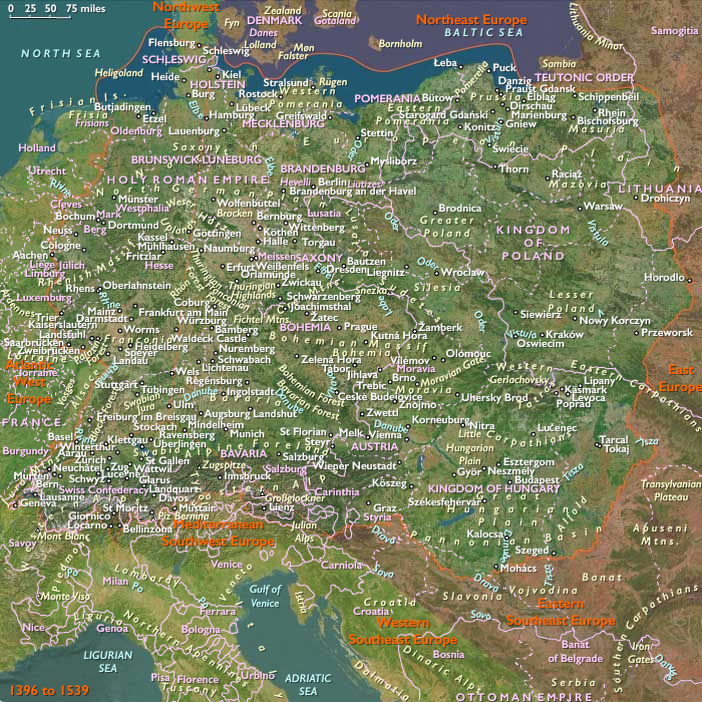
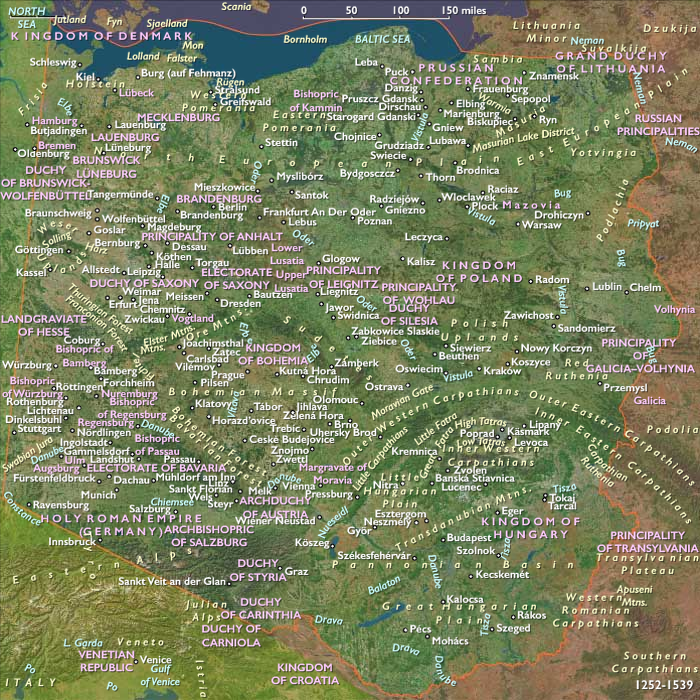
The Ascanian line of Saxe-Wittenberg had become extinct with the death of Elector Albert III in 1422, whereafter Emperor Sigismund had bestowed the country and electoral dignity upon Margrave Frederick IV of Meissen, who had been a loyal supporter in the Hussite Wars.
The late Albert's Ascanian relative Duke Eric V of Saxe-Lauenburg had protested in vain.
Frederick, one of the seven Prince-electors, was a member of the House of Wettin, which since 1089 had ruled over the adjacent Margraviate of Meissen up the Elbe river, established under Emperor Otto I in 965, and since 1242 also over the Landgraviate of Thuringia.
Thus, in 1423, Saxe-Wittenberg, the Margraviate of Meissen and Thuringia had been united under one ruler, and the unified territory gradually received the name of (Upper) Saxony.
When Elector Frederick II died in 1464, his two surviving sons, in disregard of the primogeniture principle, divide his territories by the Treaty of Leipzig on August 26, 1485, bringing about the still existing separation of the Wettin dynasty into the Ernestine and Albertine lines.
The elder son, Ernest, founder of the Ernestine line, receives large parts of the former Duchy of Saxe-Wittenberg and the electoral dignity united with it, as well as ...
Locations
People
Groups
- Bohemia, Kingdom of
- Saxony, Electorate of
- Saxe-Lauenburg, Duchy of
- Brandenburg, (Hohenzollern) Margravate of
- Holy Roman Empire
Topics
Subjects
Regions
Subregions
Years: 1480 - 1491
Locations
People
Groups
- Bohemia, Kingdom of
- Saxony, Electorate of
- Saxe-Lauenburg, Duchy of
- Brandenburg, (Hohenzollern) Margravate of
- Holy Roman Empire
Topics
Subjects
Regions
Subregions