
Some of the Caddo territory had been …
Years: 1684 - 1827
Some of the Caddo territory had been invaded by migrating Dhegihan-speaking peoples, Osage, Ponca, Omaha, and Kaw, who moved west beginning about 1200 due to years of warfare with the Iroquois in the Ohio River area of present-day Kentucky.
The Iroquois had taken control of hunting grounds in the area.
The Osage particularly had fought the Caddo, competed for territory, and become dominant in the region of present-day Missouri, Arkansas, and eastern Kansas.
These tribes had become settled in their new territory west of the Mississippi prior to mid-eighteenth-century European contact.
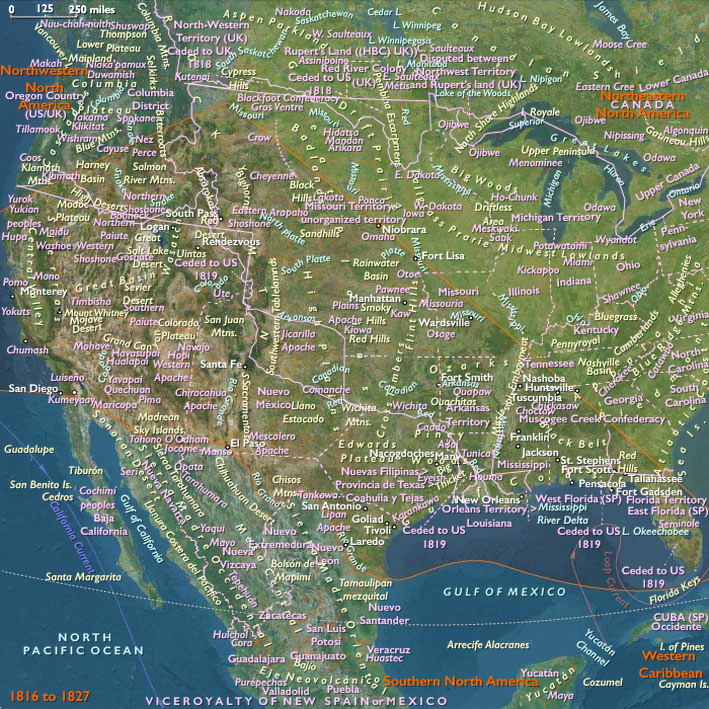
Most of the Caddo historically live in the Piney Woods ecoregion of the United States, divided among the state regions of East Texas, southern Arkansas, western Louisiana, and southeastern Oklahoma.
This region extends up to the foothills of the Ozarks.
The Piney Woods are a dense forest of deciduous and pinophyta flora covering rolling hills, steep river valleys, and intermittent wetlands called "bayous".
Caddo people primarily settle throughout the river valleys of East Texas and adjacent regions.
When they first encounter Europeans and Africans, the Caddo tribes organize themselves in three confederacies: the Natchitoches, Hasinai, and Kadohadacho.
They are loosely affiliated with other neighboring tribes including the Yowani, a Choctaw band.
The Natchitoches live in now northern Louisiana, the Hasinai live in East Texas, and the Kadohadacho live near the border of Texas, Oklahoma, and Arkansas.
The Caddo people have a diet based on cultivated crops, particularly maize (corn), but also sunflower, pumpkins, and squash.
These foods hold cultural significance, as do wild turkeys.
They also hunt and gather wild plants.
The Iroquois had taken control of hunting grounds in the area.
The Osage particularly had fought the Caddo, competed for territory, and become dominant in the region of present-day Missouri, Arkansas, and eastern Kansas.
These tribes had become settled in their new territory west of the Mississippi prior to mid-eighteenth-century European contact.
Most of the Caddo historically live in the Piney Woods ecoregion of the United States, divided among the state regions of East Texas, southern Arkansas, western Louisiana, and southeastern Oklahoma.
This region extends up to the foothills of the Ozarks.
The Piney Woods are a dense forest of deciduous and pinophyta flora covering rolling hills, steep river valleys, and intermittent wetlands called "bayous".
Caddo people primarily settle throughout the river valleys of East Texas and adjacent regions.
When they first encounter Europeans and Africans, the Caddo tribes organize themselves in three confederacies: the Natchitoches, Hasinai, and Kadohadacho.
They are loosely affiliated with other neighboring tribes including the Yowani, a Choctaw band.
The Natchitoches live in now northern Louisiana, the Hasinai live in East Texas, and the Kadohadacho live near the border of Texas, Oklahoma, and Arkansas.
The Caddo people have a diet based on cultivated crops, particularly maize (corn), but also sunflower, pumpkins, and squash.
These foods hold cultural significance, as do wild turkeys.
They also hunt and gather wild plants.
Locations
Groups
- Hasinai, or Teja (Amerind tribe)
- Mississippian culture
- Iroquois (Haudenosaunee, also known as the League of Peace and Power, Five Nations, or Six Nations)
- Osage Nation (Amerind tribe)
- Choctaw (Amerind tribe)
- Omaha (Amerind tribe)
- Caddo (Amerind tribe)
- Ponca (Amerind tribe)
- Tonkawa (Amerind tribe)
Commodoties
Regions

Subregions
Related Events
Showing 10 events out of 30218 total
Years: 1684 - 1827
Locations
Groups
- Hasinai, or Teja (Amerind tribe)
- Mississippian culture
- Iroquois (Haudenosaunee, also known as the League of Peace and Power, Five Nations, or Six Nations)
- Osage Nation (Amerind tribe)
- Choctaw (Amerind tribe)
- Omaha (Amerind tribe)
- Caddo (Amerind tribe)
- Ponca (Amerind tribe)
- Tonkawa (Amerind tribe)
Commodoties
Regions
Subregions