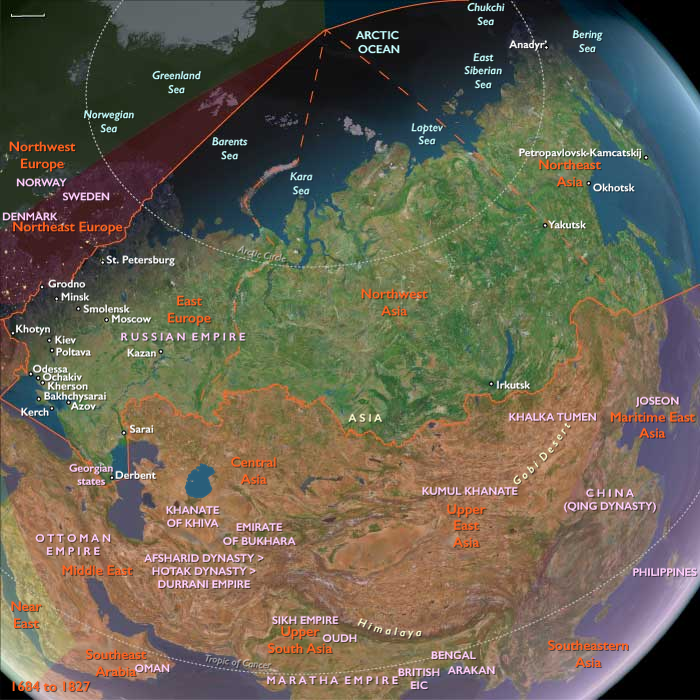
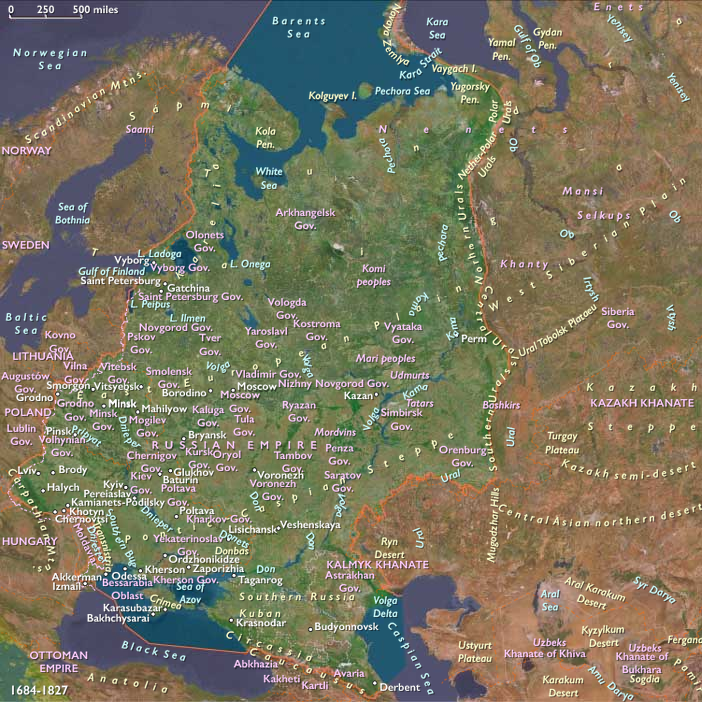
Plague breaks out in Ruthenia, Podolia and …
Years: 1705 - 1705
Locations
People
Groups
- Saxony, Electorate of
- Podolian Voivodeship
- Sweden, (second) Kingdom of
- Swedish Empire
- Polish-Lithuanian Commonwealth (Commonwealth of the Two Nations)
- Russian Empire
Topics
Subjects
Regions
Subregions
Related Events
Filter results
Showing 10 events out of 531 total
The British East India Company opens its first trading office in Canton, China and begins importing opium.
The two companies merge in 1708, by a tripartite indenture involving both companies and the state.
Under this arrangement, the merged company lends to the Treasury a sum of £3,200,000, in return for exclusive privileges for the next three years, after which the situation is to be reviewed.
The amalgamated company becomes the United Company of Merchants of England Trading to the East Indies.
In 1712, another act renews the status of the company, though the debts are repaid.
The British ships now sail to the neutral Dutch port of Batavia in what is now Indonesia, where Rogers undergoes surgery to remove a musket ball from the roof of his mouth, and the expedition disposes of the less seaworthy of the two Spanish prizes.
Dealing with the Dutch here constitutes a violation of the British East India Company's monopoly.
The Charter for the company is drawn up by Blunt, based upon that of the Bank of England.
Blunt is paid three thousand eight hundred and forty-six pounds for his services in setting up the company.
Directors will be elected every three years while shareholders will meet twice a year.
The company employs a Cashier, Secretary and Accountant.
The Governor is intended to be an honorary position and will later be customarily held by the ruling monarch.
The charter allows the full court of directors to nominate a smaller committee to act on any matter on its behalf.
Anyone who is a director of the Bank of England or East India Company is disbarred from being a director of the South Sea company.
Any ship owned by the company of more than five hundred tons is to have a Church of England clergyman on board.
The exchange of government debt for stock is to occur in five separate lots.
The first two of these totaling two and three quarters of a million pounds from about two hundred large investors had already been arranged before the company's charter is issued on September 10, 1711.
The government itself exchanges three quarters of a million pounds of its own debt held by different departments (at this time, individual office holders hold responsibility for money in their charge, and are at liberty to invest it to their own advantage before it is required).
Harley exchanges eight thousand pounds of debt and is appointed Governor of the new company.
Blunt, Caswall and Sawbridge together provide sixty-five thousand pounds, Janssen twenty-five thousand pounds of his own plus a quarter million pounds from a foreign consortium, Decker forty-nine thousand pounds, Sir Ambrose Crawley thirty-six thousand nine hundred and seventy-one pounds.
The company has a Sub-Governor, Bateman, Deputy Governor, Ongley and thirty ordinary directors.
In total, nine of the directors are politicians, five are members of the Sword Blade consortium and seven more financial magnates who have been attracted to the scheme.
The company creates a coat of arms with the motto 'A Gadibus usque ad Auroram' (from Cadiz to the dawn) and rented a large house in the City as its headquarters.
Seven sub-committees are created to handle its everyday business, the most important being the 'Committee for the affairs of the company'.
The Sword Blade company is retained as their banker and on the strength of its new government connections issues notes in its own right, notwithstanding the Bank of England monopoly.
The task of the Company Secretary is to oversee trading activities, the Accountant, Grigsby, is responsible for registering and issuing stock, and the Cashier, Robert Knight, acts as Blunt's personal assistant at a salary of two hundred pounds per year.

A legal battle ensues when the ships of the Rogers expedition finally drop anchor in the Thames River on October 14, 1711, with the investors paying the East India Company six thousand pounds (about six hund4red and sixty-six thousand pounds at 2009 values) as settlement for their claim for breach of monopoly, about four percent of what Rogers has brought back.
The investors have approximately doubled their money, while Rogers has gained sixteen hundred pounds (today perhaps one hundred and seventy-six thousand pounds) from a voyage which has disfigured him and cost him his brother, who had been killed in a battle in the Pacific.
The money is probably less than he could have made at home, and is entirely absorbed by the debts his family has incurred in his absence.
However, the long voyage and the capture of the Spanish ship make Rogers a national hero.
Rogers is the first Englishman, in circumnavigating the globe, to have his original ships and most of his crew survive.
Woodes Rogers writes an account of his journey, titled A Cruising Voyage Round the World.
While Edward Cooke, an officer aboard the Duchess, also writes a book, and beats Rogers to print by several months, Rogers' book is much more successful, with many readers fascinated by the account of Selkirk's rescue, which Cooke had slighted.
Among those interested in Selkirk's adventure is Daniel Defoe, who seeks out Selkirk, and fictionalizes the story as Robinson Crusoe.
While Rogers' book enjoys financial success, it has a practical purpose—to aid British navigators and possible colonists.
Much of Rogers' introduction is devoted to advocacy for the South Seas trade.
Rogers notes that had there been a British colony in the South Seas, he would not have had to worry about food supplies for his crew.
A third of Rogers' book is devoted to detailed descriptions of the places that he had explored, with special emphasis on "such [places] as may be of most use for enlarging our trade". (Little, Brian (1960). Crusoe's Captain. Odhams Press.)
He describes the area of the River Plate in detail because it lies "within the limits of the South Sea Company", whose schemes have not yet burst into financial scandal.
Rogers' book will be carried by such South Pacific navigators as Admiral George Anson and privateering captains John Clipperton and George Shelvocke.
Rogers has encountered financial problems on his return.
Sir William Whetstone has died, and Rogers, having failed to recoup his business losses through privateering, is forced to sell his Bristol home to support his family.
He is successfully sued by a group of over two hundred of his crew, who stated that they had not received their fair share of the expedition profits.
The profits from his book are not enough to overcome these setbacks, and he is forced into bankruptcy.
His wife gives birth to their fourth child a year after his return—a boy who dies in infancy—and Sarah and Woodes Rogers soon permanently separate.
Rogers decides the way out of his financial difficulty is to lead another expedition, this time against pirates.
He leads in 1713 what is ostensibly an expedition to purchase slaves in Madagascar and take them to the Dutch East Indies, this time with the permission of the British East India Company.
Rogers' secondary purpose, however, is to gather details on the pirates of Madagascar, hoping to destroy or reform them, and colonize Madagascar on a future trip.
The Treaty of Utrecht ending the War of the Spanish Succession grants Britain an Asiento lasting thirty years to supply the Spanish colonies with forty-eight hundred slaves per year.
Britain is permitted to open offices in Buenos Aires, Caracas, Cartagena, Havana, Panama, Portobello and Vera Cruz to arrange the slave trade.
One ship of no more than five hundred tons can be sent to one of these places each year (the Navío de Permiso) with general trade goods but one quarter of the profits are to be reserved for the King of Spain.
There is provision for two extra sailings at the start of the contract.
The Asiento is granted in the name of Queen Anne and then contracted to the East India Company.
The East India Company has arranged contracts with the Royal African Company by July to supply the necessary African slaves to Jamaica.
Ten pounds is paid for a slave aged over sixteen, eight pounds for one over ten.
Two thirds are to be male, and ninety percent adult.
The company transships twelve hundred and thirty slaves from Jamaica to America in the first year, plus any which might have been added (against standing instructions) by the ship's captains on their own behalf.
On arrival of the first cargoes, the local authorities refuse to accept the Asiento, which has still not been officially confirmed there by the Spanish authorities.
The slaves will eventually be sold at a loss in the West Indies.
Parliament votes in July 1714 "to offer a reward for such person or persons as shall discover the Longitude." (Ten thousand pounds for any method capable of determining a ship's longitude within one degree; fifteen thousand pounds within forty minutes, and twenty thousand pounds within half a degree).
The government announces that a quarter of profits of the South Sea Company will be reserved for the queen and a further seven and a half percent for a financial advisor.
Some members of company board refuse to accept the contract on these terms, and the government is obliged to reverse its decision.
Despite these setbacks, the company persists, having raised two hundred thousand pounds to finance the operations.
The company is heavily dependent on the goodwill of government, and when government changes, so too does the company board.
One of the directors who had been sponsored by Harley, Arthur Moore, had in 1714 attempted to send sixty tons of private goods on board the company ship.
He is dismissed as a director, but the result was the beginning of Harley's fall from favor with the company.
Harley is on July 27 replaced as Lord High treasurer as a result of disagreement that had broken out within the Tory faction in parliament.
Years: 1705 - 1705
Locations
People
Groups
- Saxony, Electorate of
- Podolian Voivodeship
- Sweden, (second) Kingdom of
- Swedish Empire
- Polish-Lithuanian Commonwealth (Commonwealth of the Two Nations)
- Russian Empire