
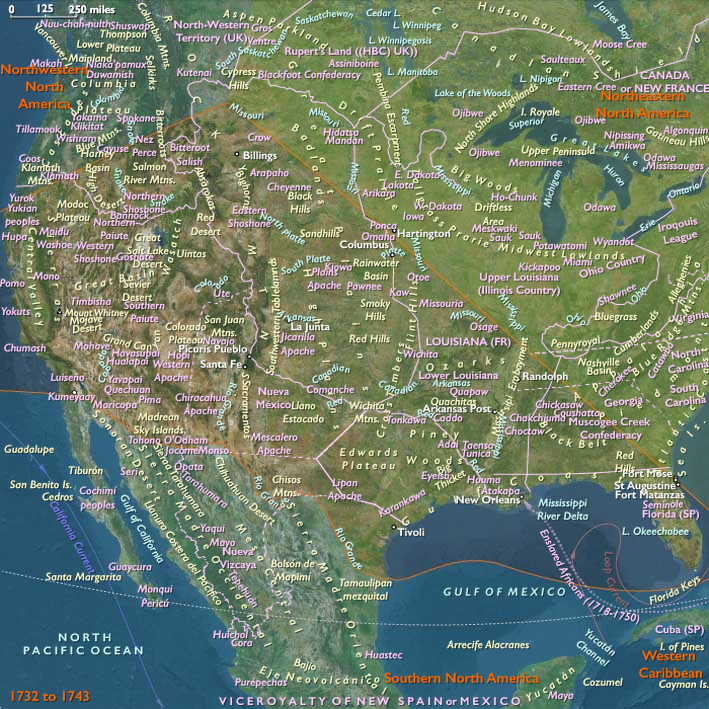
The Mallets and their party had left …
Years: 1741 - 1741
March
One of their men had married a Spanish woman and had remained in New Mexico.
Three men had split off to return to Illinois via the same route they had followed to New Mexico; the Mallets and two others had followed the Canadian River eastwards from New Mexico through the Texas Panhandle and into Oklahoma.
En route they had encountered a Comanche village and traded knives and other items for horses.
Later, probably in Oklahoma, they encountered several Padoucas (Apache?) who were frightened of them, possibly because of experience with slavers.
Downstream, when the Canadian became navigable, the Mallets abandoned their horses and made canoes and on June 24 they arrivde at the junction of the Canadian and Arkansas Rivers and found there a hunting party of French Canadians.
By boat they had proceeded down the river to Arkansas Post and hence to New Orleans, Louisiana, arriving in March 1741.
Locations
People
Groups
- Pawnee (Amerind tribe)
- Arikara people (Amerind tribe)
- Spaniards (Latins)
- New France (French Colony)
- New Spain, Viceroyalty of
- France, (Bourbon) Kingdom of
- Santa Fe de Nuevo México (Spanish Colony)
- French Canadians
- Comanche (Amerind tribe)
- Louisiana (New France)
Topics
Subjects
Regions

Subregions
Related Events
Filter results
Showing 10 events out of 27346 total
The population of China reaches about one hundred and forty-three million.
Niels Klim's Underground Travels is a satirical science-fiction/fantasy novel written by the Norwegian–Danish author Ludvig Holberg.
His only novel, it describes a utopian society from an outsider's point of view, and often pokes fun at diverse cultural and social topics such as morality, science, sexual equality, religion, governments, and philosophy.
Holberg knew that the satirical content of the novel would cause an uproar in Denmark-Norway, so the book was first published in Germany, in Latin, as Nicolai Klimii Iter Subterraneum.
He thus captured a broader audience than he would have gotten in his homeland.
The novel brings him wide acclaimed across Europe.
Danish, German, French, and Dutch translations are also published in 1741.
The book is significant in the history of science fiction, being one of the first science-fiction novels in history, along with Johannes Kepler's Somnium (The Dream, 1634), Cyrano de Bergerac's Comical History of the States and Empires of the Moon (1656), Jonathan Swift's Gulliver's Travels (1726), and Voltaire's Micromégas (1752).
It is also one of the first science fiction novels to use the Hollow Earth concept.
Andres Celsius had traveled frequently in the early 1730s, including to Germany, Italy, and France, visiting most of the major European observatories.
In Paris, he had advocated the measurement of an arc of the meridian in Lapland.
He had in 1736 participated in the expedition organized for that purpose by the French Academy of Sciences, led by the French mathematician Maupertuis to measure a degree of latitude.
The aim of the expedition was to measure the length of a degree along a meridian, close to the pole, and compare the result with a similar expedition to Peru, today in Ecuador, near the equator.
The expeditions had confirmed Isaac Newton's belief that the shape of the earth is an ellipsoid flattened at the poles.
He had in 1738 published the De observationibus pro figura telluris determinanda (Observations on Determining the Shape of the Earth).
Celsius' participation in the Lapland expedition has won him much respect in Sweden with the government and his peers, and plays a key role in generating interest from the Swedish authorities in donating the resources required to construct a new modern observatory in Uppsala.
He is successful in the request, and Celsius founds the Uppsala Astronomical Observatory in 1741.
The observatory is equipped with instruments purchased during his long voyage abroad, comprising the most modern instrumental technology of the period.
In astronomy, Celsius begins a series of observations using colored glass plates to record the magnitude (a measure of brightness) of certain stars.
This is the first attempt to measure the intensity of starlight with a tool other than the human eye.
He makes observations of eclipses and various astronomical objects and publishes catalogues of carefully determined magnitudes for some three hundred stars using his own photometric system (mean error=0.4 mag).
Celsius is the first to perform and publish careful experiments aiming at the definition of an international temperature scale on scientific grounds.
In his Swedish paper "Observations of two persistent degrees on a thermometer" he reports on experiments to check that the freezing point is independent of latitude (and of atmospheric pressure).
He determines the dependence of the boiling of water with atmospheric pressure which is accurate even by modern day standards.
He further gives a rule for the determination of the boiling point if the barometric pressure deviates from a certain standard pressure.
He proposes the Celsius temperature scale in a paper to the Royal Society of Sciences in Uppsala, the oldest Swedish scientific society, founded in 1710.
His thermometer is calibrated with a value of 100° for the freezing point of water and 0° for the boiling point. (In 1745, a year after his death, the scale will be reversed by Carl Linnaeus to facilitate more practical measurement.)
Celsius originally calls his scale centigrade, derived from the Latin for "hundred steps".
For years it will be referred to simply as the Swedish thermometer.
Celsius conducts many geographical measurements for the Swedish General map, and is one of earliest to note that much of Scandinavia is slowly rising above sea level, a continuous process which has been occurring since the melting of the ice from the latest ice age.
However, he wrongly poses the notion that the water is evaporating.
The Goldberg Variations, BWV 988, is a work for harpsichord by Johann Sebastian Bach, consisting of an aria and a set of thirty variations.
First published in 1741, the work is considered to be one of the most important examples of variation form.
The Variations are named after Johann Gottlieb Goldberg, who may have been the first performer.
Bach writes many works for harpsichord, some of which may have been played on the clavichord.
Many of his keyboard works are anthologies that encompass whole theoretical systems in an encyclopedic fashion.
Almost all the pepper that the Dutch import into their country comes from the kingdom of Kayamkulam.
The Maharajah of Travancore, Marthanda Varma, having realized that the Rajah of Kayamkulam was involved in certain conspiracies against him, has become bent on destroying Kayamkulam and annexing the kingdom.
This endangers Dutch interests, who fear the British will gain the rights to the pepper trade from them, thus ending the Dutch monopoly.
With this in view, the Dutch Governor writes to Marthanda Varma, asking him to end aggressions against Kayamkulam, to which the Maharajah responds by asking him not to interfere in matters that do not concern him.
The Governor then meets the Maharajah in person and threatens war on the basis that they are a "superior" power.
The interview is closed by a scornful remark from the Maharajah that if the "superior" power should attack them "there were forests in Travancore into which he and his people could retire in safety" and that he had himself been planning to invade Europe with the help of his fishermen.
This last interview ends, thus, in tension and the Governor decides to attack Travancore.
Marthanda Varma in a series of battles annexes the kingdoms of Attingal, Quilon, and Kayamkulam.
When he starts his campaign against the Kottarakara and other allies of the Dutch East India Company, the Dutch Governor, Van Imhoff, meets Varma to protest against his policy towards their allies, but the meeting serves only to aggravate the situation.
The Dutch in 1741 install a princess of the Elayadathu Swarupam as the ruler of Kottarakara in defiance of the demands of Marthanda Varma.
The Travancore army inflicts a crushing defeat upon the combined Kottarakara-Dutch armies and annexes the kingdom, forcing the Dutch to retreat to Cochin.
Following this, Marthanda Varma captures all of the Dutch forts in the area.
The battle of Colachel begins when a force of Dutch marines under the leadership of a Flemish commander, Captain Eustachius De Lannoy (also spelled D'lennoy) are sent to Travancore to secure a trading post from the Raja.
They land with artillery in Kulachal, a small but important coastal town, and capture the territory up to Padmanabhapuram, the capital of Travancore.
The arrival of the Raja's army from the north forces the Dutch to take up defensive positions in Kulachal, where they are attacked and defeated by the Travancore Nair Army.
The key element of the Raja's army is his personal guard, known as the Travancore Nair Brigade or locally known as the Nair Pattalam.
Captain de Lannoy and twenty-four other Dutchmen are taken prisoners, while the rest of the Dutchmen either retreat to their ships or are killed.
Donadi, de Lannoy’s lieutenant, is also captured.
The Dutch prisoners express their willingness to serve the Maharaja of Travancore.
De Lannoy is entrusted with the job of training a regiment of the army in European tactics of war and discipline.
Captain de Lannoy performs this task to the entire satisfaction of Marthanda Varma and the Maharaja appoints him as one of his Generals.
Donadi also is given a high military post.
A direct outcome of the event at Kulachal is the takeover of the black pepper trade by the state of Travancore.
This development is to have serious repercussions upon the Dutch and the trading world of Kerala at large.
Pietro Longhi, born in Venice in the parish of Saint Maria, first child of the silversmith Alessandro Falca and his wife, Antonia, had adopted the Longhi last name when he began to paint.
He was initially taught by the Veronese painter Antonio Balestra, who then recommended the young painter to apprentice with the Bolognese Giuseppe Maria Crespi, who is highly regarded by his patrons for both religious and genre painting and is influenced by the work of Dutch painters.
Longhi had returned to Venice before 1732, when was married to Caterina Maria Rizzi, by whom he will have eleven children (only three of which will reach the age of maturity).
Among his early paintings are some altarpieces and religious themes.
His first major documented work is an altarpiece for the church of San Pellegrino in 1732.
In 1734, he had completed frescoes in the walls and ceiling of the hall in Ca' Sagredo, representing the Death of the Giants.
Henceforward, his work will lead him to be viewed in the future as the Venetian William Hogarth, painting subjects and events of everyday life in Venice.
The gallant interior scenes reflect the eighteenth century's turn towards the private and the bourgeois.
Prospero Lorenzo Lambertini, born into a noble family of Bologna, at this time the second largest city in the Papal States, had been created Cardinal-Priest of Santa Croce in Gerusalemme on May 10, 1728 and had been elected Pope in 1740 to succeed Clement XII.
The conclave that elected him had lasted for six months, and he is reported to have said to the cardinals: "If you wish to elect a saint, choose Gotti; a statesman, Aldrovandi; an honest man, me".
His pontificate had begun in a time of great difficulties, chiefly caused by the disputes between Catholic rulers and the Papacy about governmental demands to nominate bishops rather than leaving the appointment to the Church.
He has managed to overcome most of these problems—the Holy See's disputes with the Kingdom of Naples, Sardinia, Spain, Venice, and Austria are settled.
He will have a very active papacy, reforming the education of priests, the calendar of feasts of the Church, and many papal institutions.
Perhaps the most important act of Benedict XIV's pontificate is the promulgation of his famous laws about missions in the two bulls, Ex quo singulari and Omnium solicitudinum.
In these bulls, he rules on the custom of accommodating Christian words and usages to express non-Christian ideas and practices of the native cultures, which had been extensively done by the Jesuits in their Indian and Chinese missions.
An example of this is the statues of ancestors—there had long been uncertainty whether honor paid to one's ancestors was unacceptable 'ancestor worship,' or if it was something more like the Catholic veneration of the saints.
This question is especially pressing in the case of an ancestor known not to have been a Christian.
The choice of a Chinese translation for the name of God had also been debated since the early seventeenth century.
Benedict XIV denounces these practices in these two bulls.
The consequence of this is that many of these converts leave the Church.
Benedict XIV on December 22, 1741, promulgates the papal bull "Immensa Pastorum principis" against the enslavement of the indigenous peoples of the Americas and other countries.
Messiah (HWV 56) is an English-language oratorio composed in 1741 by Handel, with a scriptural text compiled by Charles Jennens from the King James Bible, and from the Psalms included with the Book of Common Prayer (which are worded slightly differently from their King James counterparts).
It is first performed in Dublin on April 13, 1742, and will receive its London premiere nearly a year later.
After an initially modest public reception, the oratorio will gain in popularity, eventually becoming one of the best-known and most frequently performed choral works in Western music
The Foundling Hospital in London, founded in 1741 by the philanthropic sea captain Thomas Coram, is a children's home established for the "education and maintenance of exposed and deserted young children."
The word "hospital" is used in a more general sense than it is today, simply indicating the institution's "hospitality" to those less fortunate.
Several novels are written in response to Samuel Richardson's popular novel Pamela (November 1740), satirizing the innocence of the character of Pamela Andrews.
An Apology for the Life of Mrs. Shamela Andrews, or simply Shamela, as it is more commonly known, is a satirical novel written by Henry Fielding and first published in April 1741 under the name of Mr. Conny Keyber.
Fielding never owned to writing the work, but it is widely considered to be his own direct attack on his contemporary and rival Richardson and is composed, like Pamela, in epistolary form.
Eliza Haywood’s The Anti-Pamela; or Feign’d Innocence Detected, much like the more popular Shamela, portrays the female protagonist as a social climber, although Haywood's character is much less licentious than Fielding's Shamela.
David Garrick on October 19 makes his first appearance as Shakespeare's Richard III.
His performance quickly packs theaters.
Hogarth’s The Enraged Musician, a 1741 etching and engraving, depicts a comic scene of a violinist driven to distraction by the cacophony outside his window.
It is issued as companion piece to the third state of his print of The Distrest Poet.
Charles Wood, the first to recognize the metal subsequently known as platinum a new element, brings the new metal to the attention of The Royal Society, stressing its possible importance and the need for more investigation.
The seventh of fifteen children of William Wood of Wolverhampton and his wife Margaret, daughter of Richard Molyneux, an ironmonger in that area, he had followed his father-in-law's trade until 1715, when he became an ironmaster too and later entered into a contract to provide copper coinage for Ireland.
He was also a projector, floating his business as an ironmaster as a joint stock company at the time of the South Sea Bubble (1720).
He later sought to develop a new process of ironmaking and to obtain a charter for a "Company of Ironmasters of Great Britain".
However, the process (carried on at Frizington, Cumberland) produced little iron and he probably died in debt.
Charles Wood was a partner in some of the businesses, and certainly in the final one.
His father's will left him a legacy of fifteen thousand pounds, but his father died insolvent.
The result was that Charles and some of his brothers were also made bankrupt in the following years.
Wood had gone out to the Carolinas in 1733 following his bankruptcy but only stayed there a couple of years.
He had returned to Cumberland to marry Anne Piele of Buttermere and then went to Jamaica to superintend lead mines in Liguanea.
They had a child in Jamaica in 1739, but the next was born at Whitehaven, in Cumberland.
Wood had acquired various samples of a mysterious metal, as heavy as gold but silvery in appearance, found in the course of alluvial gold working in what is now Colombia, and smuggled from Cartagena to Jamaica.
He sends these to his relative William Brownrigg, a doctor and scientist who practices at Whitehaven, for further investigation.
Brownrigg writes up Wood's experiments and conducts some of his own.
Years: 1741 - 1741
March
Locations
People
Groups
- Pawnee (Amerind tribe)
- Arikara people (Amerind tribe)
- Spaniards (Latins)
- New France (French Colony)
- New Spain, Viceroyalty of
- France, (Bourbon) Kingdom of
- Santa Fe de Nuevo México (Spanish Colony)
- French Canadians
- Comanche (Amerind tribe)
- Louisiana (New France)
