
The area of modern Liechtenstein, once part …
Years: 1719 - 1719
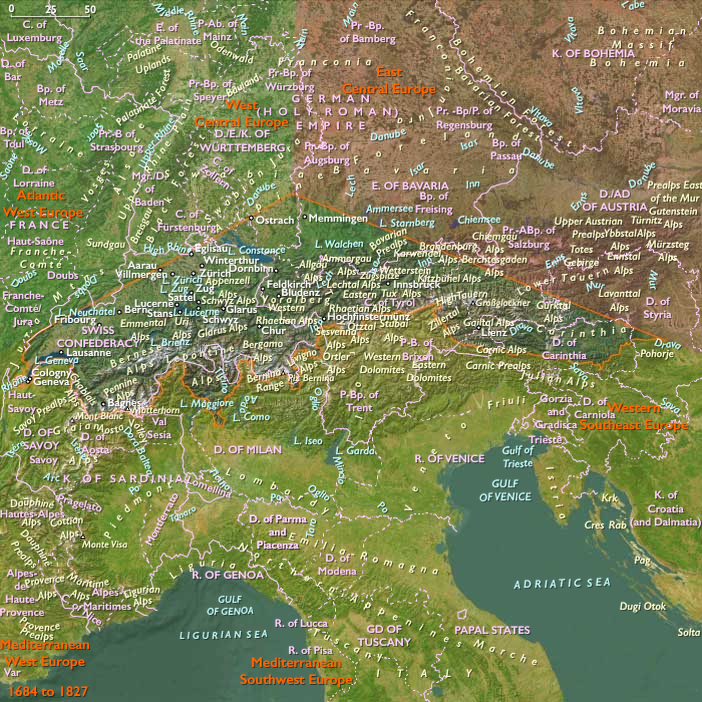
The area of modern Liechtenstein, once part of the Roman province of Rhaetia, and occupied by the southward expansion of the Alemanni tribe during the sixth century, had been incorporated into the Carolingian empire and divided into countships, which have become subdivided over the generations.
Because the duchy of Swabia lost its duke in 1268 and was never restored, all vassals of the duchy had become immediate vassals of the Imperial Throne (as had happened in much of Westphalia when the duchy of Saxony was divided and partially dissolved in aftermath of the defeat of Henry the Lion).
The medieval county of Vaduz had been formed in 1342 as a small subdivision of the Werdenberg county of the dynasty of Montfort of Vorarlberg.
The Liechtenstein dynasty, from which the Principality takes its name (rather than vice-versa) from Castle Liechtenstein in faraway Lower Austria, which it owned from at least 1140 until the thirteenth century (and will own again from 1807 onward).
Over the centuries, it has acquired vast swathes of land, mostly in Moravia, Lower Austria and Styria, but all these expansive and rich territories are held in fief under other more senior feudal lords, particularly under various lines of the Habsburg family, to which many Liechtensteins have been close advisors.
Thus, and without any territory held directly under the Imperial throne, the Liechtenstein dynasty has been unable to meet a primary requirement to qualify for a seat in the Imperial diet, the Reichstag, although they had been elevated to princely rank in 1608.
The third prince, Johann Adam Andreas, had bought the domain of Schellenberg in 1699 and the county of Vaduz in 1712.
This Prince Liechtenstein has wide landholdings in Austria, Bohemia and Moravia, but none of the lands are held directly from the Emperor.
Thus the prince is barred from admittance to the Council of Princes and the prestige and influence that would entail.
By acquiring these Lordships, which are directly subordinate to the Holy Empire because there is no longer a duke of Swabia, the prince obtains his end by having this small patch of mountain villages.
The territory took the name of the family that now ruled the county.
Emperor Charles VI on January 23, 1719, decrees that the counties of Vaduz and Schellenberg be promoted to a principality with the name Liechtenstein for his servant Anton Florian of Liechtenstein, whereby they become Heiliger Römischer Reichsfürst.
Locations
People
Groups
Subjects
Regions
Subregions
Related Events
Showing 10 events out of 28184 total
Years: 1719 - 1719
Locations
People
Groups
Subjects
Regions
Subregions