The architect and sculptor Benedetto Antelami had …
Years: 1196 - 1196
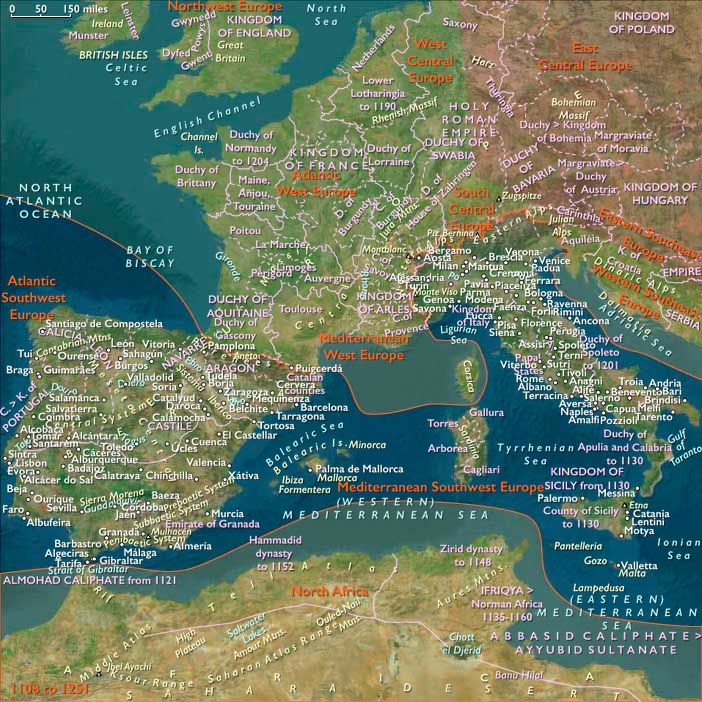
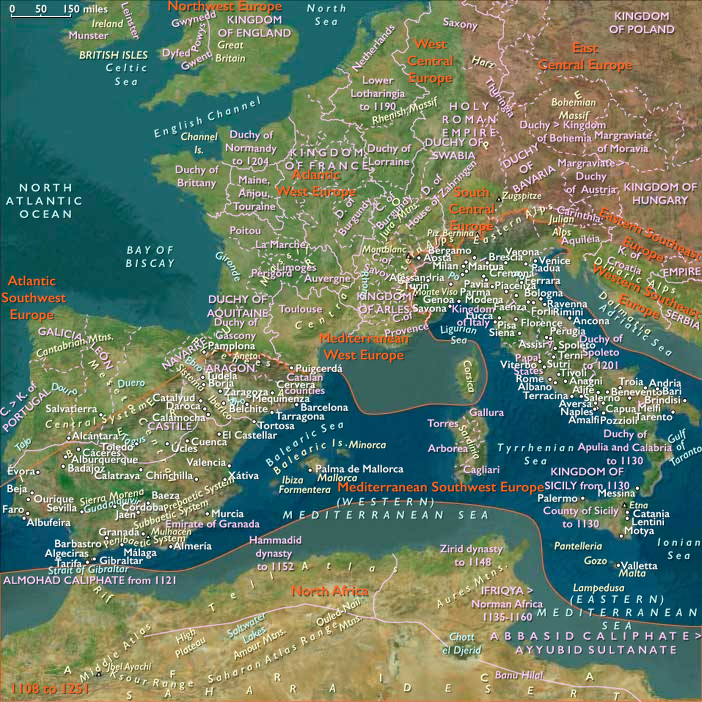
The architect and sculptor Benedetto Antelami had received the commission from the city council to design the Parma Baptistery, begun in 1196; he also creates its elaborate sculptural decorations.
The octagonal building, faced in pink Verona marble, is considered to be among the most important Medieval monuments in Europe.
His name is derived from the "Magistri Antelami," a guild of master builders with whom he trained, spending part of his formative years in southern France.
Stylistically bridging the Romanesque and Gothic periods, Antelami’s architecture and sculpture display stylistic and iconographic parallels with Provençal Romanesque art.
Locations
People
Groups
- Papal States (Republic of St. Peter)
- Italy, Kingdom of (Holy Roman Empire)
- Holy Roman Empire
- Christians, Roman Catholic
Topics
Subjects
Regions
Subregions
Related Events
Filter results
Showing 10 events out of 47746 total
The unrestrained corruption and cruelty of Goryeo's rukler Yi Ui-min, who comes from a nobi (slave) background, leads to a coup by general Choe Chung-heon, who assassinates Yi Ui-min and takes supreme power in 1196.
For the next sixty-one years, the Choe house will rule as military dictators, maintaining the emperors as puppet monarchs.
Constantinople's forces are thoroughly defeated in 1196 after nearly a decade of intermittent warfare between the Empire and Bulgaria.
Ivan Asen is killed later in this year by one of his boyars, Ivanko, who had been threatened with punishment for an affair with the sister of Ivan Asen I's wife.
The murderer attempts to assume control in Turnovo.
Petar Asen, Ivan’s brother, who had retired to Preslav without abdicating the throne, marches on Turnovo, besieges the Ivanko, and forces him to flee to Constantinople.
The late Saladin, although having provided for the division of his Muslim empire among his male Ayyubid relatives, had failed before his death to designate a successor to the sultanate of Cairo.
A dynastic war begins in 1196 between his sons, one the ruler of Egypt, the other of Syria.
Abdicating in 1196, Nemanja joins his son Rastko (later canonized as St. Sava) in a monastery at Mount Athos, Greece, and assists him in establishing the monastery of Khilandar, which will become a focal point of medieval Serbian culture and ecclesiastical leadership.
The Rise of La Rochelle as a Major Port and the Legacy of Alexandre Auffredi (10th–12th Century CE)
Located on the Bay of Biscay, La Rochelle emerged as a significant port city in the 12th century, shaped by the political ambitions of the Dukes of Aquitaine and later the Plantagenet rulers of England. Its strategic maritime position fostered its economic and commercial expansion, attracting merchants and adventurers seeking to capitalize on the riches of the sea trade.
The Establishment of La Rochelle as a Free Port
- Founded in the 10th century, La Rochelle gained importance after William X, Duke of Aquitaine, defeated Isambert de Châtelaillon in 1130 and destroyed Châtelaillon’s harbor, shifting regional trade to La Rochelle.
- In 1137, William X granted La Rochelle a communal charter, making it a free port, allowing the city to govern itself and regulate its commerce.
- Eleanor of Aquitaine, William X’s daughter, upheld the charter after inheriting Aquitaine and, in 1187, established the first appointed mayor in France, Guillaume de Montmirail.
La Rochelle Under Plantagenet Rule (1152–1204)
- After Eleanor’s marriage to Henry Plantagenet in 1152, La Rochelle fell under Plantagenet control when Henry became King of England in 1154.
- Henry II built Vauclair Castle in 1185 to strengthen the city’s defenses; its remains still exist in Place de Verdun.
- Under Plantagenet rule, La Rochelle became a center of maritime commerce, trading with England, the Netherlands, and Spain.
- The city gained privileges under its communal charter, including:
- The right to mint its own coins.
- Exemption from certain royal taxes, encouraging entrepreneurial growth.
This favorable economic environment helped develop the bourgeoisie (merchant middle class), a social group that would shape La Rochelle’s prosperity for centuries.
The Expedition of Alexandre Auffredi (1196–1203)
- In 1196, Alexandre Auffredi, a wealthy merchant from La Rochelle, financed a fleet of seven ships bound for Africa, hoping to tap into the riches of the continent.
- However, as years passed without word from his fleet, Auffredi fell into financial ruin, becoming bankrupt and destitute.
- Finally, in 1203, after seven years, the fleet returned, laden with riches, vindicating his risky commercial venture.
- Having regained wealth, Auffredi dedicated his remaining years to philanthropy, founding the Saint-Barthélemy Hospital and helping the poor.
- A central district in La Rochelle would later be named in his honor.
Legacy of La Rochelle in the 12th Century
- A key maritime hub under Plantagenet rule, La Rochelle laid the foundation for its long-standing commercial significance.
- The establishment of self-governance and economic privileges helped develop one of the first bourgeois-dominated urban economies in medieval France.
- Auffredi’s voyage exemplified the risks and rewards of medieval commerce, reflecting La Rochelle’s ambition to expand beyond Europe.
By the end of the 12th century, La Rochelle stood as one of the most dynamic trading centers in Western Europe, a status it would maintain for centuries to come.
William Fitz Osbert, or William with the long beard, is a citizen of London who in the spring of 1196 takes up the role of the advocate of the poor in a popular uprising.
The events are significant in that they illustrate how rare popular revolt by the poor and peasants in England has been in the twelfth century, and how quickly and easily it is suppressed.
Such revolts will become more common in later centuries; in the twelfth and thirteenth centuries English kings are in constant trouble from revolts by the aristocracy, but rarely have trouble from the lower classes.
The fullest known source comes from the contemporary English historian William of Newburgh in his Historia rerum anglicarum from a chapter entitled "Of a conspiracy made in London by one William, and how he paid the penalty of his audacity".
Fitz Osbert, a striking figure who holds demagogue-like charismatic power over his followers, has a long beard and is given the nickname "the Bearded".
He has a University education, had been on Crusade and holds a civic office in London.
Having become a champion of the poor of London, Fitz Osbert holds gatherings with stirring speeches, travels surrounded by mobs of the poor for protection, and has gathered over fifty-two thousand supporters.
Stocks of weapons are cached throughout the city for the purpose of breaking into the houses of the rich citizens of London.
He does not, however, overtly oppose the king, Richard I, and had gone to the king in Normandy to make clear his loyalty.
Hubert Walter, Archbishop of Canterbury, decides nevertheless, that Fitz Osbert has to be stopped.
He sends two accomplices to capture Fitz Osbert when he is alone and not surrounded by his mob.
In the melee that follows, one of the accomplices is killed and Osbert escapes with a few followers to take refuge in the nearby church of St. Mary le Bow, intending not to seek sanctuary but to defend it as a fortress.
Most of his supporters, however, fear to defend the church by force, and Hubert surrounds it with armed men and has it burned down.
As Fitz Osbert emerges from the smoke and flames he is stabbed and wounded in the belly by the son of the man whom he had earlier killed, upon which Osbert is taken into custody.
Within days, he is convicted and "first drawn asunder by horses, and then hanged on a gibbet with nine of his accomplices who refused to desert him".
His followers call him a martyr and the spot where he is hanged becomes a daily place of gathering; objects associated with his execution are venerated, and even the dirt at the spot where he died is collected, resulting in the creation of a pit.
Armed guards are put in place eventually to keep people away.

Peter is killed by the boyars a year after he ascends the Bulgarian throne.
His younger brother Kaloyan is then crowned tsar.
The Pala Empire, which had eventually disintegrated in the twelfth century under the attack of the Sena dynasty, had been the last empire of India’s middle kingdoms whose capital was Patliputra (modern Patna).The Bihar region was largely in ruins when visited by Hsüan-tsang, the famous Buddhist monk from China, and had suffered further damage at the hands of Muslim raiders in the twelfth century.
With the advent of the foreign aggression and eventual foreign subjugation of India, Bihar passes through very uncertain times during the medieval period.
Muhammad of Ghor has attacked this region of the Indian subcontinent many times.
Muhammad’s armies have destroyed many Buddhist institutions, including the great Nalanda university.
The Buddhism of Magadha is finally swept away in 1197 by the Islamic invasion under Muhammad Bin Bakhtiyar Khilji, one of Qutb-ud-Din's generals, who destroys monasteries fortified by the Sena armies.
During this invasion, many of the viharas and the famed universities of Nalanda and Vikramshila are destroyed, and thousands of Buddhist monks are massacred.
The Kingdom of Jerusalem is now relatively secure, with its new capital at Acre, from which a narrow strip along the Mediterranean coast is ruled.
When the Muslims recaptured Jerusalem in 1187, the Hospitallers had removed their headquarters first to Margat and in 1197 to Acre.
Members continue to nurse the sick, guard the roads, and fight the Muslims.
On the accidental death of Henry of Champagne in 1197 (due to a fall from a first-floor window of his palace), Amalric succeeds to the throne of Jerusalem-Acre, accepting investiture as King Amalric II of Jerusalem from the chancellor of the Hohenstaufen emperor Henry VI.
A widower, Amalric is induced to marry Henry's widow, the thrice married, thrice widowed Queen Isabella I, because the emperor's German advisers are hoping to get the Latin kingdom of Jerusalem as a fief like Cyprus.
Genoese privateers in 1197 occupy Corfu, an imperial possession; they will hold the island for a decade before losing it to Venice.
Years: 1196 - 1196
Locations
People
Groups
- Papal States (Republic of St. Peter)
- Italy, Kingdom of (Holy Roman Empire)
- Holy Roman Empire
- Christians, Roman Catholic