
The Aramaeans during the eleventh and the …
Years: 1053BCE - 910BCE
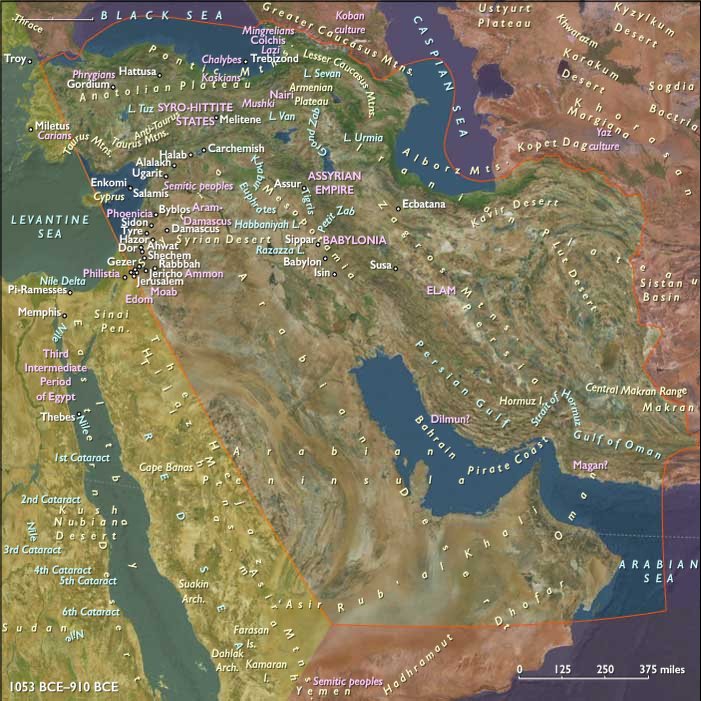
The Aramaeans during the eleventh and the tenth centuries conquer Sam’al (Zenjirli), also known as Yaudi, the region from Arpad to Aleppo, which they rename Bît-Agushi, and Til Barsip, which becomes the chief town of Bît-Adini, also known as Beth Eden.
At the same time, Aramaeans move to the east of the Euphrates, where they settle in such numbers that the whole region becomes known as Aram-Naharaim or "Aram of the two rivers".
One of their earliest kingdoms in Mesopotamia is Bît-bahiâni (Tell Halaf).
North of Sam'al is the Aramaean state of Bit-Gabbari, sandwiched between the Neo-Hittite states of Carchemish, Gurgum, Tabal, Khattina and Unqi.
While these later states maintain a Neo-Hittite hieroglyphic for official communication, it would seem that the population of these small states is progressively aramaeanized; hence, the term Syro-Hittite states.
The Aramaic kingdoms around Damascus, as well as those in Palestinian border areas, interact after 1000 with the Hebrews, sometimes as opponents, other times as expedient allies.
The Bible relates that Saul, David, and Solomon (supposed to have flourished in the late eleventh to tenth centuries) fought against the Aramaean kingdoms across the northern frontier of Israel: Aram-Sôvah in the Beq’a, Aram-Bêt-Rehob, and Aram-Ma’akah around Mount Hermon, Geshur in the Hauran, and Damascus.
An Aramaean king's account dating at least two centuries later, the Tel Dan Stele, was discovered in northern Israel, and is famous for being perhaps the earliest non-Israelite extra-biblical historical reference to the Israelite royal dynasty, the House of David.
Farther north, the Aramaeans, in possession of Hamath on the Orontes, are soon to become strong enough to dissociate with the Neo-Hittite block.
Locations
Groups
- Mesopotamia
- Aramaeans
- Assyria, (Middle) Kingdom of
- Hebrews
- Syro-Hittite states
- Aram-Damascus (Syria), Kingdom of
- “Israel, Kingdom of (United Monarchy)”
- Syrian people
Topics
Subjects
Regions
Subregions
Years: 1053BCE - 910BCE
Locations
Groups
- Mesopotamia
- Aramaeans
- Assyria, (Middle) Kingdom of
- Hebrews
- Syro-Hittite states
- Aram-Damascus (Syria), Kingdom of
- “Israel, Kingdom of (United Monarchy)”
- Syrian people
Topics
Subjects
Regions
Subregions