The Arabs drive the Romans from Utica …
Years: 669 - 669
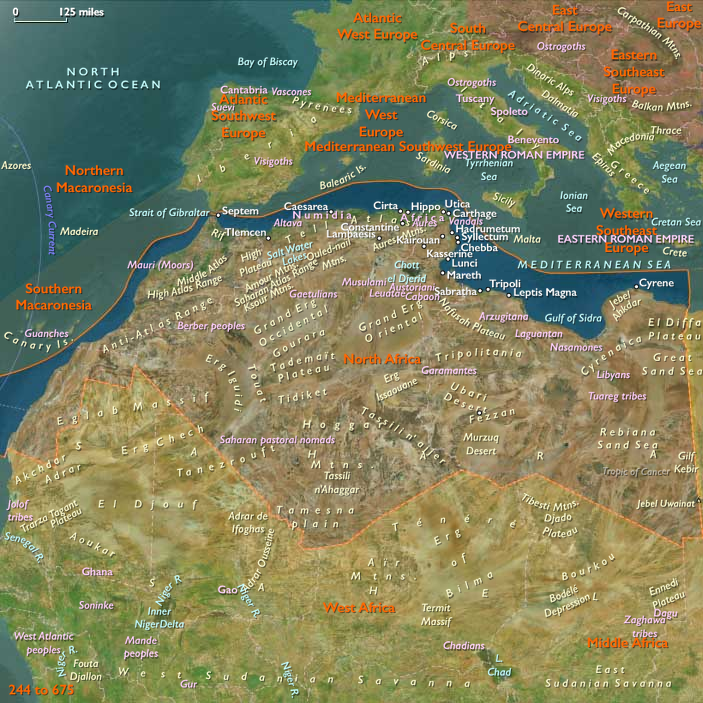
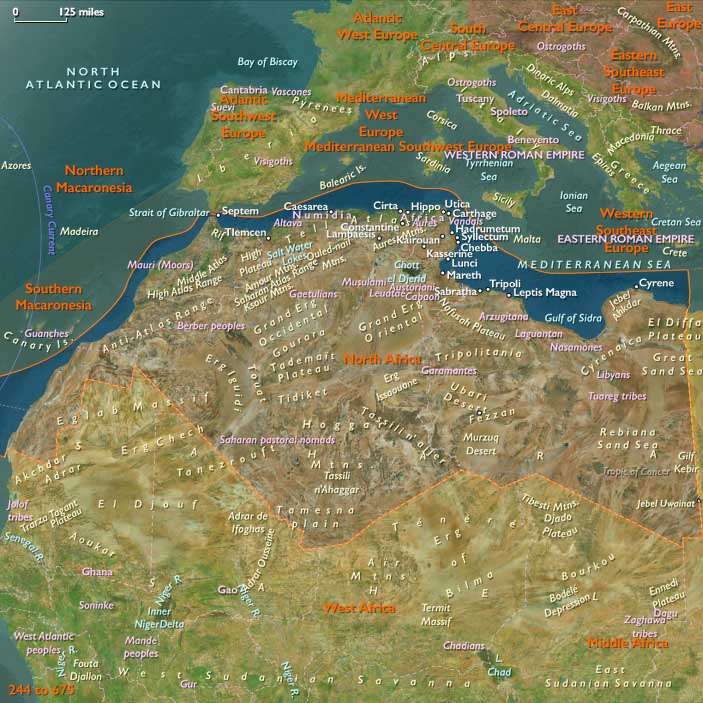
The Arabs drive the Romans from Utica in 669, totally destroying the city in the process.
Locations
Groups
- Arab people
- Africa proconsularis (Roman province)
- Africa Byzacena (Roman province)
- Greeks, Medieval (Byzantines)
- Tripolitania (Roman province)
- Africa, or Carthage, Exarchate of
- Roman Empire, Eastern: Heraclian dynasty
- Islam
- Umayyad Caliphate (Damascus)
Topics
Commodoties
Subjects
Regions
Subregions
Related Events
Filter results
Showing 8 events out of 8 total
Igor of Kiev is killed while collecting tribute from the Drevlyans in 945.
The Byzantine historian and chronicler, Leo the Deacon (born around 950), describes how Igor met his death: "They had bent down two birch trees to the prince’s feet and tied them to his legs; then they let the trees straighten again, thus tearing the prince’s body apart.")
He is avenged by his wife, Olga of Kiev.
The Primary Chronicle blames his death on his own excessive greed, indicating that he was attempting to collect tribute a second time in a month.
As a result, Olga changes the system of tribute gathering (poliudie) in what may be regarded as the first legal reform recorded in Eastern Europe.
Constantine Zuckerman, drastically revising the chronology of the Primary Chronicle, argues that Igor actually reigned for three years, between summer 941 and his death in early 945.
He explains the epic thirty-three-year span of his reign in the chronicle by its author's faulty interpretation of Byzantine sources.
Indeed, none of Igor's activity are recorded in the chronicle prior to 941.
Sviatoslav, a member of the Varangian Rurik dynasty, succeeds his father as duke of Kiev; his mother, Olga, rules as regent.
Virtually nothing is known about Sviatoslav's childhood and youth, which he spent reigning in Novgorod.
Sviatoslav was tutored by a Varangian named Asmud (meaning "quick as a leopard").
The tradition of employing Varangian tutors for the sons of ruling princes will survive well into the eleventh century.
Princess Olga, the widow of Igor I, Grand Prince of Kiev, who had been assassinated in 945 by his subjects while attempting to extort excessive tribute, had become regent (for their son, Sviatoslav) of the grand principality of Kiev.
She had soon had Igor's murderers scalded to death and hundreds of their followers killed.
Olga is the first Rus' ruler to convert to Christianity, either in 945 or in 957.
The ceremonies of her formal reception in Constantinople are minutely described by Emperor Constantine VII in his book De Ceremoniis.
Following her baptism, she takes the Christian name Yelena, after the reigning Empress Helena Lekapena.
The Slavonic chronicles add apocryphal details to the account of her baptism, such as the story how she charmed and "outwitted" Constantine and how she spurned his matrimonial proposals.
In truth, at the time of her baptism, Olga was an old woman, while Constantine had a wife.
Constantine VII, renowned for his abilities as a writer and scholar, has written, or had commissioned, the works De Ceremoniis ("On Ceremonies"), describing the kinds of court ceremonies (also described later in a more negative light by Liutprand of Cremona); De Administrando Imperio ("On the Administration of the Empire"), giving advice on running the Empire internally and on fighting external enemies; and a history of the Empire covering events following the death of the chronographer Theophanes the Confessor in 817.
Among his historical works is a history eulogizing the reign and achievements of his grandfather, Basil I (Vita Basilii).
These books are insightful and of interest to the historian, sociologist, and anthropologist as a source of information about nations neighboring the Empire.
They also offer a fine insight into the Emperor himself.
Constantine has had active diplomatic relationships with foreign courts, including those of the caliph of Córdoba, Abd ar-Rahman III and of Otto I, Holy Roman Emperor.
Constantine had been visited by Olga of Kiev, regent of the Kievan Rus' in the autumn of 957.
The reasons for this voyage have never been clarified; but she had been baptized a Christian with the name Helena, and sought Christian missionaries to encourage her people to adopt Christianity.
Constantine VII dies at Constantinople in November 959.
It is rumored that Constantine had been poisoned by his daughter-in-law Theophano or his so, who now ascends the imperial throne as Romanos II.
A politically incapable ruler, he will leave affairs of state to the eunuch Joseph Bringas and military affairs to Nikephoros Phokas.
Nikephoros has employed brilliant strategy n the campaigns of 962–963 to conquer the cities of Cilicia and to advance into Syria, where had captured Aleppo, in collusion with his nephew, John Tzimiskes, but they had made no permanent conquests.
It is on these campaigns that he has earned the sobriquet, "The Pale Death of the Saracens".
Emperor Romanos II dies unexpectedly of uncertain cause on March 15, 963, at the age of twenty-six.
Both contemporary sources and later historians seem to either believe that the young Emperor had exhausted his health with the excesses of his sexual life and his heavy drinking, or suspect Empress Theophano, his wife, of poisoning him.
Theophano had already gained a reputation as an intelligent and ambitious woman.
She will later gain a reputation for ruthlessness in achieving her goals.
Romanos had already crowned as co-emperors his two sons Basil II and Constantine VIII.
At the time of Romanos' death, however, Basil is five years old and Constantine only three years old, so Theophano is named regent.
Theophano is not allowed to rule alone.
Joseph Bringas, the eunuch palace official who had become Romanos' chief councilor, maintains his position.
According to contemporary sources he intended to keep authority in his own hands.
He also tries to reduce the power of Nikephoros Phokas.
The victorious general had been accepted as the actual commander of the army and maintains his strong connections to the aristocracy.
Joseph is afraid that Nikephoros could claim the throne with the support of both the army and the aristocracy.
Joseph's intrigues during the following months will turn both Theophano and Nikephoros against him.
Nikephoros is very popular, but there is no indication that the general—whose physical appearance at fifty-one is reportedly not very agreeable and who seems destined under the influence of Athanasius the Athonite to embrace the monastic life—will end up seducing and being seduced by the young and beautiful empress.
If such a plan exists at this time (and there is reason to believe it does), it is probably the brainchild of the ambitious Theophano, who is unhappy with Bringas' government.
Unknown to Joseph, Nikephoros is urged to seize the throne by his nephew John Tzimiskes, and he enters into negotiations with Theophano.
With the help of Theophano and the patriarch, Nikephoros Phokas receives supreme command of the eastern forces.
The people of Constantinople, aroused by the eunuch minister Basil the chamberlain, revolt against Bringas, and the imperial army, through the intermediation of the Armenian general John Tzimisces, Nikephoros' nephew and faithful lieutenant, “obliges” the soldier to accept the crown at Caesarea on July 3, 963, and to march against Constantinople, where his partisans have overthrown his enemy Bringas.
Thanks to his popularity with the army, Nikephoros II Phokas is crowned emperor by the patriarch Polyeuctus at the side of Romanos's young sons in the Hagia Sophia on August 16, 963.
In spite of the opposition of the patriarch, the new emperor marries their mother, the regent Theophano, on September 30.
Tzimisces, descended from an aristocratic Armenian family and related through his mother to Nikephoros, had entered the imperial army and fought with Nikephoros against the Arabs in Cilicia and Syria.
His reward for having helped Nikephoros gain the throne is the supreme command of imperial forces in the East, though the emperor retains personal command of operations against the Arabs.
Early in his life, Nikephoros had married one Stephano, who had died before his rise to fame, and after her death he had taken an oath of chastity.
This will create problems later on.

The Khazar city of Sarkel, a large limestone-and-brick fortress on the left bank of the lower Don River, had been built in 833 to protect the northwestern border of the Khazar state, when the Khazars had asked their ally, emperor Theophilus, for engineers to build them a fortified capital, and Theophilus had sent his chief engineer Petronas.
In recompense for these services, the Khazar khagan had ceded Chersonesos and some other Crimean dependencies to Constantinople.
The city serves as a bustling commercial center, as it controls the Volga-Don portage, which is used by the Rus to cross from the Black Sea to the Volga and thence to the Caspian; the route is known as the "Khazarian Way".
A garrison fortified at Sarkel includes Oghuz and Pecheneg mercenaries.
Around 965, Sviatoslav destroys Sarkel and possibly sacks (but does not occupy) the Khazar city of Kerch on the Crimea.
At Sarkel, Sviatoslav establishes a Rus' settlement called Belaya Vyezha ("the white tower" or "the white fortress", the East Slavic translation for "Sarkel").
The efforts of Kievan ruler Olga to bring Christianity to Russia are resisted by her son Sviatoslav, grand prince of Kiev from 945, who, after coming of age around 963, had begun a series of bold military expeditions, leaving his mother to manage the internal affairs of the Kievan state.
Sviatoslav is the son of Grand Prince Igor, who was himself probably the grandson of Rurik, prince of Novgorod.
Virtually nothing is known about his childhood and youth, which he spent reigning in Novgorod.
Sviatoslav's father, Igor, had been killed by the Drevlyans around 942.
The Russian Primary Chronicle says that Sviatoslav “sent messengers to the other lands announcing his intention to attack them.” Shortly after his accession to the throne, Sviatoslav had begun campaigning to expand the Rus' control over the Volga valley and the Pontic steppe region.
Between 963 and 965, he has attacked the Ossetes and Circassians in the northern Caucasus; …
…he has also attacked the Volga Bulgars.
Sviatoslav’s greatest success is the conquest of Khazaria, the Jewish state between the Volga and the Don, which for centuries has been one of the strongest states of Eastern Europe.
The sources are not clear about the roots of the conflict between Khazaria and Rus', so several possibilities have been suggested.
The Rus' had an interest in removing the Khazar hold on the Volga trade route because the Khazars collected duties from the goods transported by the Volga.
Historians have suggested that Constantinople may have incited the Rus' against the Khazars, who had fallen out with the Empire after the persecutions of the Jews in the reign of Romanus I Lecapenus.
Sviatoslav began by rallying the Khazars' East Slavic vassal tribes to his cause.
Those who would not join him, such as the Vyatichs, are attacked and forced to pay tribute to the Kievan Rus' rather than the Khazars.
Proceeding by the Oka and Volga rivers, he invades Volga Bulgaria and exacts tribute from the local population, thus bringing under Kievan control the upper Volga River.
He employs Oghuz and Pecheneg mercenaries in this campaign, perhaps to counter the Khazars' and Bulgars' superior cavalry.
Years: 669 - 669
Locations
Groups
- Arab people
- Africa proconsularis (Roman province)
- Africa Byzacena (Roman province)
- Greeks, Medieval (Byzantines)
- Tripolitania (Roman province)
- Africa, or Carthage, Exarchate of
- Roman Empire, Eastern: Heraclian dynasty
- Islam
- Umayyad Caliphate (Damascus)