
The Arab Christian Ghassanids of southern Syria …
Years: 539 - 539
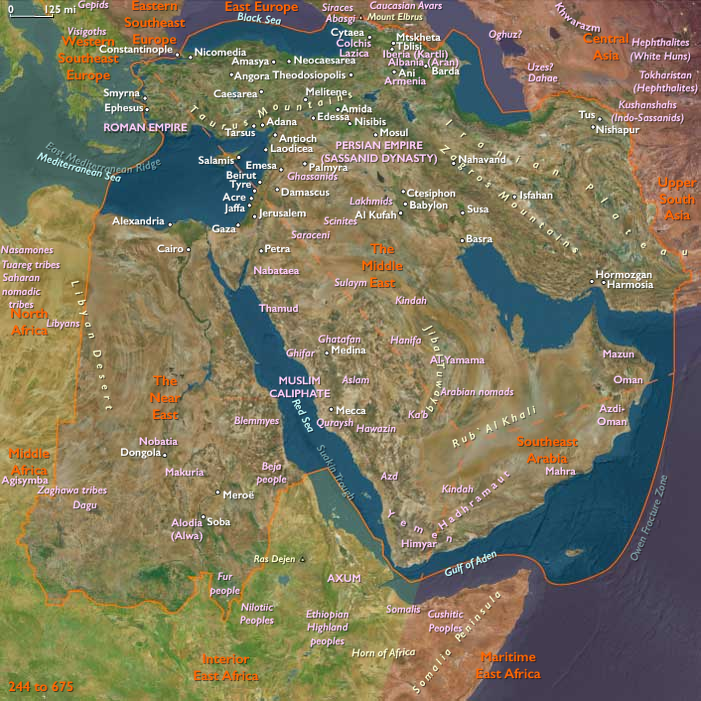
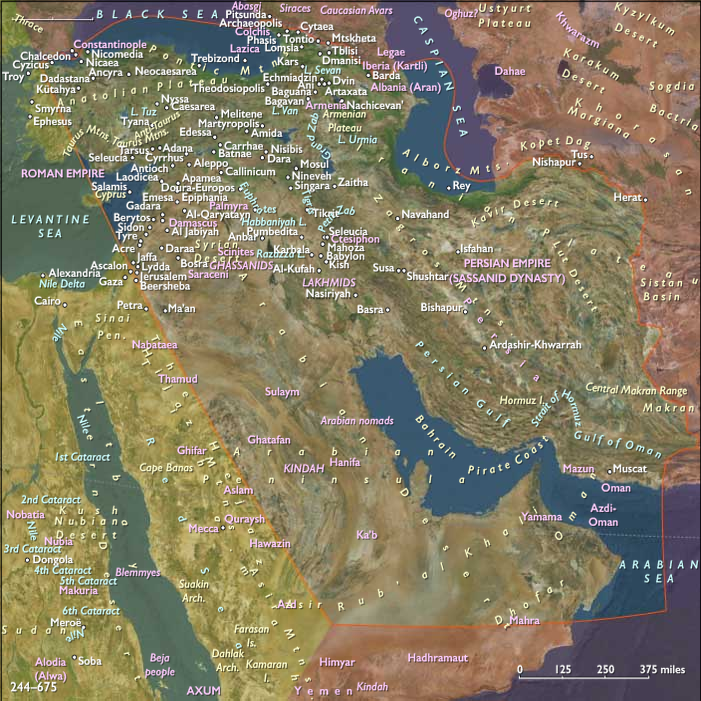
The Arab Christian Ghassanids of southern Syria are Roman allies, forming a buffer zone against the other Bedouins penetrating Roman territory.
Their capital is Jabiyah in the Golan Heights.
Geographically, the Ghassanid kingdom occupies much of Syria, Mount Hermon (Lebanon), and Palestine, and its authority extends via tribal alliances with other Azdi tribes all the way to the northern Hijaz as far south as Yathrib (Medina).
Al-Harith ibn Jabalah, king of the Ghassanids from 529, has continued to support the Roman Empire against Sassanid Persia and had been given the title patricius in 529 by Justinian.
He is an adherent of Miaphysitism, the doctrine that in the one person of Jesus Christ, Divinity and Humanity are united in one "nature" ("physis"), the two being united without separation, without confusion, and without alteration.
The term "miaphysitism" had arisen as a response to Nestorianism.
As Nestorianism had its roots in the Antiochene tradition and was opposed by the Alexandrian tradition, Christians in Syria and Egypt who wanted to distance themselves from the extremes of Nestorianism and wished to uphold the integrity of their theological position adopted this term to express their position.
The Council of Chalcedon had in 451 condemned Monophysitism, of which they had considered Miaphysitism to be a form, but the Oriental Orthodox Churches reject this characterization.
Al-Harith supports opponents of the Council and in the region, where he has helped to revive the Syriac Orthodox Church despite the disapproval of Orthodox Constantinople.
Locations
People
Groups
- Arab people
- Bedouin
- Christians, Eastern (Diophysite, or “Nestorian”) (Church of the East)
- Christians, Monophysite
- Christians, Miaphysite (Oriental Orthodox)
- Christianity, Chalcedonian
- Ghassan, Kingdom of
- Roman Empire, Eastern: Justinian dynasty
Topics
Commodoties
Subjects
- Commerce
- Labor and Service
- Conflict
- Faith
- Government
- Technology
- Movements
- Theology
- Geography
- Christology
Regions
Subregions
Related Events
Showing 10 events out of 57760 total
Years: 539 - 539
Locations
People
Groups
- Arab people
- Bedouin
- Christians, Eastern (Diophysite, or “Nestorian”) (Church of the East)
- Christians, Monophysite
- Christians, Miaphysite (Oriental Orthodox)
- Christianity, Chalcedonian
- Ghassan, Kingdom of
- Roman Empire, Eastern: Justinian dynasty
Topics
Commodoties
Subjects
- Commerce
- Labor and Service
- Conflict
- Faith
- Government
- Technology
- Movements
- Theology
- Geography
- Christology
Regions
Subregions